
Travelling With Pets: A Practical Guide to Domestic and International Relocation
September 10, 2026
Travelling with pets across borders? Use a route-specific plan for airline rules, health documents, customs handoffs, and a safer door-to-door move.
Travelling with pets is not simply putting a dog or cat on the same flight as a family member. It is the coordinated movement of an animal through several systems: veterinary preparation, destination-entry rules, airline acceptance, airport handling, customs or quarantine inspection, and final delivery. A mistake in any one system can delay the animal even when every other part of the trip is ready.
That distinction matters most for military families on PCS orders, employees accepting overseas assignments, diplomatic households, and families moving to or from Hawaii. The right plan depends on the animal, routing, season, destination, airline, and whether the pet travels in the cabin, as checked baggage where permitted, or as manifested cargo. This guide explains how the process works, where it commonly breaks, and how relocation professionals can turn a complicated itinerary into a sequence of controlled decisions.
What Travelling With Pets Actually Involves
Pet travel is best understood as a chain of custody and compliance, not a single reservation. The owner, veterinarian, airline, government agencies, airport handlers, customs officials, and delivery provider each control a different part of the journey. No party can safely assume that another party has completed its task.
The five layers of a pet move
- Eligibility: Confirm that the destination accepts the species, breed, age, origin, and proposed route. Some destinations impose special rules for dogs from certain countries, while others regulate cats, birds, or exotic species differently.
- Veterinary preparation: Complete required identification, vaccinations, examinations, laboratory tests, treatments, and certificates within the destination’s permitted windows.
- Transport acceptance: Match the animal and crate to the airline’s operational rules. An airline may reject a booking because of aircraft type, temperature, crate condition, breed restrictions, or a connection it cannot support.
- Border clearance: Present the correct documents to the destination authority, customs broker, airport animal facility, or quarantine office. A health certificate alone does not guarantee release.
- Final delivery: Move the pet from the arrival facility to the residence, temporary lodging, military installation, or quarantine location without losing control of timing or documentation.
These layers interact. A certificate can be medically correct but outside the destination’s validity window. A compliant crate can still be unsuitable for an airline’s aircraft. A route can appear available online but fail because the connection airport does not accept live animals on that date.
For that reason, begin with a route-specific requirement matrix. At minimum, record:
- Origin country, state, territory, or island
- Final destination and any transit countries
- Species, breed, age, sex, and approximate weight
- Microchip or other identification details
- Vaccination and laboratory-test history
- Airline, aircraft type, connection points, and travel season
- Who will collect the pet and where the animal will be delivered
For United States-bound moves, the U.S. Department of Agriculture’s Animal and Plant Health Inspection Service directs owners to destination-specific pet travel requirements, while the Centers for Disease Control and Prevention maintains separate rules for dogs entering the United States. Review both official sources for a 2026 move rather than treating a general airline page as the complete entry rule: USDA APHIS pet travel guidance and the CDC dog importation guidance.
Why the Planning Standard Is Higher for Relocation
A holiday trip and a relocation may use the same aircraft, but they do not have the same tolerance for error. A vacationer may be able to return home or delay a booking. A PCS family may have household goods in transit, temporary lodging reserved, children enrolled in school, and orders tied to a reporting date. An executive or diplomatic family may also require discreet coordination and a precise handoff at the destination.
Small errors create large operational consequences
The most expensive problems are often not dramatic medical emergencies. They are administrative mismatches that surface at the worst possible point:
- A required document is signed too early and expires before arrival.
- The pet’s microchip number on the certificate does not match the veterinary record or booking.
- A connection is legal for passengers but not approved for live-animal transfer.
- The destination requires an import permit, yet the family assumes the health certificate is enough.
- The airline accepts the reservation but later refuses carriage because of heat, cold, aircraft restrictions, or a crate issue.
- The driver is scheduled for passenger arrival instead of the pet’s actual release from the animal facility.
These are dependency failures. Each task has a predecessor. You cannot finalize the correct health certificate until the destination rules and itinerary are known. You cannot finalize the itinerary until airline acceptance is confirmed. You cannot promise delivery until the arrival facility’s release process is understood.
Use a written responsibility map rather than relying on email memory. For each task, assign one owner, one due date, and one proof of completion. “Veterinarian” may own the examination, but the relocation coordinator may own checking that the certificate contains the destination-required language. “Airline” may own acceptance, but the family or agent must confirm that the animal is listed correctly on the booking.
Military families should build the plan around the reporting date and temporary lodging reality, not only the passenger itinerary. For a PCS move, ask whether the pet can be released directly to the installation, whether the family will stay in a hotel first, and whether the receiving household can accept the animal if the member’s flight changes. Guidance for military pet shipping should be treated as a logistics plan connected to orders, not as a last-minute airline purchase.
Animal welfare is part of operational planning
Stress reduction is not a substitute for compliance, but it is a legitimate planning objective. A familiar crate introduced before departure, a realistic feeding routine, appropriate exercise before check-in, and clear instructions for handlers can reduce avoidable disruption. Sedation decisions belong to the treating veterinarian; owners should not improvise medication because a flight is long or the pet appears anxious.
Do not assume that a direct flight is always the best answer. A nonstop route may reduce handling, but a longer ground transfer at either end could be harder on a large dog. Conversely, a connection may create a second loading event, a new temperature exposure, and another chance for documents or labels to be checked incorrectly. Compare the entire door-to-door journey.
How a Well-Managed Pet Move Works
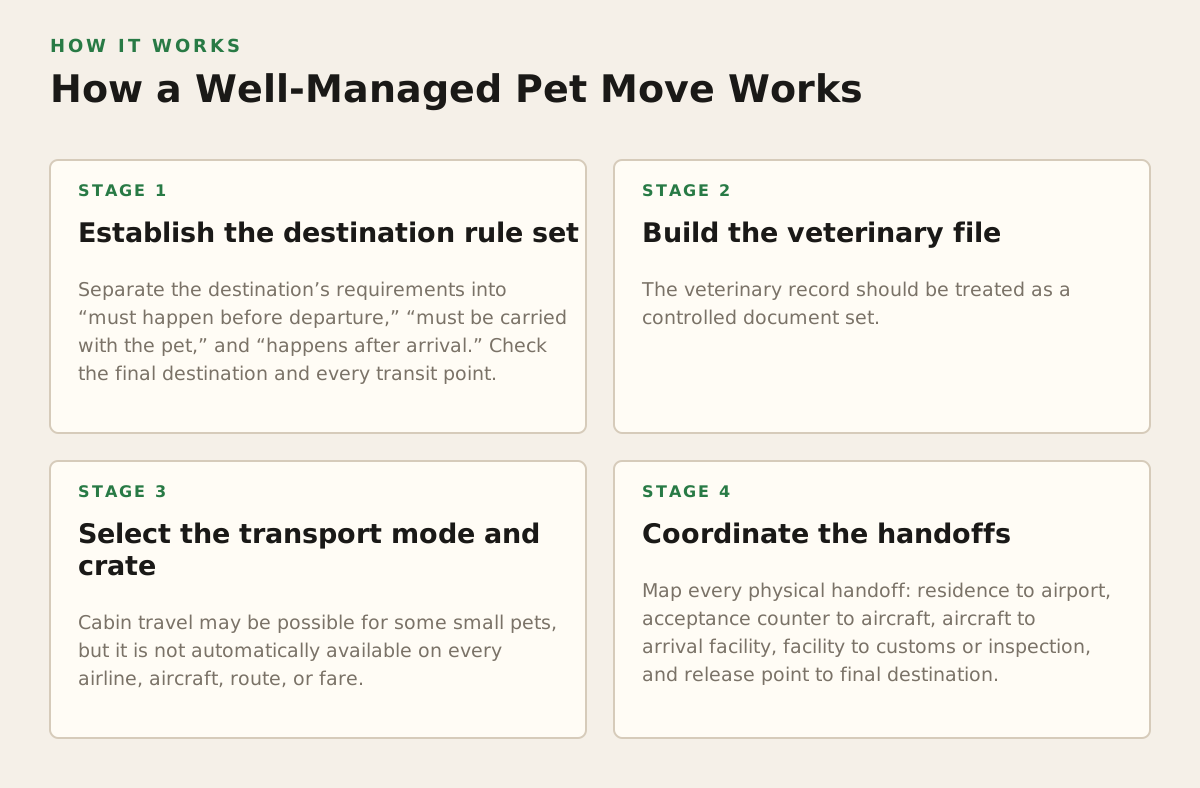
A dependable process starts early enough to preserve options. The exact lead time varies by destination and animal, so a universal promise is misleading. The practical rule is to begin when the assignment, purchase, or move becomes credible—before flights are nonrefundable and before veterinary windows become compressed.
Step 1: Establish the destination rule set
Separate the destination’s requirements into “must happen before departure,” “must be carried with the pet,” and “happens after arrival.” Check the final destination and every transit point. Countries may impose different rules for dogs and cats, and rules can change according to the animal’s country of origin.
For example, Great Britain publishes its own process for bringing dogs, cats, and ferrets, including documentation and approved routes; consult the official GOV.UK pet travel guidance for requirements applicable in 2026. For movement within or into the European Union, the European Commission’s companion-animal movement guidance explains the relevant framework and links to official conditions.
At this stage, identify whether the destination requires:
- Permanent identification before a rabies vaccination is recognized
- A waiting period after vaccination or a blood test
- An endorsed health certificate or import permit
- Parasite treatment within a prescribed interval
- Arrival through a particular airport or approved route
- Quarantine, preapproval, inspection, or a government fee
Step 2: Build the veterinary file
The veterinary record should be treated as a controlled document set. Ask the clinic to verify the pet’s identity against the microchip or other accepted identifier, then keep copies of certificates, laboratory results, vaccination history, and treatment records in one digital folder and one travel packet.
The timing of a health certificate is often the hardest part. A certificate issued too soon may expire; one issued too late may not leave enough time for government endorsement, airline review, or corrections. The veterinarian needs the actual destination instructions, not merely the phrase “international travel.” If the pet will transit another country, include that route in the consultation.
For an illustrative planning policy—not a universal legal deadline—an owner might set these internal checkpoints:
- 120 days before departure: identify the route, read official entry rules, and check whether a blood test or import permit could affect the schedule.
- 90 days before departure: verify the microchip, review vaccination history, and ask the veterinarian to identify missing steps.
- 60 days before departure: request airline routing guidance and confirm crate specifications for the likely aircraft.
- 30 days before departure: recheck government and airline rules, reserve the animal movement, and confirm the delivery address.
- Within the destination’s permitted certificate window: complete the examination, obtain signatures or endorsements, and reconcile every identifier.
Those numbers are a project-management example only. The destination authority’s published windows control the move. A professional should replace the illustrative schedule with a route-specific calendar.
Step 3: Select the transport mode and crate
Cabin travel may be possible for some small pets, but it is not automatically available on every airline, aircraft, route, or fare. Larger animals commonly require another transport arrangement, and international moves may use manifested cargo because that is the channel available for the destination or airline.
Choose the crate based on the animal’s ability to stand, turn, and lie naturally, while also meeting the carrier’s construction and labeling requirements. Do not buy a crate only by the pet’s weight. Body length, height, ventilation, door design, water access, and aircraft acceptance all matter. A crate that seems generous at home may not fit the airline’s handling system; a crate that fits the aircraft may be too restrictive for the animal.
Introduce the crate gradually and observe the pet in it before travel. Useful preparation includes:
- Leaving the crate open in a familiar room
- Feeding occasional meals near or inside it without forcing entry
- Practicing brief door-closed periods while the owner remains nearby
- Taking short ground trips if the pet tolerates them
- Recording the pet’s feeding, medication, and emergency instructions
The International Air Transport Association publishes industry guidance for the carriage of live animals, including container and handling considerations. Airline implementation still controls the booking, so use the IATA pet travel information as a reference point rather than as a guarantee that a particular carrier will accept a specific animal or crate.
Step 4: Coordinate the handoffs
Map every physical handoff: residence to airport, acceptance counter to aircraft, aircraft to arrival facility, facility to customs or inspection, and release point to final destination. The person responsible for each handoff should know the animal’s name, crate label, document packet, emergency contact, and next destination.
Live tracking can improve visibility, but tracking is not the same as control. A location update may show that the aircraft landed without showing whether the pet has cleared inspection or is ready for collection. The meaningful status sequence is closer to:
- Accepted by the airline or cargo facility
- Loaded or tendered for departure
- Arrived at the destination airport
- Transferred to the animal reception or inspection facility
- Cleared and released
- Collected by the delivery provider
- Delivered to the approved address
Agree in advance on who receives delay notices and what happens if the passenger itinerary changes. For high-profile, government, and diplomatic relocations, limit unnecessary disclosure of the residence and use need-to-know coordination. Discretion is a process choice: it should shape the contact list, delivery instructions, and document handling from the beginning.
Where Pet Travel Plans Commonly Break
The weakest point in a move is usually the assumption that one successful step proves the entire plan is safe. It does not. A veterinarian’s approval does not equal airline acceptance, and airline acceptance does not equal border release.
Regulatory changes and ambiguous advice
Online discussions often mix old rules, personal anecdotes, and requirements for a different origin country. “The destination allows pets” is too broad to be useful. The correct question is: what does this destination require for this species, from this origin, on this route, arriving on this date?
Recheck official pages when the booking is made, when the veterinary appointment is scheduled, and shortly before departure. If a rule is unclear, ask the destination authority, airline, accredited veterinarian, or qualified customs professional for a written interpretation. Preserve the answer with the travel file.
Airline and aircraft constraints
Airline schedules are not static promises for live-animal carriage. Aircraft substitutions, seasonal temperature restrictions, embargoes, staffing, and connection limitations can change acceptance. A passenger itinerary may remain confirmed while the pet’s separate movement is no longer workable.
Build a backup decision before the crisis occurs. For example, decide whether the family will:
- Move the pet on an alternate flight
- Use a different airport with a longer ground transfer
- Delay the pet while a family member travels ahead
- Change from cabin travel to an approved cargo arrangement
- Use temporary boarding near the origin or destination
A backup is useful only if its documents, crate, delivery, and cost responsibility are understood. Do not wait until the animal is at the airport to discover that the alternate route has a different entry requirement.
Hawaii and island-entry complications
Hawaii requires especially careful preparation because island biosecurity procedures can determine whether a pet is released at the airport or placed into quarantine. The Hawaii Department of Agriculture publishes the state’s animal quarantine information, forms, fee information, and program instructions at its official Hawaii Animal Quarantine Information Page. Requirements can depend on the animal’s records, origin, arrival airport, and completion of steps before travel.
For a family moving under orders or accepting a job in the islands, treat Hawaii pet shipping as a preclearance project. Confirm the destination island, arrival airport, approved inspection process, document submission method, and residence address before purchasing the pet’s ticket. A missed pre-arrival step can affect release timing even when the pet is otherwise healthy.
Weather, health, and welfare risks
Heat and cold can affect whether an airline accepts an animal, particularly during ramp handling and ground transfers. Avoid designing a plan that depends on the narrowest possible weather window. Ask how the pet will move between the vehicle, terminal, warehouse, aircraft, and destination facility, and whether a temperature-related refusal would trigger a same-day recovery plan.
Medical risk also varies by animal. Senior pets, brachycephalic breeds, animals with respiratory disease, and pets with anxiety or previous travel problems need individualized veterinary advice. A professional should never promise that a particular routing is medically safe without the treating veterinarian’s assessment.
How Practitioners Apply the Process to Real Moves
The strongest relocation plans convert uncertainty into decisions with owners, deadlines, and escalation points. They do not promise that nothing will change; they show what will happen when something changes.
Scenario: a military PCS with a large dog
Suppose a service member receives orders from the continental United States to an overseas installation. The dog is too large for cabin travel, the family will spend several nights in temporary lodging, and the receiving installation has a specific delivery address.
The plan should first confirm destination entry rules and the installation’s acceptance arrangements. Next, the veterinarian’s timeline should be reconciled with the flight date and any endorsement requirement. The transport coordinator should then verify the crate, airline acceptance, airport handling, and delivery window. The family should provide a backup lodging address in case the household cannot accept the dog immediately.
The key decision is not “Which flight is cheapest?” It is which complete routing preserves legal entry and a controlled handoff. A slightly less convenient passenger itinerary may be preferable if it gives the pet a supported route and avoids an unworkable connection.
Scenario: an international corporate relocation with two cats
Two cats may share a household but still require separate identification records, carrier arrangements, and document checks. The relocation file should distinguish each animal clearly. If one cat has a different vaccination history or medical condition, the pair cannot be managed as one interchangeable shipment.
For an illustrative checklist, the coordinator might require these numbered confirmations before release:
- 1: one verified identity record for each cat
- 2: two document packets reconciled against the identity records
- 3: one confirmed airline acceptance for the actual aircraft and date
- 4: one named arrival contact and one backup contact
- 5: one written delivery address that matches the family’s lodging plan
The numbers are process controls, not legal requirements. Their purpose is to prevent a common administrative error: assuming that a pair of pets has one shared record.
Scenario: a diplomatic or high-profile family
Discreet transport requires the same compliance foundation as any other move, plus tighter information discipline. The operational file should contain only the details each participant needs. Drivers should receive verified collection instructions, not an unnecessarily broad itinerary. The family should approve the names and phone numbers that can receive status updates.
Do not sacrifice resilience for secrecy. A small authorized contact group still needs a backup plan for flight changes, customs delays, medical concerns, and an unreachable recipient. The best arrangement is both private and legible: every responsible person knows the next action without receiving unrelated sensitive information.
Scenario: a veterinarian or relocation professional helping a client
Professionals supporting pet owners can reduce failure by asking for the final route before completing forms. A useful intake interview covers:
- Where the pet is now and where it will ultimately live
- All countries, states, territories, and airports in the routing
- Whether the move is military, corporate, diplomatic, academic, or personal
- Whether the owner travels with the animal or arrives separately
- Any prior travel, behavioral, respiratory, orthopedic, or medication concerns
- Who has authority to approve changes if the original plan fails
After intake, issue the owner a single action calendar. Identify which requirements are legal, which are airline-specific, and which are recommended welfare practices. That distinction prevents owners from treating advice as a guarantee or treating a recommendation as optional when it is actually a destination rule.
The final recommendation is straightforward: plan the pet’s entire door-to-door journey before committing to the passenger itinerary. Verify official entry requirements in 2026, reconcile veterinary documents with the route, obtain airline acceptance for the actual animal and crate, and assign responsibility for every handoff.
BestPetTravel can coordinate domestic and international pet transportation, including airline arrangements, paperwork, customs support, live tracking, and delivery logistics. For a move where timing or compliance cannot be left to guesswork, start with BestPetTravel and provide the complete origin, destination, pet profile, and intended travel date.
Authored with NotFair SEO