
Pet Transportation Services Cost: What You’re Paying For in 2026
August 23, 2026
Learn what pet transportation services cost, which fees drive the quote, and how military, international, and Hawaii movers can compare providers.
Pet transportation services cost depends less on a simple mileage rate than on the work required to move an animal legally, safely, and predictably. A military family flying to a new duty station, an executive relocating overseas, and a family sending a cat to Hawaii may all receive very different quotes because their routes, documents, handling requirements, and failure risks are different.
This guide explains what a professional pet transport quote should include, which service category fits each move, how providers build and implement a plan, and where apparently inexpensive arrangements can become costly. The goal is not to identify a universal price. No responsible provider can do that without the pet’s species, size, origin, destination, dates, routing, and regulatory requirements.
What pet transportation services include—and what they do not
Pet transportation is the coordinated movement of a dog, cat, or other permitted animal from one location to another. A service may include some or all of the following: itinerary design, airline booking, kennel guidance, document review, veterinary coordination, airport handling, customs preparation, ground transfers, tracking, and final delivery.
The important distinction is between transport execution and transport advice. A consultant may tell an owner which forms are needed. A full-service provider may obtain or coordinate those forms, reserve transport, monitor the journey, manage handoffs, and deliver the pet. Neither is automatically better; the right choice depends on how much operational responsibility the owner, military relocation office, veterinarian, or employer wants to retain.
Four service categories and the buyer each serves
- Airline-only coordination: Appropriate when the owner can manage veterinary appointments, permits, airport drop-off, customs, and destination pickup but needs help selecting an airline-compliant routing.
- Document and compliance support: Useful for international moves, Hawaii entry, diplomatic travel, and destinations with tightly controlled health certificates or import permits. The buyer pays for regulatory interpretation and deadline management rather than physical handling alone.
- Airport-to-airport transport: A fit for experienced travelers who can safely handle both local legs. The trade-off is that responsibility remains with the owner at each endpoint, including delays, missed connections, and terminal rules.
- Door-to-door relocation: Designed for families, PCS moves, executives, and owners who need one coordinated plan from residence to destination residence. It generally involves more parties and therefore more coordination, but reduces the number of handoffs the owner must manage.
Some providers also arrange only the ground portion, such as a residence-to-airport transfer or a customs-to-home delivery. Ask whether the quote covers the entire movement chain or only one segment. “Door-to-door” should identify the actual pickup point, delivery point, responsible party at every handoff, and any location that is excluded because of access, security, or airline rules.
Why a quote is not the same as a final invoice
A quote is usually an estimate based on known information at a particular date. The final amount can change if the pet’s measured kennel dimensions differ, the airline changes its routing, a required certificate must be reissued, a government fee changes, or the owner changes travel dates. That does not make every change legitimate. A professional proposal should distinguish between fixed service charges, pass-through costs, and conditional charges.
Request these categories in writing:
- Professional planning, coordination, or management fee.
- Airline, cargo, terminal, handling, or ground transportation charges.
- Veterinary, laboratory, permit, import, customs, or government charges.
- Kennel, food, medication, storage, redelivery, or after-hours charges.
- Cancellation, date-change, rebooking, and emergency-response terms.
Why the cost matters: risk, labor, and consequences
Pet transport is a chain of dependencies. A correct vaccination does not help if the certificate is issued outside the destination’s accepted window. A valid health certificate does not solve a connection problem if the route requires a transfer that the airline will not accept for animals. A carefully booked flight can still fail if the kennel is too small, the cargo facility is closed, or the receiving party is unavailable.
The service fee buys coordination capacity, but it does not eliminate government rules or airline discretion. The practical question is therefore not “Which quote is cheapest?” It is “Which provider has identified the risks in this particular move, assigned an owner to each task, and stated what happens when a dependency changes?”
The major cost drivers
- Route complexity: Nonstop, one-connection, multi-connection, domestic, international, and island routes create different planning burdens. A route with fewer miles can be harder if it has limited animal acceptance or strict entry processing.
- Species, breed, size, and kennel: Airlines and destinations may apply different rules to dogs, cats, snub-nosed breeds, large animals, or unusual species. The pet’s combined weight and kennel dimensions can affect the available transport method.
- Regulatory burden: Import permits, rabies documentation, microchip sequencing, laboratory tests, government endorsements, quarantine arrangements, and destination inspections may all require separate timing and coordination.
- Origin and destination handling: A residence in a remote area, a military base, a secured facility, an apartment with loading restrictions, or an island destination can require additional ground planning.
- Timing and flexibility: Peak travel periods, narrow reporting windows, short-notice PCS orders, weather risk, and immovable start dates can reduce routing options. A flexible date may create more choices, but this must be evaluated rather than assumed.
- Service scope: A quote covering paperwork review only should not be compared directly with one covering pickup, airline coordination, customs support, live tracking, and destination delivery.
For Hawaii, begin with the destination authority rather than a carrier’s marketing page. Hawaii’s Animal Industry Division publishes official animal quarantine and import information, including the requirements owners must review for entry; those rules can affect document timing and the feasibility of direct release on arrival. See the Hawaii Department of Agriculture animal quarantine information for the applicable process in 2026.
International dog moves require a similar discipline. The U.S. Centers for Disease Control and Prevention states that dogs entering the United States must meet requirements that vary according to where the dog has been in the relevant period and other factors. Check the CDC dog importation requirements for current 2026 rules before comparing quotes. A provider that does not ask detailed questions about travel history may be pricing the wrong move.
Budget questions that produce useful answers
Do not ask only, “How much does it cost?” Ask what assumptions make the quote valid:
- Is the price for one pet, one kennel, or multiple pets traveling together?
- Are airline charges included, estimated separately, or paid directly by the owner?
- Are veterinary visits, laboratory work, government endorsements, and permits excluded?
- What happens if the airline rejects the kennel, the certificate expires, or the flight is canceled?
- Does the quote include customs clearance, destination taxes, quarantine, storage, and final delivery?
- Which charges are refundable if the owner cancels or receives a changed PCS date?
As an illustrative budgeting policy—not a universal price benchmark—an employer or relocation office could require every proposal to show a base coordination fee, known pass-through costs, conditional costs, and a written contingency policy. That format makes competing bids comparable without pretending that every route has the same economics.
How providers build and implement a pet transport plan
A sound plan starts with an intake that is specific enough to expose constraints. At minimum, the provider should collect the pet’s species, age, breed, weight, kennel dimensions, health conditions, medication needs, microchip information, vaccination history, origin, destination, desired travel window, owner itinerary, and whether the move is military, corporate, diplomatic, or personal.
Stage one: regulatory and routing feasibility
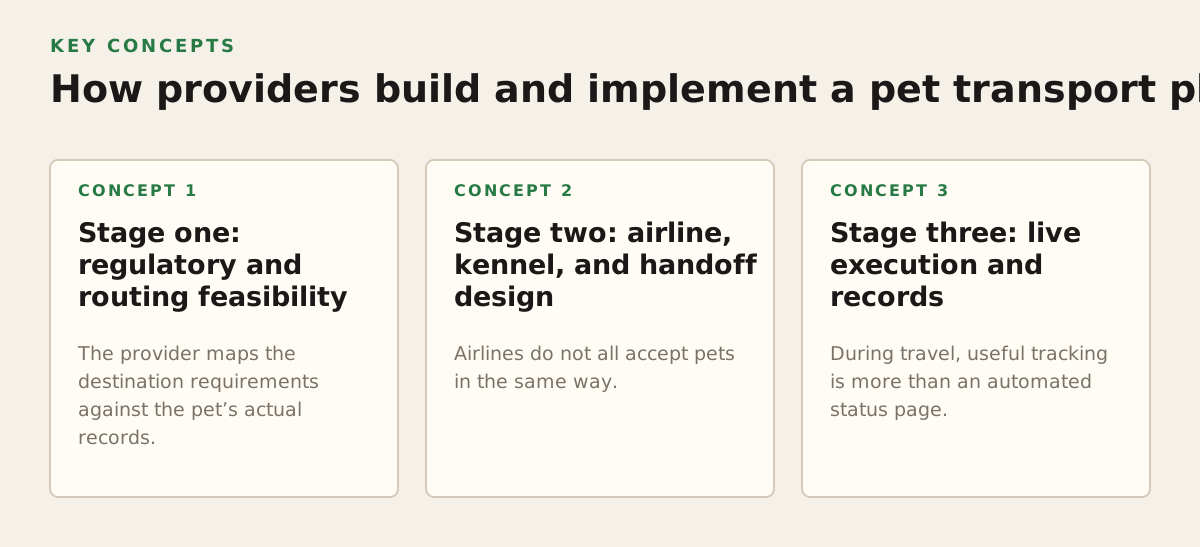
The provider maps the destination requirements against the pet’s actual records. The order of events matters. For example, a microchip may need to be documented before a rabies vaccination is accepted for a particular process, while a laboratory test may require a waiting period before travel. The provider should identify which date controls the itinerary, not merely list documents in a checklist.
For U.S. outbound travel, the USDA Animal and Plant Health Inspection Service explains that destination countries set their own requirements and that endorsement procedures can apply to health certificates. Owners and professionals should use the USDA APHIS pet travel resource for current destination guidance and endorsement information in 2026.
At this stage, ask for a written critical-path schedule containing:
- The earliest date each veterinary action can occur.
- The latest date each document can be issued and remain valid.
- The submission deadline for any government endorsement or permit.
- The airline booking deadline and kennel approval requirement.
- The required drop-off, customs, and delivery windows.
A provider should also identify an alternate plan. “We will rebook if needed” is not enough. An alternate plan should state who contacts the airline, whether the pet remains at the origin or moves to a holding facility, who pays for additional handling, and how the owner receives updates.
Stage two: airline, kennel, and handoff design
Airlines do not all accept pets in the same way. They may distinguish between cabin travel, checked arrangements where available, and air cargo. Acceptance can depend on aircraft type, season, temperature, breed, kennel, destination facility, and whether the pet is traveling with the owner. The International Air Transport Association publishes guidance for transporting live animals and emphasizes container and handling considerations; review its official pets and live animals guidance alongside the operating carrier’s rules.
The kennel is not a minor accessory. It must permit the pet to stand, turn, sit, and lie in a natural position under the applicable carrier and destination requirements. A provider should confirm the kennel model and dimensions before booking, explain whether the owner supplies it, and avoid promising acceptance based only on breed or weight.
Every handoff deserves an identified person or organization:
- Origin residence to local driver or airport facility.
- Origin facility to airline or cargo acceptance counter.
- Arrival airline facility to customs, quarantine, or inspection authority.
- Arrival facility to local driver or final delivery representative.
- Driver or representative to the named recipient at the destination.
Fewer uncontrolled handoffs usually means fewer communication gaps, but fewer handoffs do not automatically mean lower cost or lower risk. A specialist may deliberately use a local partner because that partner knows a particular airport or base. The evaluation question is whether the lead provider remains accountable and whether the owner knows who is acting at each stage.
Stage three: live execution and records
During travel, useful tracking is more than an automated status page. Ask what events generate an update: pickup, acceptance, departure, arrival, customs release, delivery dispatch, and completed delivery. Also ask whether an exception triggers a human call or only a system notification.
For a PCS move, the provider should coordinate with the family’s travel dates without assuming the pet can use the same itinerary. For an executive or diplomatic move, the plan may require discreet communication, controlled release of address information, and a clearly authorized receiving contact. Those requirements should be documented before booking, not improvised at the airport.
Where pet transport plans break—and how to test a provider
Most failures occur at interfaces: between the veterinarian and the government office, between the booking desk and the airline, between the airline and the destination handler, or between the provider and the owner. A provider cannot control every authority, but it can expose dependencies early and explain escalation paths.
Common failure points
- Document timing errors: A form is technically correct but issued too early, signed by the wrong authority, missing a required identification detail, or not endorsed in the required format.
- Unverified airline assumptions: A proposed flight appears available online but does not accept the pet’s kennel, route, breed, or travel date.
- Undersized or unapproved kennel: The owner buys a container that meets a general retail description but fails the carrier’s operational requirements.
- Unclear cost boundaries: Customs, quarantine, storage, taxes, or redelivery appear late because the original quote did not state whether they were included.
- Weak exception handling: A delay occurs outside business hours and no one can say who authorizes rebooking, feeding, veterinary attention, or overnight care.
- Bad destination assumptions: The provider treats a private residence, base gate, port, airport, quarantine station, and government inspection point as interchangeable.
The Transportation Security Administration states that pets are allowed through security screening, but owners should remove the pet from the carrier while the empty carrier is screened; procedures can differ at checkpoints. Its TSA guidance on traveling with pets is useful for owners handling an airport segment themselves. It does not replace an airline’s cargo or acceptance rules.
Red flags in a proposal or sales call
- A guaranteed total is offered before the provider knows the destination, dates, pet details, or service scope.
- The representative cannot identify the authority that controls the import or entry decision.
- The proposal uses “all-inclusive” without listing exclusions and conditional charges.
- The provider says the owner can “sort out” a permit, customs release, or health certificate after arrival.
- No one explains what happens if the airline cancels, refuses acceptance, or changes the routing.
- The company will not name the responsible contact for pickup, arrival, or emergency escalation.
- The quote is dramatically lower because it omits local delivery, regulatory work, or after-hours handling.
A low quote is not proof of poor service, and a high quote is not proof of expertise. The useful test is scope-adjusted comparison: put two proposals into the same columns, then note every included task, excluded cost, assumption, and response obligation.
Vendor interview checklist
Use these questions with a relocation coordinator, veterinarian, airline specialist, or prospective transport provider:
- Which service category are you proposing, and what responsibilities remain with the owner?
- Who validates the destination rules, and how are rule changes documented for a 2026 move?
- Which airline and routing assumptions support this quote?
- Who confirms kennel suitability, and when must the kennel be available?
- What is included in the coordination fee versus paid directly to airlines, veterinarians, laboratories, or authorities?
- How are date changes, cancellations, flight disruptions, and rejected documents handled?
- What updates will the owner receive, at which milestones, and through which channel?
- Who has authority to make an urgent decision if the owner is unreachable?
- How are sensitive addresses, military orders, executive travel details, or diplomatic contacts handled?
- What measurable event marks successful completion: delivery to the named recipient, customs release, or another agreed endpoint?
Choosing the right service for military, international, and Hawaii moves
The best service level follows the consequences of failure and the owner’s available time. A family with a flexible domestic move may reasonably handle its own airport legs. A short PCS reporting window, an international import permit, or a Hawaii entry process can justify paying for more coordination because the cost of a missed dependency is not limited to the transport invoice.
| Buyer need | Likely service type | Main trade-offs |
|---|---|---|
| Owner can manage paperwork and both airport legs | Airline-only or airport-to-airport coordination | Lower coordination burden for the provider, but more responsibility for the owner during delays and handoffs |
| International move with permits, tests, or endorsements | Document and compliance support plus airline coordination | Better control of the critical path, but government decisions and veterinary work remain outside the provider’s control |
| Military PCS with fixed reporting dates | Door-to-door planning with contingency and delivery coordination | More managed logistics, but the quote must be checked against orders, travel dates, reimbursement rules, and allowable services |
| Move to or from Hawaii | Destination-compliance planning with coordinated ground and air transport | Fewer avoidable entry errors, while inspection, document timing, and island delivery constraints still require owner participation |
| Executive, official, or diplomatic relocation | Discreet door-to-door coordination with authorized contacts | Reduced communication burden and controlled information flow, but the plan must specify permissions and receiving authority |
| Multiple pets traveling together | Multi-pet relocation plan | Potentially simpler family coordination, but kennel allocation, airline acceptance, and document matching become more complex |
Applying the decision to a PCS move
Military families should begin with the orders, the report-no-later-than date, the family’s commercial travel plan, and the pet’s medical records. The pet’s routing may not match the family’s routing. Review military pet shipping early enough to determine which tasks are eligible for support or reimbursement under the applicable orders and program rules; a private provider’s quote does not establish what the government will reimburse.
Ask the provider to separate services that are operationally necessary from optional conveniences. For example, airport pickup may be essential if the family arrives at a different time, while a premium communication channel may be optional. Keep receipts, approvals, and written scope because reimbursement decisions are made under the governing policy, not under the provider’s description of a service.
Applying the decision to Hawaii
Hawaii moves deserve a destination-first review. The owner should confirm the entry pathway, document sequence, inspection or release expectations, and final-island delivery plan before booking a flight. A carrier itinerary that looks efficient may not align with the arrival process or the hours during which a pet can be released.
Use Hawaii pet shipping as a planning starting point, then verify the current requirements with the relevant Hawaii authority. The provider should tell you which tasks it performs, which forms the veterinarian must complete, which fees are government or facility charges, and what happens if a document misses its validity window.
Applying the decision to international family and corporate relocations
For an overseas family move, appoint one person to own the pet file even if a corporate mobility team is paying the invoice. That person should have the final versions of the vaccination record, identification details, permit, health certificate, airline confirmation, and destination contact. A corporate coordinator can manage policy and budget while the pet specialist manages the animal-specific dependencies.
For a high-profile or diplomatic household, ask for a communication protocol as part of the statement of work. It should define approved contacts, permitted delivery instructions, escalation authority, and the minimum information shared with drivers or local partners. “Discreet” is too vague unless it is translated into operational instructions.
How to judge whether the service worked
Cost evaluation should continue after delivery. A successful move is not simply “the pet arrived.” Establish measurable success criteria before travel so that the provider, owner, veterinarian, and relocation office understand the endpoint.
- The pet is delivered to the named recipient and address, or released to the named authority under the agreed procedure.
- All required documents are returned, archived, or transferred to the owner.
- Every planned handoff is recorded, including exceptions and corrective actions.
- The final invoice identifies changes from the estimate and the reason for each change.
- The owner receives the agreed travel and delivery updates.
- Any medication, feeding, rest, inspection, or special-care instruction is documented at handoff.
Here is an illustrative comparison, not a universal quote or benchmark:
- Plan A: The owner handles a 1-pet domestic airport-to-airport move, supplies the kennel, and accepts responsibility for both airport legs. The provider’s work is limited to route and airline coordination.
- Plan B: The provider handles a 1-pet international door-to-door move, coordinates 3 document milestones, arranges 2 ground legs, manages customs support, and provides delivery updates. The scope is broader, so comparing only the headline fee would be misleading.
- Plan C: A military family has 2 pets, a fixed report date, and a destination with a regulated entry process. The correct comparison should show the cost and responsibility for each pet, each document, each ground leg, and each contingency rather than presenting one unexplained total.
These examples show why the cheapest transport category is not always the lowest-risk choice. They also show why a provider should not be evaluated solely on whether it can “get a flight.” The durable value is a complete, auditable chain from eligibility and booking through delivery.
For 2026 planning, select the narrowest service that still gives you adequate control over the move’s critical risks. If you have the time, experience, and local access to manage airport and document tasks, coordination-only service may be sensible. If the move involves military deadlines, international compliance, Hawaii entry, multiple pets, sensitive travel details, or several handoffs, choose a provider that will accept explicit responsibility for the tasks you cannot safely manage yourself.
BestPetTravel provides door-to-door domestic and international pet transportation, including airline coordination, paperwork, customs support, live tracking, and delivery logistics. For a route-specific scope review, BestPetTravel can help identify which parts of your move need professional coordination and which can remain with your family, veterinarian, or relocation office.
Authored with NotFair SEO