
Pet Transportation: A Practical Guide for International, Military, and Hawaii Moves
August 31, 2026
Pet transportation explained for military PCS, international, and Hawaii moves: documents, airline planning, customs risks, and safer door-to-door decisions.
Pet transportation is the coordinated movement of an animal from one address to another, including the health documents, airline arrangements, border procedures, handling, tracking, and final delivery that make the move legally and operationally possible. For a military family reporting to a new duty station, an executive transferring overseas, or a household entering Hawaii, it is not simply a matter of buying a kennel and reserving a seat.
The practical job is to connect several systems that do not share one universal rulebook: your veterinarian’s examination, the origin and destination authorities, an airline’s live-animal policies, airport handling, customs or quarantine controls, and ground transport at both ends. A successful move therefore depends on sequencing requirements correctly, identifying constraints early, and assigning someone to manage exceptions when a flight changes or a document is rejected.
What Pet Transportation Actually Includes
Pet transportation is best understood as a chain of custody and compliance rather than a single trip. The chain begins with route design and ends only when the dog or cat is delivered to the approved destination and any required release, inspection, or quarantine process is complete. A provider may coordinate the entire chain, while an owner, veterinarian, military transportation office, airline, customs broker, or receiving agent handles individual links.
The five operational layers
- Eligibility and destination rules: Determine whether the animal can enter, which vaccinations or tests are required, whether an import permit is needed, and whether the destination imposes quarantine or pre-arrival approval.
- Veterinary documentation: Schedule identification, vaccinations, laboratory work, health examinations, certificates, endorsements, and translations within the destination’s permitted windows.
- Air and ground routing: Select airlines, connections, airports, crate specifications, climate restrictions, and pickup and delivery arrangements.
- Border and airport handling: Prepare the shipment for airline acceptance, customs review, inspection, transfer, and release.
- Exception management: Respond to delayed flights, missed connections, document discrepancies, weather restrictions, aircraft changes, or an animal that is not accepted at check-in.
These layers matter because a correct rabies certificate does not compensate for an invalid connection, and a confirmed flight does not cure an expired health certificate. Legal readiness and transport readiness are separate tests. Both must pass on the relevant day.
The word “transportation” can also describe different service scopes. An owner might handle the veterinary visit and airport check-in but hire help for the international segment. A door-to-door arrangement can add residence pickup, crate preparation, airline coordination, customs support, live tracking, and delivery logistics. For a professional relocation department or diplomatic household, the value is often single-point coordination and discretion rather than a particular mode of travel.
What it does not mean
Pet transportation is not a guarantee that every route is available, that an airline will accept every breed or crate, or that a destination authority will waive a missed deadline. It is also not veterinary diagnosis. A veterinarian determines whether an animal is fit for travel; a transport coordinator helps translate that determination into a compliant itinerary.
In 2026, start by writing down the exact origin address, destination address, species, age, breed, microchip information, travel date range, military or corporate deadline, and whether the owner will travel on the same itinerary. Those facts determine which rule set applies. “Moving to Europe” is not enough; the destination country, transit countries, airport, and ownership circumstances can change the file.
Why the Details Matter More Than the Distance
A short international flight can be more complicated than a long domestic move because border agencies judge the paperwork and timing, not just the number of miles. Hawaii illustrates the point: it is a domestic destination from the continental United States, but its animal quarantine process has separate requirements. The Hawaii Department of Agriculture publishes the applicable animal-quarantine information and forms on its official site at Hawaii’s Animal Quarantine Information Page, so an owner should use that source rather than assume ordinary domestic travel rules apply.
Destination-specific timing is the first major reason to plan early. A requirement may depend on when a microchip was read, when a rabies vaccination became valid, when a blood sample was drawn, when an official certificate was endorsed, or when the animal arrives. A document can be medically accurate and still unusable because it was issued outside the permitted window.
Four kinds of risk
- Eligibility risk: The animal, breed, age, or health status may not meet the destination or airline’s rules.
- Documentation risk: A missing signature, inconsistent microchip number, wrong form, untranslated page, or expired certificate can stop release.
- Routing risk: A connection may require reacceptance, an overnight hold, a different aircraft, or a climate exception.
- Handoff risk: The correct person may not be available with identification, authorization, payment arrangements, or a suitable vehicle when the animal is released.
For dogs entering the United States, the Centers for Disease Control and Prevention explains that requirements vary according to factors such as the dog’s recent travel history and whether it has been in a high-risk rabies country. The current CDC guidance should be checked for the specific case at CDC dog importation requirements. The lesson for a relocation planner is not to copy a generic checklist: the animal’s travel history changes the compliance path.
Cats can follow a different path from dogs, and transit rules may matter even when the animal never leaves an airport. The CDC maintains separate information for cats at CDC cat importation guidance. A coordinator should keep separate files for each animal instead of assuming that one pet’s documents can be reused for another.
Worked example: a PCS move
Consider an illustrative example: a service member receives orders from Virginia to an overseas duty station and has one dog. The family has a reporting date, but the destination authority requires a certificate within a particular arrival window. The airline has its own booking and crate acceptance requirements. If the family schedules the veterinary exam too early, the certificate may expire before arrival. If it schedules too late, there may be no time for endorsement, correction, or an alternative flight.
- Day 1: verify the destination rule set, animal identity, and likely route.
- Day 14: confirm vaccination and laboratory prerequisites with the veterinarian.
- Day 30: reserve a compliant crate and identify the airline’s acceptance process.
- Day 45: complete the examination and certificate work if the official window permits.
- Day 50: recheck the itinerary, documents, weather exposure, and receiving contact before departure.
The numbers above are an illustrative planning example, not a universal schedule. The correct dates come from the destination authority, airline, and veterinarian. The decision principle is stable: work backward from the legally meaningful arrival date, not merely from the family’s preferred departure date.
How a Compliant Move Is Built
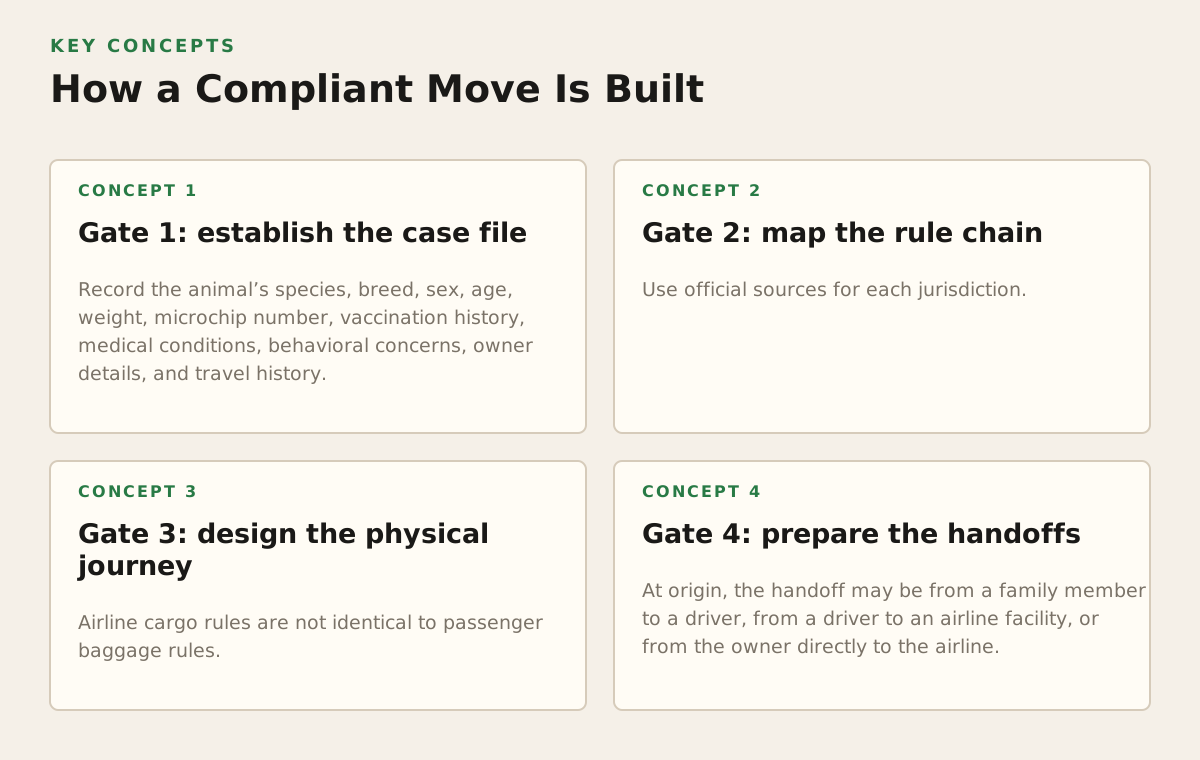
A reliable file is built in gates. Each gate answers a different question, and moving forward without an answer creates expensive rework. The process below applies to many domestic, international, military, and Hawaii moves, but the actual requirements must be verified for the route.
Gate 1: establish the case file
Record the animal’s species, breed, sex, age, weight, microchip number, vaccination history, medical conditions, behavioral concerns, owner details, and travel history. Note whether the animal will travel as accompanied baggage, cargo, or by ground transport. A brachycephalic breed, an elderly animal, a pet requiring medication, or a destination with temperature restrictions may need a different routing decision.
- Confirm the microchip number in the veterinary record and on every required form.
- Ask the veterinarian about fitness for the planned mode of travel, not just general health.
- List every country where the animal will enter or transit customs control.
- Identify who can make decisions if a flight is canceled or an animal is refused.
- Keep scanned copies and a clearly labeled physical document packet.
Identity consistency is a basic but frequently overlooked control. A one-digit discrepancy in a microchip number or a mismatch in the owner’s name can create questions at check-in or inspection. Corrections should be made through the issuing authority or veterinarian, not by altering an official form after signature.
Gate 2: map the rule chain
Use official sources for each jurisdiction. The U.S. Department of Agriculture’s Animal and Plant Health Inspection Service maintains its pet travel portal at USDA APHIS pet travel, including destination-specific information for animals leaving the United States. For a move into Great Britain, the government’s guidance at GOV.UK guidance for bringing pets to Great Britain demonstrates why country-level instructions should be read directly rather than inferred from an airline page.
Build a requirement matrix with columns for requirement, issuing party, date window, owner, backup action, and completion status. Include transit countries, not only the final destination. If an official source is unclear, ask the relevant authority or a qualified relocation professional before purchasing a nonrefundable itinerary.
| Requirement | Question to answer | Failure consequence |
|---|---|---|
| Identification | Which microchip standard and number must appear? | Vaccination or certificate may not be linked to the animal. |
| Vaccination | When does it become valid, and is prior history accepted? | Arrival may occur before eligibility. |
| Laboratory test | Is a test required, and must a specific lab perform it? | Departure may need to be postponed. |
| Health certificate | Who signs it, who endorses it, and how long is it valid? | Border or airline acceptance can fail. |
| Import approval | Is a permit, pre-clearance, or quarantine reservation needed? | Release may be delayed or refused. |
Gate 3: design the physical journey
Airline cargo rules are not identical to passenger baggage rules. The International Air Transport Association describes its Live Animals Regulations as standards and guidance for transporting live animals by air at IATA’s official live-animal transport page. That resource is useful for understanding the transport framework, but the operating airline remains the authority for its current acceptance rules.
Choose the simplest route that satisfies the legal and welfare constraints. Fewer connections generally create fewer handoffs, but a nonstop flight is not automatically best if it uses an airport with poor ground access, restrictive seasonal operations, or no viable recovery plan. Route simplicity is a risk decision, not merely a convenience preference.
- Prefer a route with enough connection time for documented handoffs rather than a tight theoretical connection.
- Confirm whether the animal changes aircraft, terminal, airline, or custody at each point.
- Check seasonal heat and cold restrictions for every exposed airport segment.
- Use an airline-approved crate with enough ventilation, secure fasteners, absorbent material, and correctly attached labels.
- Plan water, feeding, medication instructions, and emergency contacts without sedating unless the veterinarian specifically directs it.
Never assume that a reservation is the same as acceptance. Ask who confirms the animal, when the crate is inspected, where check-in occurs, what documents must be presented, and what happens if the scheduled aircraft changes. Record the name or reference number associated with each confirmation.
Gate 4: prepare the handoffs
At origin, the handoff may be from a family member to a driver, from a driver to an airline facility, or from the owner directly to the airline. At destination, it may involve customs, a quarantine facility, an airport agent, a local driver, and the receiving household. Each handoff needs a named party, contact method, location, time window, identification requirement, and contingency instruction.
For documents issued in one language and reviewed by another country, arrange a proper translation before departure. Owners handling certificates, permits, or scanned medical records can use translate PDF documents to translate pet import paperwork into the destination country’s language while preserving document formatting; this helps keep the import paperwork readable and maintain the original formatting for customs or quarantine review.

Where Pet Moves Break—and How to Recover
Most failures are not dramatic mechanical events. They are small mismatches discovered at the worst possible handoff: an arrival date outside a certificate window, a crate that does not satisfy the airline, a missing quarantine reservation, or a receiving driver who cannot access the cargo facility. Exception planning should begin before booking, while alternatives still exist.
Documentation failures
Common problems include an incorrect form version, an incomplete address, a missing official endorsement, an unreadable scan, an inconsistent microchip number, or a certificate signed by the wrong professional. A translated document may improve comprehension but does not automatically replace an official form or satisfy an authority’s certification rule.
- Compare every name, date, number, and address across the packet.
- Separate “required,” “recommended,” and “supporting” documents.
- Ask whether originals, copies, digital files, or stamped versions are required.
- Set a final document audit before the animal leaves home.
If a document is rejected, do not improvise a handwritten correction at the counter. Ask the rejecting authority what specific correction is required, who may issue it, and whether the animal can remain in a controlled location while the correction is obtained.
Airline and weather failures
Airline acceptance can change with aircraft type, route, seasonal conditions, embargoes, or local station capability. A weather restriction may affect the ground segment even when the flight itself operates. For that reason, a recovery plan should include an alternate flight window, a safe holding location, food and water instructions, and a person authorized to approve additional handling.
Illustratively, a family with a reporting date on Friday might set a starting policy of avoiding an itinerary that leaves no recovery day before the required arrival. That is not a universal benchmark; mission requirements, airline schedules, and the animal’s needs control the decision. The important question is: what is the latest safe recovery point before the owner’s obligation is affected?
Animal welfare and medical limits
Travel stress is individual. A young healthy cat, an anxious adult dog, and a senior animal with heart disease should not receive the same plan merely because they share a route. Discuss feeding, hydration, exercise, medication, motion sickness, temperature exposure, and warning signs with the veterinarian. A transport coordinator should communicate instructions accurately but should not prescribe treatment.
Crate conditioning is a practical preparation step. Begin gradually, use familiar bedding when permitted, and observe whether the animal can rest, stand, turn, and lie naturally in the selected crate. Do not wait until the day of departure to discover that the animal panics when confined. Welfare constraints can override schedule preferences; a cheaper or faster route is not a good route if it creates an avoidable medical or handling risk.
Border and quarantine surprises
Border authorities may inspect documents, verify identification, collect fees, or direct the animal to an approved facility. The receiving party should know whether release occurs at an airline cargo terminal, customs area, quarantine station, or another designated site. A driver who arrives at the wrong building can add hours to an already stressful handoff.
For Hawaii moves, review the state’s current instructions well before the flight and confirm any pre-arrival submission, inspection, or release arrangements. For international moves, check the final destination and every meaningful transit point. Transit is part of compliance whenever the animal is subject to a new authority’s control.
How Practitioners Apply the Framework
Professionals apply pet transportation as a project-management discipline. They translate a family’s deadline into a feasible movement plan, then keep the medical, regulatory, airline, and delivery tracks synchronized. The best plan is not the one with the most paperwork; it is the one where each document and handoff has a clear purpose.
For military PCS relocations
Military families must coordinate orders, housing, leave, airline availability, household goods, and pet requirements under a deadline that may change. Begin by separating the official report date from the date the pet must depart. Then identify whether the family, a service member, or an authorized agent will receive the animal.
- Keep a copy of orders and the destination contact information with the pet file.
- Ask whether the installation, sponsor, airline, or destination authority requires additional confirmation.
- Build a plan for the family’s temporary lodging if the pet arrives before housing is available.
- Decide in advance who can accept the animal if the service member is delayed.
- Track reimbursement or entitlement questions separately from compliance decisions.
A dedicated military pet shipping process can be useful when military orders, overseas rules, airline coordination, and delivery timing must be managed together. The service category does not eliminate the need to verify current destination requirements, but it can reduce the number of disconnected handoffs for a PCS household.
For Hawaii relocations
Hawaii planning requires attention to the state’s animal-quarantine process in addition to airline acceptance. A family should decide whether the objective is direct release, an approved quarantine arrangement, or another lawful pathway, then work backward from the intended arrival date. The dog or cat’s identification, vaccination history, certificates, submissions, and inspection arrangements must agree.
Do not book a flight first and assume the paperwork can follow. If the destination process requires an advance submission or an appointment, the flight date must be chosen around that requirement. A Hawaii pet shipping coordinator can help organize the airline, document, inspection, and final-delivery tracks, while the owner remains responsible for providing accurate medical history and making informed welfare decisions.
For international families and corporate transferees
International moves benefit from a shared responsibility chart. The family supplies accurate records and authorization; the veterinarian handles medical assessment and eligible certificates; the transport coordinator manages routing and handoffs; the relevant authorities decide entry and release. A corporate mobility team should assign one case owner rather than asking the employee to reconcile several vendors while preparing for a new job.
- Use one master timeline with local time zones identified.
- Store the original document location and a backup copy.
- Record every confirmation number, contact, and expiration date.
- Make the receiving address and emergency contact usable in the destination country.
- Set a decision deadline for changing the itinerary if a requirement remains unresolved.
Executives, officials, and diplomatic families may also need discreet scheduling and limited disclosure of personal details. That is a coordination requirement, not a reason to bypass official procedures. Share only what the airline, authority, veterinarian, and delivery team need to perform their roles, and confirm who is authorized to receive status updates.
For veterinarians and relocation professionals
Veterinarians can make the process safer by documenting the animal’s identity consistently, explaining fitness-for-travel considerations, and identifying medical issues that affect routing. Relocation professionals should avoid promising entry before the authority confirms eligibility. Their strongest contribution is maintaining a single source of truth for dates, documents, contacts, and unresolved decisions.
A useful case review asks five questions:
- What exact rule determines eligibility?
- Which date controls the next action?
- Who has authority to issue or correct the document?
- What happens if the planned flight is unavailable?
- Who physically receives the animal at every handoff?
Use those answers to create a final movement brief containing the itinerary, animal profile, document index, crate instructions, emergency contacts, handoff locations, and escalation path. Send it to the people who actually need to act on it, and revalidate time-sensitive details shortly before departure.
For a family, the most practical recommendation is to choose a coordinator based on the complexity of the move: one pet on a straightforward domestic route may need limited assistance, while a PCS, Hawaii, or international relocation may justify end-to-end management. BestPetTravel provides door-to-door domestic and international pet transportation with airline coordination, paperwork, customs support, live tracking, and delivery logistics; see BestPetTravel when the move requires one team to connect those steps.
Authored with NotFair SEO