
Pet Tracking Services for Relocation: What Buyers Should Expect
September 19, 2026
Pet tracking services for pet relocation: compare GPS, milestone updates, handoff checks, costs, limits, and questions for safer PCS moves.
Pet tracking services for relocation usually combine shipment milestone updates, human handoff confirmation, and—when practical—an onboard or attached GPS device. They are most useful when a dog or cat will pass between a relocation coordinator, airport agent, airline, customs broker, and destination driver. Before buying, confirm whether the service provides continuous location data or only status events, who watches exceptions, what the device can legally and safely do, and how tracking connects to the pet’s paperwork and handoffs.
What Pet Tracking Services actually include
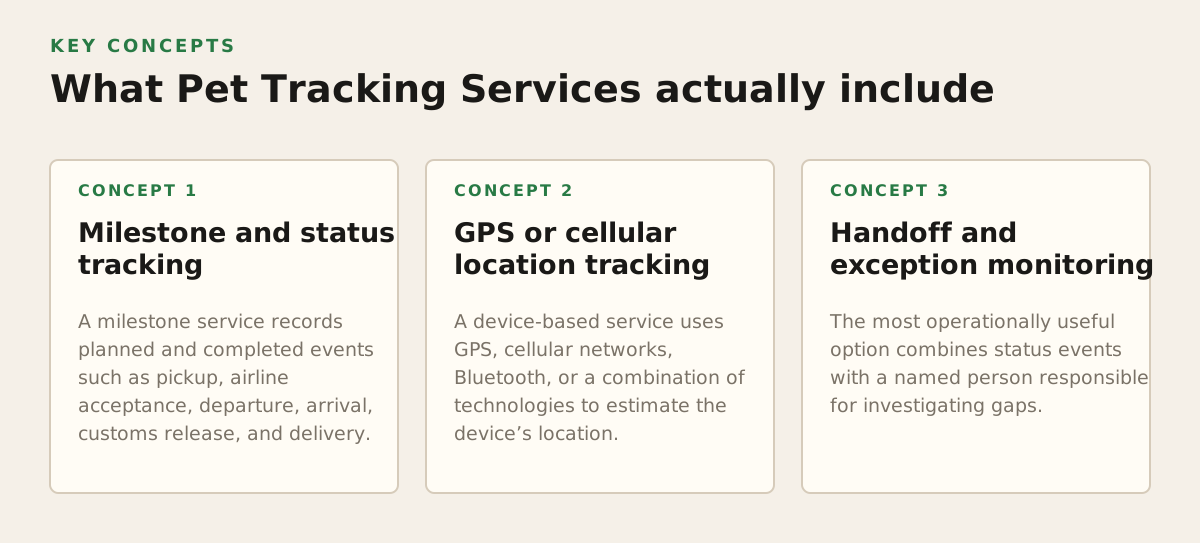
“Tracking” is not one standardized product. In pet transportation, it can describe anything from a coordinator sending manual updates to a technology platform showing a moving map. A buyer should identify the service category before comparing providers, because each category solves a different operational problem.
Milestone and status tracking
A milestone service records planned and completed events such as pickup, airline acceptance, departure, arrival, customs release, and delivery. Updates may come from a dispatcher, airline cargo system, airport representative, or driver. This is often the most dependable layer because it follows the transport workflow, rather than relying on a wireless signal inside an aircraft or cargo facility.
GPS or cellular location tracking
A device-based service uses GPS, cellular networks, Bluetooth, or a combination of technologies to estimate the device’s location. It can be valuable during road legs, airport transfers, and local delivery. Its limitations are equally important: aircraft restrictions, weak indoor signals, battery life, roaming availability, device attachment, and the fact that a device may be near the pet without proving the pet is in the correct person’s custody.
Handoff and exception monitoring
The most operationally useful option combines status events with a named person responsible for investigating gaps. That person may confirm that the crate was accepted, check a delayed connection, coordinate with a destination agent, or tell the family what action is required. This is exception management, not merely a map pin.
For a family, the right category depends on the move:
- Domestic door-to-door move: milestone updates plus driver check-ins may be sufficient; GPS can add reassurance during long road segments.
- Military PCS relocation: documented handoffs, schedule changes, and a reachable coordinator matter more than a continuously refreshing map.
- International relocation: customs and veterinary-document milestones are essential because a perfectly functioning tracker cannot correct an incomplete import file.
- Hawaii move: arrival coordination and quarantine-related documentation deserve priority over consumer-style location sharing.
- Executive or diplomatic move: restricted access, discreet notifications, and a small, clearly assigned contact group may be more appropriate than broad family sharing.
Why tracking matters—and what it cannot prove
Pet tracking reduces uncertainty at the points where responsibility changes. The most stressful moments are usually not the hours when an animal is moving according to plan; they are the gaps between pickup and airline acceptance, aircraft arrival and customs release, or customs release and final delivery.
A tracking record can help answer four practical questions:
- Where is the shipment in the process? For example, has the airline accepted the crate or is it still with the origin agent?
- Who had responsibility last? A signed or time-stamped handoff is more useful than an unexplained location point.
- What changed? A missed connection, weather disruption, document query, or delivery delay should trigger an update.
- What happens next? The family needs an action, owner, and expected update time—not just “delayed.”
Tracking does not prove that a pet is healthy, that a crate is correctly ventilated, or that an import authority will release the animal. The International Air Transport Association describes live-animal transport as a process involving container, handling, documentation, and operational requirements; its official pet travel guidance is a useful reminder that location is only one part of safe air transportation.
It also does not replace destination compliance. Requirements can include identification, vaccinations, health certificates, permits, testing, and arrival procedures, depending on the destination and origin. The U.S. Department of Agriculture’s pet travel guidance directs owners to check the destination’s current requirements and work with a veterinarian where applicable. A provider that promises “full tracking” but cannot explain document checkpoints is solving the visible problem while leaving the release risk untouched.
Practical rule: buy tracking to improve visibility and response time, not as a substitute for competent routing, paperwork control, crate preparation, or human custody checks.
How a professional tracking program works
A reliable program begins before pickup. The provider should create a shipment record containing the pet’s identity, route, contacts, crate information, flight or ground segments, required documents, and escalation instructions. The tracking layer then attaches updates to that record instead of scattering them across texts, emails, and calls.
1. Build the event plan
Ask for the exact events that will generate updates. Useful events commonly include:
- origin pickup completed;
- arrival at the origin facility;
- airline or carrier acceptance;
- departure and arrival;
- transfer to a customs, quarantine, or destination agent;
- release for delivery;
- final handoff to the authorized recipient.
The list should also identify exception triggers: missed connection, delayed acceptance, missing document, damaged crate, inability to reach the recipient, or a change in the delivery window. A service that only reports successful milestones may look polished while remaining silent when intervention is most necessary.
2. Assign people to each handoff
Every movement should have a responsible party and a confirmation method. That might be a driver’s electronic signature, an airline acceptance record, a destination agent’s call, or a recipient confirmation using a pre-agreed code. For sensitive moves, limit information to the people who need it and define who may authorize a reroute or delivery change.
3. Add technology where it helps
GPS is most useful on road legs and during local transfers, where the device has a reasonable chance of communicating. A provider should explain whether the device is attached to the crate or carried separately, how it is charged, whether cellular service works across borders, and what happens if the signal disappears.
Do not put an unapproved electronic device inside a crate or assume a consumer tracker is acceptable for an aircraft journey. The airline and carrier determine what equipment is permitted. The Transportation Security Administration’s pet-screening guidance also explains that pets and carriers may be handled separately during screening, which is one reason a family should ask how custody is recorded at the airport rather than relying on a device alone.
4. Close the record after delivery
Completion should include recipient confirmation, delivery time, condition notes, and any unresolved issue. For military, corporate, or government travel, retain the record according to the organization’s travel and privacy policies. A closed record helps a relocation professional reconcile invoices, document custody, and investigate a later question.
An illustrative tracking plan—not a universal benchmark—might include:
- 4 scheduled milestones: pickup, carrier acceptance, arrival, and delivery.
- 2 mandatory handoff confirmations: origin-to-carrier and destination-agent-to-recipient.
- 1 exception owner: a named coordinator who contacts the family if an event is late or missing.
- 15-minute update policy: an example internal target for acknowledging an urgent exception, not a guaranteed industry standard.
Where tracking programs break down
The most common failure is a mismatch between the buyer’s expectation and the service definition. “Live updates” may mean that a coordinator posts progress when someone receives a phone call. “Real-time GPS” may mean a device that reports only when it has power and network access. Put the meaning in writing.
- Aircraft and terminal interference: devices may not transmit continuously in aircraft, metal facilities, cargo areas, or underground spaces.
- Battery and attachment failure: a tracker can run out of power, detach from the crate, or be separated from the animal during screening.
- Cross-border connectivity: a cellular device may need roaming or local network access; ask who pays and what coverage is expected on every leg.
- False reassurance: a location point can show where a device is without confirming the pet’s condition or legal release.
- Multiple clocks: airport, airline, customs, driver, and family records may use different time zones unless the provider standardizes timestamps.
- Privacy leakage: a public map or broad notification list can expose a family’s travel pattern, home address, or destination.
Hawaii moves deserve a separate check because arrival procedures and animal quarantine rules can affect routing and release. The Hawaii Department of Agriculture’s Animal Quarantine Station information page provides the official starting point for current requirements. A tracker showing that a pet landed does not mean the pet is cleared to leave the airport or facility.
Red flags during vendor evaluation include:
- promising uninterrupted GPS coverage without discussing aircraft, battery, or network limits;
- refusing to identify who receives an alert after a missed milestone;
- providing a device but no documented handoff process;
- treating a tracking subscription as proof that customs or quarantine requirements are complete;
- offering a low headline price while leaving device, roaming, after-hours response, or exception-management fees undefined;
- requesting more personal or location data than the move requires.
How to compare service types, costs, and implementation burden
Pricing varies by route, number of legs, staffing, technology, and destination requirements, so a responsible comparison starts with a written scope rather than an invented per-trip benchmark. Ask whether tracking is included in transportation, priced per shipment, charged per day, billed per device, or added as an after-hours or exception service.
| Buyer need | Best-fit service type | Trade-offs and questions |
|---|---|---|
| Visibility during a simple domestic road move | Driver check-ins and milestone updates | Lower technology burden, but less continuous location data. Confirm update frequency and missed-stop escalation. |
| Several airport and ground handoffs | Milestones plus documented custody events | More coordination work, but clearer accountability. Ask who records acceptance and release. |
| International dog or cat relocation | End-to-end status tracking with paperwork checkpoints | Best for complex routing, but requires accurate documents and destination coordination. Confirm what the provider does versus what the owner and veterinarian must do. |
| Long road segment before or after a flight | Human updates plus GPS during the road leg | Useful location detail where networks work, but device charging and attachment must be managed. |
| High-privacy or official travel | Restricted-access dashboard or coordinator-led updates | Fewer people see the itinerary, but the buyer may receive less self-service visibility. Define authorized contacts and incident language. |
Implementation burden is often overlooked. Someone must provide accurate contact details, approve the route, keep the phone available, respond to document questions, and ensure the destination recipient can accept delivery. For a PCS family, coordinate tracking contacts with the move calendar and temporary lodging. For a veterinarian or relocation professional, confirm who owns the client communication so the family does not receive contradictory updates.
Use measurable success criteria in the statement of work. Examples include:
- all agreed milestones appear in one record;
- each physical handoff has a named custodian and time stamp;
- exceptions identify an owner and next action;
- the final record confirms delivery and unresolved issues;
- the provider states the expected fallback when GPS, cellular service, or a portal is unavailable.
How practitioners should use tracking for real moves
For military pet shipping, tracking should be tied to the PCS itinerary, not treated as a separate gadget purchase. Confirm the pet’s authorized recipient, lodging or delivery constraints, airline segment, and backup contact before pickup. A family may value a simple “accepted by carrier” notice more than a map because it confirms that the critical custody transition occurred.
For Hawaii pet shipping, build the tracking plan around document review, arrival handling, and release coordination. Verify the current state process early, preserve copies of submissions and approvals, and make sure the destination driver knows whether the pet can be collected immediately or must follow an arrival procedure.
For international corporate, diplomatic, or executive relocations, agree on notification discipline in advance. Decide whether updates go to the family, travel manager, household staff, veterinarian, or relocation lead. Use a minimum-necessary data policy: the person coordinating delivery may need the address and arrival window, while a broader group may need only “in transit” or “delivered.”
Vendor interview checklist
Ask these questions before approving a service:
- Is the service continuous GPS, milestone reporting, human check-ins, or a combination?
- Which events are automatic, and which require a person to make a call or update?
- Who monitors a missed flight, document query, or delivery delay?
- What is the fallback when the device loses power, signal, or attachment?
- Is the device approved for every transport segment, and who installs and retrieves it?
- Are roaming, device, after-hours, customs, and exception-management charges included or separate?
- Who can see the route and location data, how long is it retained, and how is access removed after delivery?
- What evidence will we receive for airline acceptance, customs release, and final handoff?
- What information must the owner, veterinarian, airline, or destination authority provide?
- Can you show a sample status record with an exception, not only a successful delivery?
Choose the simplest service that meets the route’s actual risk. A domestic driver with clear check-ins may not need a device. A complex international itinerary may need a coordinator who integrates paperwork, airline timing, customs communication, and destination delivery. The decisive feature is not the most impressive map; it is clear custody, actionable exceptions, and a documented finish.
BestPetTravel provides door-to-door domestic and international pet transportation with airline coordination, paperwork and customs support, live tracking, and delivery logistics; see how the service can fit a complex relocation at BestPetTravel.
Authored with NotFair SEO