
Pet Shipping Services For Dogs: A Practical Guide for Relocation Decisions
September 12, 2026
Compare pet shipping services for dogs, understand paperwork and airline logistics, avoid import delays, and choose support for PCS, Hawaii, or overseas moves.
Choosing pet shipping services for dogs is not simply buying an airline ticket for an animal. It means coordinating the dog’s identification, veterinary documents, airline acceptance, destination-entry rules, customs or agriculture inspection, ground transfers, and handoffs between people. For a PCS family, an executive relocating overseas, or a veterinarian helping a client, the right service depends on the route, the dog’s condition, the owner’s schedule, and how much operational responsibility the owner can safely retain.
What Pet Shipping Services For Dogs actually include
A dog-shipping service is a set of transportation and compliance tasks arranged around one animal’s itinerary. The provider may act as a travel adviser, documentation coordinator, freight agent, ground transporter, customs liaison, or full-service relocation manager. Those roles are not interchangeable, so a quote should identify what is included rather than relying on a broad label such as “door-to-door.”
Four service categories buyers should distinguish
- Airline coordination: The provider checks route suitability, crate requirements, seasonal restrictions, connection risks, booking procedures, and cargo or accompanied-pet options. This is useful when the owner can manage the veterinary work and local driving but does not want to make airline arrangements alone.
- Document and compliance support: The provider builds a destination-specific checklist, tracks deadlines, reviews forms, and helps coordinate certificates or endorsements. The veterinarian still supplies medical judgments and signs documents where required.
- Ground transportation: A driver collects the dog, takes it to an airport, transfers it between terminals or facilities, or completes final delivery. This helps when the owner is deployed, traveling separately, or moving from a rural location.
- End-to-end relocation: One coordinator manages the itinerary, paperwork workflow, airline arrangements, customs or agriculture steps, live updates where offered, and delivery logistics. It reduces the number of handoffs the owner must supervise, but it requires careful review of scope, exclusions, and contingency procedures.
There are also different operating models. A managed relocation generally gives the customer one accountable coordinator, while a booking-only arrangement may leave the owner responsible for veterinary timing, airport delivery, document presentation, and destination pickup. Neither model is automatically better. A confident owner with a flexible schedule may prefer to retain control; a family arriving in a new country after a long PCS journey may value fewer operational decisions.
What the service does not replace
Transportation providers do not replace a veterinarian’s assessment of whether a dog is fit to travel. They also cannot waive an importing authority’s requirements, guarantee that an airline will accept a particular animal, or make an unsuitable itinerary safe through paperwork alone. In 2026, requirements can vary by destination, transit country, dog age, origin risk classification, purpose of travel, and whether the dog is traveling with its owner.
For official rules, start with the destination authority rather than a generic checklist. The U.S. Department of Agriculture’s APHIS pet travel guidance explains that requirements depend on the country and type of travel. The U.S. Centers for Disease Control and Prevention separately maintains dog importation requirements for dogs entering the United States. These are examples of why “international pet transport” is a process category, not a single universal procedure.
Why route and buyer situation change the right choice
The same dog may need a different service level for three different moves. A domestic relocation across state lines may involve airline acceptance and a ground handoff. A military family moving under orders may face a fixed report date, limited time at the destination, and several travelers whose flights cannot be changed easily. A move to Hawaii can involve a tightly sequenced entry process in addition to transportation.
| Buyer need | Best-fit service type | Main trade-off |
|---|---|---|
| Owner can drive to and from the airport and has time for paperwork | Airline booking plus document review | Lower coordination burden than self-booking, but the owner retains more responsibility |
| Military PCS with a firm report date and limited flexibility | End-to-end relocation with ground transfers and deadline tracking | More coordination value, but the contract must explain changes caused by orders or airline disruptions |
| International move involving transit through another country | Full compliance and itinerary management | Fewer owner-managed handoffs, but every transit and destination rule must be confirmed |
| Move to Hawaii with possible inspection or quarantine implications | Hawaii-focused documentation, airline, and arrival support | Route convenience cannot compensate for missing or mistimed entry documents |
| Dog with mobility, anxiety, brachycephalic, or other health concerns | Veterinary-led planning plus a provider experienced with the relevant restriction | Some air routes or seasons may be unsuitable, requiring a different airport, timing, or ground plan |
| Executive, diplomatic, or high-profile relocation requiring discretion | Named coordinator, controlled communications, and private ground logistics | Service expectations must be documented; “discreet” should not remain an undefined promise |
Route complexity is a better buying signal than distance. A short international route with a transit stop, an entry permit, and a required veterinary certificate can create more work than a longer direct domestic journey. Ask the provider to map every leg: residence, departure airport, aircraft or cargo segment, transit point, destination airport, inspection location, and final address.
How to judge value without assuming a price
Providers may structure charges as a flat coordination fee, separate line items, bundled transport, pass-through airline and government charges, or a combination. Do not infer that a higher total means better care or that a cheaper booking includes compliance support. Ask for a written breakdown of what is known, what is estimated, and what is payable to a third party.
- Included work: Identify whether the quote covers itinerary design, airline booking, crate advice, document review, customs support, airport handling, local driving, delivery, and status updates.
- Variable charges: Ask which items can change, such as airline charges, veterinary services, government fees, storage, customs examination, additional driving, or itinerary changes.
- Payment triggers: Confirm when deposits, final balances, airline charges, cancellation fees, and change fees become due.
- Contingency exposure: Ask who pays if a flight is canceled, a document is rejected, the dog misses a connection, or delivery must move to the next available route.
- Budget ownership: For PCS or employer-sponsored moves, clarify which costs are reimbursable and which documents the sponsor requires before approving reimbursement.
Use a written budget worksheet rather than a verbal estimate. An illustrative worksheet—not a universal cost benchmark—might contain eight lines: coordination, airline transport, veterinary work, official endorsement, crate, origin ground transfer, destination handling, and contingency. The point is to expose cost ownership before booking, not to predict a price without a route and dog profile.
How a professional dog relocation works
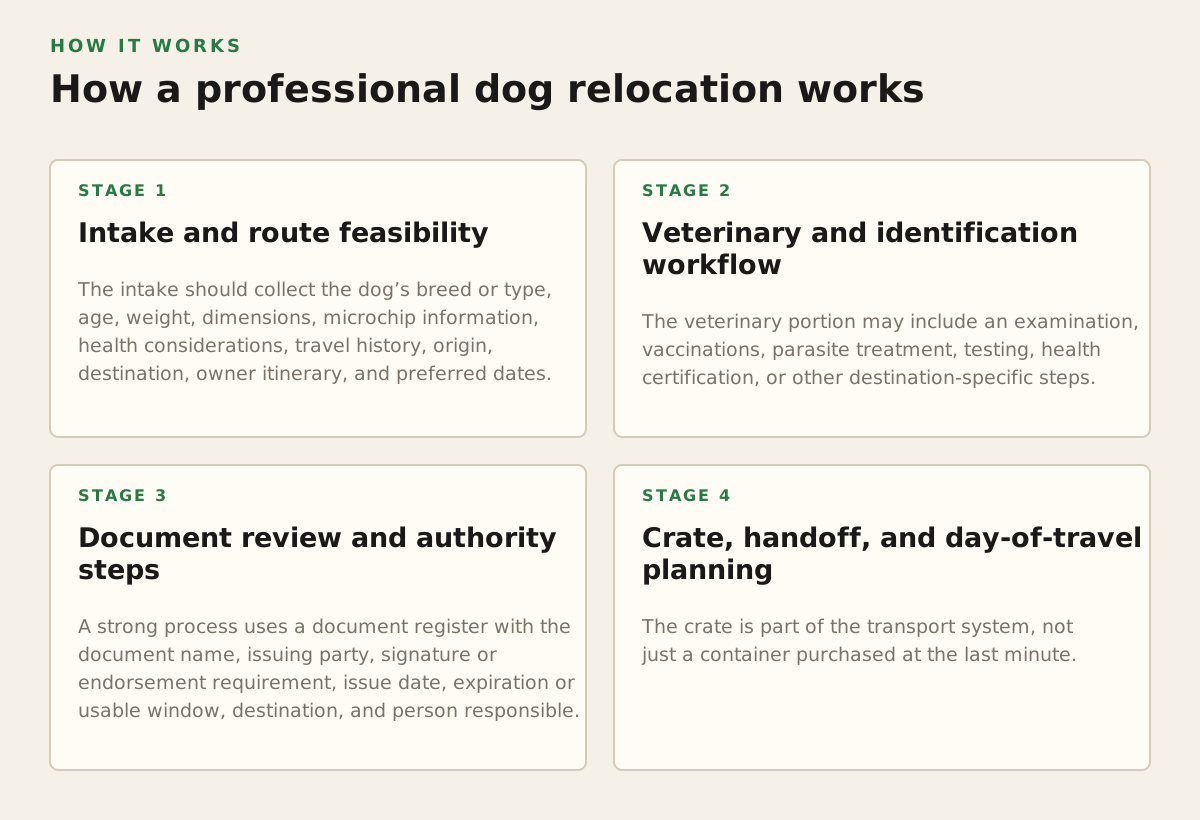
A reliable move is a sequence of gates. The provider should be able to explain which facts are needed before each gate closes and what happens if a requirement changes. The owner should not wait until the final week to discover that the chosen airport, crate, certificate, or transit country is incompatible.
1. Intake and route feasibility
The intake should collect the dog’s breed or type, age, weight, dimensions, microchip information, health considerations, travel history, origin, destination, owner itinerary, and preferred dates. It should also establish whether the dog is traveling as accompanied baggage, manifest cargo, or by ground transport. Those options may be restricted by airline policy, aircraft type, season, temperature, destination, or the animal’s characteristics.
Feasibility comes before convenience. A direct flight is often simpler to manage, but it is not automatically available or appropriate. A provider should identify connection points, overnight exposure, airport changes, and the party responsible for each transfer. If the proposed plan depends on an assumption—such as an airline accepting a crate at a specific airport—ask when that assumption will be verified.
2. Veterinary and identification workflow
The veterinary portion may include an examination, vaccinations, parasite treatment, testing, health certification, or other destination-specific steps. The exact sequence belongs to the destination authority and the veterinarian. A transport provider can track the sequence, but should not tell an owner that a medical requirement is unnecessary merely because another route did not require it.
Microchip details deserve special attention. The identification number must match the records and travel documents wherever the destination requires that relationship. Have the veterinarian scan the chip and compare the number against the service file before documents are finalized. A mismatch is a small administrative error with potentially large consequences at inspection.
For European Union travel, the European Commission’s official non-commercial pet movement guidance describes rules and documentation for dogs, cats, and ferrets moving under that framework. It is a useful example of why the owner’s purpose of travel and the route’s legal classification matter; commercial movement and relocation arrangements may not be treated identically.
3. Document review and authority steps
A strong process uses a document register with the document name, issuing party, signature or endorsement requirement, issue date, expiration or usable window, destination, and person responsible. “Health certificate completed” is not enough if the document also needs an official endorsement, an original copy, a specific language, or arrival within a defined period.
- Confirm the destination and all transit countries in writing.
- Separate veterinary documents from airline forms and government entry documents.
- Record the earliest date and latest usable date for each time-sensitive item.
- Check names, addresses, microchip numbers, dates, and dog descriptions against the booking.
- Keep physical and digital copies according to the destination and carrier instructions.
- Obtain final acceptance or approval where required before treating the itinerary as secure.
For Hawaii, use the Hawaii Department of Agriculture animal quarantine guidance rather than assuming that a mainland domestic flight has ordinary domestic-arrival rules. The Hawaii process can involve pre-arrival requirements and inspection or quarantine conditions. A provider should identify the applicable pathway for the specific dog and arrival airport, then work backward from the intended arrival date.
4. Crate, handoff, and day-of-travel planning
The crate is part of the transport system, not just a container purchased at the last minute. The dog should be able to stand, turn, and lie naturally within the carrier required by the relevant airline or authority. The provider should explain labeling, absorbent material, water access, feeding instructions, leash handling, and whether the crate will be opened during any handoff.
Handoffs are failure points. The itinerary should name the person or team responsible at origin, the airline or cargo facility, the transit point if applicable, the destination facility, and final delivery. It should also state how identity is verified, how delays are escalated, and how the owner receives an update. “Live tracking” may mean different things—from status messages to location data—so ask what is actually supplied and at what milestones.
5. Arrival, inspection, and delivery
Arrival work may include document presentation, customs or agriculture interaction, cargo release, local driving, and delivery to a residence, hotel, base lodging, or other approved location. The owner should receive instructions for what to do if the dog is not released when expected, if the destination office requests another document, or if the receiving address changes.
A useful success definition is measurable and route-specific. For example, an illustrative service-level checklist could require: all required documents reviewed before submission; booking details matching the approved itinerary; named contacts for every handoff; an update at departure and arrival; and documented delivery to the authorized recipient. These are starting policies for evaluating execution, not guarantees that an authority or airline will never cause a delay.
Where dog shipping plans break down
Most serious problems are not caused by one dramatic failure. They arise when an assumption remains unverified until several other decisions depend on it. A vendor interview should therefore focus on failure handling, not just the ideal itinerary.
Common operational failure points
- Deadline compression: The owner begins after discovering a certificate or test has a narrow timing window. The remedy is a route-specific calendar created before the veterinary appointment.
- Transit ambiguity: The quote covers the destination but not the legal or handling requirements of a connection country. Every transit point should appear in the written plan.
- Carrier mismatch: The proposed airline or aircraft does not accept the dog, crate, route, or season combination. Acceptance should be confirmed for the actual booking, not assumed from a general airline policy.
- Document inconsistency: The microchip, owner name, destination, or date differs across forms. Use a single master data sheet and perform a final comparison.
- Temperature or health restrictions: Weather, breed characteristics, age, or medical concerns make a flight unacceptable or unavailable. A backup airport, date, or ground segment may be needed.
- Unclear responsibility: The owner assumes the provider will handle customs or delivery, while the provider considers those services optional. The scope must name each handoff and fee.
- Change without escalation: A flight moves, but no one tells the person collecting the dog. The plan should contain a primary contact, backup contact, and escalation clock.
Red flags include a guaranteed arrival date before airline acceptance and government review are complete, pressure to skip veterinary advice, a quote that does not identify exclusions, refusal to explain who handles a missed connection, and a promise to “take care of customs” without naming the entry process. Another warning sign is a provider unwilling to discuss what happens when the preferred route is unavailable.
Health and welfare decisions require restraint
Transport convenience should never override a veterinarian’s assessment. Ask the veterinarian and provider to discuss the dog’s age, anxiety, respiratory risks, previous travel behavior, medication instructions, feeding plan, and emergency contact. Do not add sedatives or change medication instructions because a transport worker suggests it; medication decisions belong with the prescribing veterinarian.
The provider should also explain its policy for dogs that become ill, are refused by a carrier, or arrive with a concern. The important question is not whether anyone can promise a perfect journey. It is whether the plan provides a defined response, a responsible decision-maker, and a communication path.
How practitioners should evaluate and apply the service
Veterinarians, relocation professionals, military administrators, and corporate mobility teams need a repeatable intake rather than an informal referral. Build a short case file that can be handed from the owner to the provider without losing the details that drive eligibility.
A practical vendor interview checklist
- Which service category are you quoting: booking, paperwork support, ground transport, or end-to-end relocation?
- Who is the named coordinator, and who is the backup if that person is unavailable?
- Which legs are handled directly, and which are subcontracted or performed by an airline, cargo facility, customs broker, or local driver?
- How will you verify airline acceptance for this dog, crate, route, date, and aircraft?
- Who identifies the destination and transit-country requirements, and where should the owner verify them independently?
- Which veterinary appointments, endorsements, translations, permits, or inspections are the owner responsible for arranging?
- What documents are included in the review, and how many review rounds are included?
- What happens after a canceled flight, missed connection, rejected document, weather restriction, or delayed release?
- What updates are provided, at which milestones, and what does “tracking” specifically mean?
- Which charges are fixed, which are estimates, and which third-party costs can change?
- What are the cancellation, postponement, refund, and change policies?
- How will the dog’s identity and the receiving person’s identity be confirmed at delivery?
Request sample deliverables with sensitive information removed: a timeline, document checklist, itinerary, handoff record, and contingency workflow. These reveal more than polished marketing language. A usable document should show dates, owners, dependencies, and decision points.
Apply different standards to different professional cases
For a military PCS, begin with the report date, authorized travel dates, destination installation, lodging plan, and reimbursement documentation. Build a backup around the possibility that the service member’s itinerary changes. Families comparing military pet shipping options should ask specifically how orders, temporary lodging, and a late flight change affect delivery.
For an international corporate or diplomatic relocation, assign one authorized decision-maker and define confidentiality expectations in writing. “Discreet” should translate into practical controls such as limited distribution of itinerary details, approved contacts, and delivery verification—not an undefined claim. The relocation team should also confirm whether the employer or government sponsor requires invoices, receipts, or preapproval.
For Hawaii, treat the entry process as a separate workstream, not an afterthought to the flight booking. Owners evaluating Hawaii pet shipping should ask who tracks pre-arrival documents, who communicates with the arrival facility, and what happens if the dog’s paperwork is not accepted on the planned date.
For veterinarians and referral partners, provide facts without promising an outcome: dog identity, origin, destination, proposed dates, health considerations, owner contact, and whether the move is personal, commercial, military, or employer-sponsored. Refer medical questions back to the veterinarian and regulatory questions to the responsible authority. A transportation provider can coordinate those inputs, but cannot responsibly invent an approval.
Choose based on accountability, not the biggest package
The best service level is the one that matches the owner’s available time and the route’s failure consequences. If the owner can manage local transport and has experience with documents, a narrower service may be efficient. If the family is crossing borders during a PCS, traveling separately from the dog, or facing multiple handoffs, full coordination may justify its additional scope.
Before signing, require four written outcomes: a route map, a responsibility matrix, a cost and exclusions schedule, and a contingency procedure. Those documents make performance review possible. After the move, assess whether the provider met the agreed milestones, communicated changes promptly, maintained document consistency, and delivered the dog to the authorized recipient—not merely whether the original flight time remained unchanged.
For complex domestic and international moves, BestPetTravel provides door-to-door pet transportation with airline coordination, paperwork support, customs assistance, live tracking, and delivery logistics. Visit BestPetTravel to discuss a route-specific plan for a family move, PCS, Hawaii relocation, or overseas assignment.
Authored with NotFair SEO