
Pet Relocation International: A Practical Guide for Overseas Moves
August 17, 2026
Pet relocation international explained: plan health documents, airline handling, customs, and delivery for military PCS, Hawaii, and overseas moves.
Pet relocation international is the coordinated process of moving a dog or cat across a national border while satisfying destination-country rules, airline requirements, veterinary conditions, customs procedures, and final delivery logistics. It is not simply booking an animal on a flight. For a military family on PCS orders, an executive transferring overseas, or a diplomatic household requiring discreet handling, the move succeeds only when each dependent step is completed in the right order.
What international pet relocation actually includes
A useful way to define the service is as a chain of custody and compliance. The chain begins with identifying the animal, route, and legal destination; continues through veterinary preparation and transport; and ends when the pet is legally released and delivered to the correct residence or quarantine facility. A missed document, unsuitable aircraft connection, or incorrect import category can interrupt the chain even when the pet is otherwise healthy.
The five workstreams behind a successful move
- Eligibility: Confirm that the destination accepts the species, breed, age, microchip format, and origin country under the applicable import pathway.
- Veterinary preparation: Arrange identification, vaccinations, laboratory tests, parasite treatments, health certificates, and endorsements in the sequence required by the destination.
- Airline coordination: Select a pet-appropriate itinerary, reserve the animal correctly, verify crate and temperature rules, and coordinate handoffs at each airport.
- Border clearance: Prepare declarations, permits, certificates, customs documents, and any pre-arrival notification required by the destination authority.
- Ground delivery: Move the pet between home, airport, inspection point, quarantine location, and final residence with contingency planning for delays.
These workstreams overlap, but they should not be treated as interchangeable. A veterinarian may prepare a health certificate; that does not mean the certificate has been endorsed by the government authority when endorsement is required. An airline may accept a crate at origin; that does not guarantee the destination will release the pet without an import permit or inspection appointment.
Why the destination matters more than the airline
Airline rules influence the route, but the destination’s import law determines the legal path. The same dog can face different procedures when traveling from the United States to Japan, Germany, the United Kingdom, Australia, or Hawaii. Even movement between two countries with broadly similar veterinary standards can involve different certificate forms, deadlines, approved laboratories, or quarantine arrangements.
For U.S.-origin travel, the USDA Animal and Plant Health Inspection Service pet travel guidance explains that destination-country requirements must be checked before travel and that an accredited veterinarian may need to complete export documentation. The practical implication is important: begin with the destination authority and USDA pathway, then build the flight plan around the documents—not the reverse.
A relocation specialist is most valuable when the move has dependencies that a normal passenger booking does not expose. Examples include a rabies vaccination that must precede a blood test, a certificate that must be issued within a narrow travel window, or a route that requires the pet to be rebooked because a transit country applies its own entry rules.
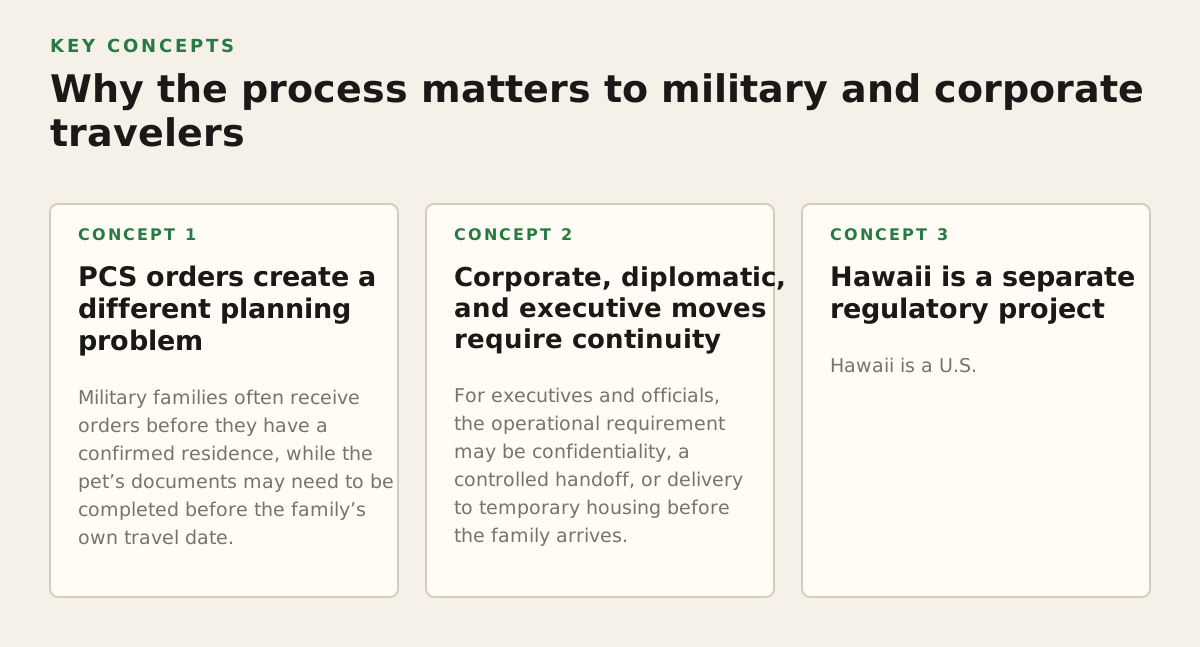
Why the process matters to military and corporate travelers
International pet relocation protects more than convenience. It reduces the chance that an animal is refused at check-in, held for inspection, placed into quarantine, separated from the family, or sent back to the origin country. Those outcomes can create housing costs, missed reporting dates, emergency boarding, and difficult decisions during an already compressed move.
PCS orders create a different planning problem
Military families often receive orders before they have a confirmed residence, while the pet’s documents may need to be completed before the family’s own travel date. A service member may also have a report-no-later-than date, an authorized route, or government-arranged transportation that does not align with the pet’s most suitable itinerary.
For these households, the first planning question is not “Which flight is cheapest?” It is “Which dates are legally possible, operationally safe, and compatible with the orders?” A sound file should connect:
- the installation, destination country, and final address or temporary lodging plan;
- the family’s passenger itinerary and the pet’s proposed itinerary;
- the required veterinary milestones and certificate validity windows;
- the airline’s live-animal acceptance conditions for each flight segment;
- the name and phone number of the person authorized to receive the pet.
Families arranging military pet shipping should also distinguish reimbursable or authorized movement from expenses that may remain their responsibility. Policies can vary by assignment, service branch, orders, and current program rules. A relocation coordinator can organize the paperwork and transport plan, but the family should verify funding and entitlement questions with the appropriate military office before committing to nonrefundable services.
Corporate, diplomatic, and executive moves require continuity
For executives and officials, the operational requirement may be confidentiality, a controlled handoff, or delivery to temporary housing before the family arrives. That changes the information flow. The transport plan should identify who can receive status updates, who can authorize changes, and what happens if the residence is unavailable on arrival.
Useful controls include:
- One accountable decision-maker: Name the person who can approve a reroute, boarding extension, or alternate delivery address.
- Document ownership: Keep the original certificates, scans, permit numbers, and endorsement records in a shared but access-controlled file.
- Handoff records: Record the pet’s condition, crate number, food instructions, and transfer time at each custody change.
- Arrival fallback: Pre-authorize a boarding facility, trusted representative, or temporary address if the household cannot receive the pet.
These controls are not bureaucratic decoration. They address the most common operational failure: information exists, but it is held by the wrong person when a flight is delayed or an inspection office asks for clarification.
Hawaii is a separate regulatory project
Hawaii is a U.S. destination, but it has its own animal quarantine and import procedures designed to protect the islands from certain diseases. The Hawaii Department of Agriculture’s Animal Quarantine Station guidance identifies the required process and forms for dogs and cats entering the state. Requirements can depend on the animal’s origin, destination island, documentation, and whether the pet qualifies for direct airport release.
That means Hawaii pet shipping should be planned as a destination-specific compliance move, not as an ordinary domestic flight. A family moving under military orders should check the Hawaii requirements as soon as orders are available, because a missed test, certificate, or document submission can affect whether the pet is released on arrival.
How a professional move is built, step by step
The best workflow starts with a feasibility review and ends with a documented delivery. The sequence below is a planning model; the exact requirements must be replaced with the current rules for the animal’s origin, destination, transit points, and travel date.
1. Build the route and risk profile
Collect the information that changes the legal or operational plan:
- species, breed, age, sex, weight, and any special handling needs;
- microchip number and whether the chip can be read by the destination authority;
- current rabies and other vaccination records;
- origin address, destination address, and every transit country;
- preferred travel date, flexibility range, and whether the family must travel together;
- medical conditions, anxiety triggers, mobility limitations, and feeding schedule.
Then classify the move as low, medium, or high complexity for planning purposes. This classification is an internal starting policy, not a universal industry standard. A direct route with a healthy adult cat and complete records may be relatively simple. A dog traveling through two countries, requiring a rabies titer, government endorsement, and arrival inspection is materially more complex. A brachycephalic dog, senior pet, or animal with a medical condition adds airline and veterinary risk even if the import rules are straightforward.
2. Convert legal requirements into a milestone calendar
Do not store requirements as a loose checklist. Convert each requirement into an owner, date, dependency, and proof of completion. For example, “rabies vaccination” is not enough. The file should show the vaccination date, product details, veterinarian signature, microchip association, and the next action that depends on it.
Some destinations require an official health certificate or government endorsement. The USDA explains its export-certification process for pets through its pet travel checklist and certification resources; the applicable form and endorsement method depend on the destination. Use the current official instructions rather than an old certificate saved from a previous move.
A planning calendar should contain at least these columns:
- Requirement: vaccination, test, permit, certificate, treatment, or inspection.
- Earliest date: when the action can legally occur.
- Latest safe date: the internal deadline before the official deadline.
- Responsible party: owner, veterinarian, laboratory, government office, airline, or broker.
- Evidence: certificate, receipt, lab report, permit, approval email, or booking record.
- Failure response: the alternate flight, revised appointment, or escalation path.
3. Coordinate the veterinarian, laboratory, and government authority
Veterinary preparation is a sequence, not a single appointment. The veterinarian needs the destination instructions before completing forms, because an otherwise valid certificate may omit a required statement or use the wrong template. If a laboratory test is required, the sample date and result date can affect the earliest permitted travel date.
For dogs entering the United States, the U.S. Centers for Disease Control and Prevention dog-importation guidance describes requirements that can include a minimum age, microchip, vaccination documentation, and other steps depending on where the dog has been during the relevant period. CDC rules are distinct from USDA export requirements, so both sides of the move must be reviewed in 2026 rather than assuming one agency’s approval covers the other.
Do not schedule the final certificate appointment until the authority’s timing window is clear. A certificate issued too early can expire before arrival; one issued too late may not leave time for endorsement, courier delivery, or airline document review.
4. Select the transport method around welfare and compliance
Air travel may be appropriate, but route quality matters more than the number of flight segments alone. Evaluate cabin or cargo eligibility, aircraft type, seasonal temperature restrictions, connection length, airport handling, and the availability of staff to receive the animal if the itinerary changes.
The International Air Transport Association’s pet travel guidance covers subjects such as container preparation and airline-specific requirements. IATA guidance is not a substitute for the carrier’s current booking rules or the destination authority’s law, but it is a useful reference for crate suitability and transport preparation.
Medication deserves particular caution. Sedation can impair an animal’s ability to respond to transport stress, temperature changes, or reduced oxygen availability. Any medication decision belongs to the treating veterinarian, who should know the route, flight duration, animal’s history, and emergency contact information. Do not add a sedative to the plan simply because the owner is worried about the flight.
5. Prepare the arrival handoff
Arrival is a separate operation. Confirm whether the pet will be collected from a cargo terminal, inspected at an approved facility, released at the airport, or transferred to quarantine. The receiving person needs identification, authorization, contact details, and instructions for food, water, medication, and onward transport.
Before departure, give the receiving team:
- a legible copy of the pet’s travel and health documents;
- the original document location and a backup contact;
- crate dimensions, label details, and feeding instructions;
- the destination address and a secondary address;
- veterinarian and emergency contact information;
- a written plan for delay, missed connection, or after-hours arrival.
Illustrative planning examples
The following numbers are illustrative planning examples, not universal deadlines or benchmarks. Actual dates must come from the relevant government authority, veterinarian, and airline.
- PCS dog move: Start a 90-day planning file, reserve a veterinary review at day 1, set an internal document-complete target at day 60, and keep the final 30 days for endorsement, airline confirmation, and contingency handling.
- Executive cat move: Use a 3-contact chain—owner, relocation coordinator, and destination representative—and prepare 2 delivery addresses in case the residence is not ready.
- Multi-country itinerary: Review 3 rule sets—origin, transit, and destination—before selecting the flight, even if the pet remains airside during the connection.
- Senior pet: Schedule 2 veterinary discussions: one for route suitability and one for final travel clearance, with the treating clinic’s after-hours number in the handoff file.
Where international pet moves break down
Most failures occur at interfaces: between the owner and veterinarian, veterinarian and government authority, shipper and airline, or airline and border officials. The animal may be ready while the paperwork is not, or the documents may be correct while the route violates a carrier restriction.
Document timing is the hidden constraint
Import permits, rabies records, laboratory reports, health certificates, treatments, and endorsements can each have separate validity periods. A document can be genuine and correctly completed yet unusable because it was issued outside the destination’s permitted window.
Use a dependency map rather than a single due date:
- microchip before the vaccination record that must identify the chip;
- vaccination before any waiting period or laboratory test;
- laboratory result before the earliest legal arrival date;
- health certificate within the destination’s accepted period;
- government endorsement before the airline or border authority needs the original;
- arrival notification before the inspection appointment, where required.
The strongest operational habit is to set an internal deadline earlier than the legal deadline. That buffer is a risk-control decision, not a guarantee. It creates room for a rejected scan, a missing signature, a laboratory delay, or a canceled appointment.
Airline acceptance is not guaranteed by a passenger ticket
A passenger can hold a confirmed seat while the pet remains unconfirmed. Live-animal capacity, aircraft type, crate dimensions, temperature restrictions, connecting-airport procedures, and seasonal embargoes can all affect acceptance. Airline rules may also differ by route and change after the original itinerary is issued.
Ask the carrier or transport coordinator to confirm in writing:
- the pet’s booking status for every segment;
- whether the animal travels in cabin, as checked baggage, or as manifested cargo;
- the approved crate dimensions and ventilation requirements;
- check-in location and document presentation requirements;
- temperature or breed restrictions on the travel dates;
- the procedure for a delayed, canceled, or misconnected flight.
Avoid choosing a connection solely because it is the shortest. A slightly longer itinerary with fewer handoffs, a suitable climate window, and a staffed transfer point may offer a more controllable risk profile than a tight connection that leaves no recovery time.
Transit countries can create unexpected obligations
“The pet is only transiting” does not always answer the legal question. Some countries distinguish between remaining in a secure transit area and entering the country; others may apply requirements based on the airport, length of connection, or change of terminal. Ask about every transit point before the ticket is purchased.
This is especially important for military and corporate itineraries built around government-negotiated passenger routes. The most convenient human itinerary may not be the legally or operationally viable animal itinerary. If the pet must travel separately, define the separation period, temporary care arrangement, and person responsible for receiving the animal.
Health and welfare risks cannot be solved with paperwork
Documents establish eligibility; they do not prove that a particular animal should fly. A veterinarian should evaluate respiratory risk, heat sensitivity, anxiety, age, pregnancy, injury, chronic illness, and the effect of time in a crate. Feeding should be familiar and conservative. New food, an unfamiliar crate, or an untested calming product on travel day can create avoidable problems.
Watch for these escalation signals:
- the pet has breathing difficulty, repeated vomiting, collapse, or unusual lethargy;
- a medication plan has not been reviewed for the specific route;
- the animal cannot stand, turn, or lie naturally in the selected crate;
- the destination has extreme temperatures or a long ground transfer;
- the itinerary changes after the veterinary certificate is issued.
Any of these should trigger a veterinary or transport review before departure. A relocation company can coordinate people and documents, but it cannot replace clinical judgment.
How practitioners apply the process to real moves
Experienced coordinators treat every relocation as a decision tree. They identify the hard constraints first, then optimize comfort, cost, timing, and convenience within those limits. This avoids the common mistake of building an attractive itinerary that later fails a regulatory or airline check.
Case pattern: military family with a dog and uncertain housing
Start by separating the legal destination from the final delivery address. The dog may be permitted to enter before the family has permanent housing, but release, customs, or local registration may require a usable address and responsible receiver. Confirm temporary lodging rules before assuming the pet can go directly to the hotel.
The working file should connect the PCS orders, installation arrival date, pet documents, airline booking, and receiving plan. If the family’s passenger itinerary changes, the pet’s booking must be reviewed immediately rather than assumed to follow automatically. A backup caregiver near the destination can prevent a last-minute delivery failure.
Case pattern: family moving with two cats
Two animals create additional handling decisions. Determine whether they can share a suitable container under current airline and welfare rules; never assume that because they live together they should travel together. Compare individual crates, combined handling, and the effect of each option on airline acceptance and airport transfers.
Label each carrier clearly and keep separate records for microchip numbers, vaccination history, medications, and feeding instructions. At arrival, confirm that both animals are released and transferred before the receiving party leaves the inspection or cargo area.
Case pattern: executive relocation with a senior dog
For a senior dog, the route should be reviewed by the treating veterinarian before a nonrefundable itinerary is selected. The plan may need a direct route, a climate-controlled ground transfer, additional recovery time, or a different travel date. If the executive’s schedule is fixed, the pet may need to travel earlier with a designated representative and temporary care arrangement.
Discreet service does not mean withholding necessary information from the airline, veterinarian, or border authority. It means limiting updates to authorized contacts while ensuring that every party with a safety or compliance responsibility has accurate information.
Case pattern: relocation to or from Hawaii
Begin with the Hawaii Animal Quarantine Station pathway, then determine whether the pet can qualify for direct release or must follow another process. Build the schedule around required records, tests, treatments, submissions, and inspection arrangements. The destination island and arrival airport can affect the practical handoff.
For a family moving from Hawaii to the mainland or another country, do not assume the outbound process is the reverse of entry. The receiving destination’s rules control the export file, while Hawaii’s local requirements may still affect veterinary preparation and airport handling.
Use a go/no-go review before the final booking
A professional review should happen before the last payment or irreversible document step. The reviewer should be able to answer “yes,” “no,” or “pending” to each question:
- Is the exact destination pathway identified for this species and origin?
- Are all transit countries and airport transfers reviewed?
- Does the microchip appear consistently across the records?
- Are vaccination, testing, treatment, certificate, and endorsement dates sequenced correctly?
- Is every airline segment confirmed for the animal, not merely for the passenger?
- Is the crate compliant, labeled, and familiar to the pet?
- Is there a named receiver and a delay plan at destination?
- Does the veterinarian agree that the animal is fit for the proposed route?
If one answer is “pending,” the move may still proceed, but the unresolved item needs an owner and a deadline. If the answer is “no,” do not mask the problem with a tighter itinerary. Change the route, date, documentation plan, or transport method.
A practical recommendation for choosing support
Choose international pet relocation support when the move involves more than one authority, a narrow document window, a connecting itinerary, military reporting constraints, Hawaii entry procedures, a medically sensitive animal, or a destination where you do not speak the local administrative language. For a simple domestic-style journey, an owner may be able to manage the process directly; for a cross-border move, the value of professional coordination lies in preventing disconnected tasks from becoming a failed arrival.
When comparing providers, ask for a written scope that distinguishes veterinary work, government fees, airline charges, customs or broker services, ground transportation, crate preparation, tracking, and emergency changes. Also ask who owns each deadline and what happens when an authority or airline changes its instructions. Avoid any provider that promises a guaranteed outcome without first reviewing the origin, destination, species, route, and travel date.
BestPetTravel coordinates door-to-door domestic and international pet transportation, including airline coordination, paperwork, customs support, live tracking, and delivery logistics. For military PCS, Hawaii, and complex overseas moves, BestPetTravel can help turn the legal requirements and transport handoffs into one managed relocation plan.
Authored with NotFair SEO