
Pet Import Requirements Quarantine Duration: What Moves the Clock?
November 12, 2026
Pet import requirements quarantine duration depends on destination, origin and completed steps. Compare official rules for Hawaii, Australia, Japan and more.
Pet import requirements quarantine duration depends on the destination, your pet’s origin and whether required steps are completed before arrival. Some rules specify a minimum stay in an approved facility; others use a pre-travel waiting period that may affect confinement only if it remains incomplete on arrival. Hawaii, Australia, Japan, New Zealand and Great Britain illustrate why there is no single duration for every move. Check the official rule for your pet’s route before fixing travel or household dates.
Separate preparation time from time in a facility
The word “quarantine” can refer to different parts of an import process. A vaccination, test, waiting period or document review may need to happen before travel. That preparation time is not automatically facility quarantine. A facility stay is a separate post-arrival requirement, with its own admission and release conditions.
An arrival inspection is different again. Officials may check the animal and its records at entry; that check does not, by itself, tell you whether the pet must remain in an approved facility. To estimate the period that affects when your pet can join the household, find the destination’s stated post-arrival outcome—not just its general import timeline.
When reading official guidance, distinguish among these possible rules:
- Pre-travel waiting period: time tied to a medical step or test, which may be completed before departure.
- Arrival inspection: an entry check that may result in release if the requirements are met.
- Minimum facility stay: a required period after admission, even when earlier paperwork is complete.
- Conditional hold: additional confinement may apply if a required step or record is missing or unacceptable.
This distinction matters when a family is coordinating a PCS report date, a corporate start date, temporary housing or a home closing. A pet may need to travel on a different schedule from its people, and a release date may not match the family’s arrival date. Do not add a pre-travel wait to a facility stay as though they were one continuous quarantine. Record each period separately and confirm what event starts and ends it.
Compare the destination’s actual quarantine pathway
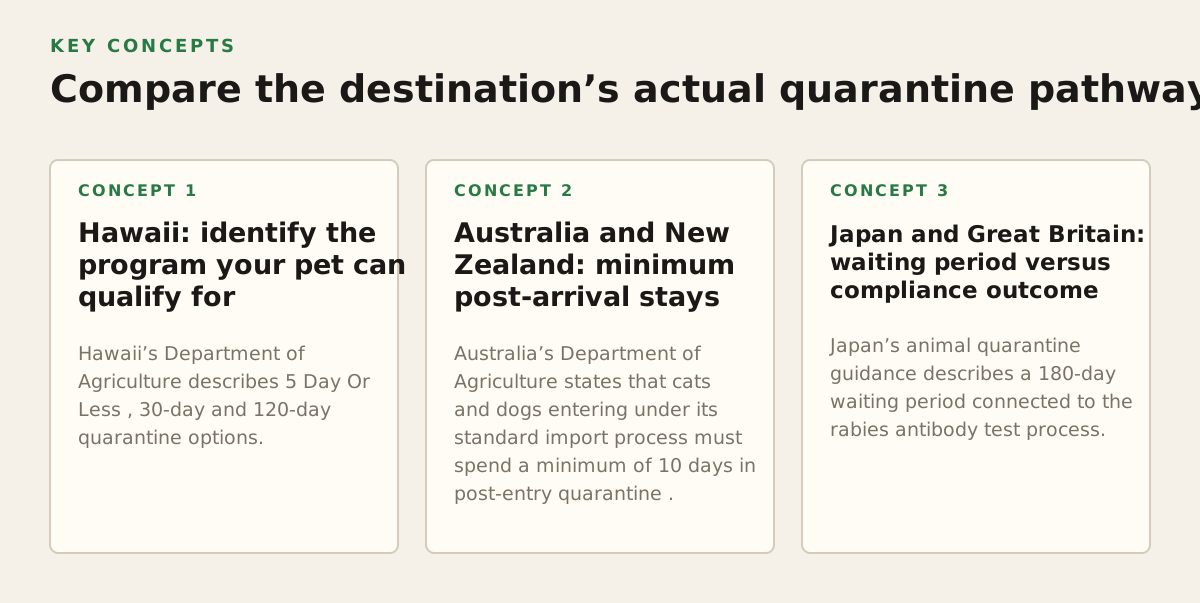
These examples concern different jurisdictions and entry systems; they are not interchangeable estimates. Eligibility, origin and completion of the required process can change which pathway applies. Use each official page to check the current conditions for your route, rather than treating a destination name or a duration in isolation as a booking guarantee.
Hawaii: identify the program your pet can qualify for
Hawaii’s Department of Agriculture describes 5 Day Or Less, 30-day and 120-day quarantine options. Direct airport release is associated with the 5 Day Or Less program when its requirements are met; it is not a blanket promise for every arriving animal. The state’s animal quarantine information explains the programs and requirements. For a move to the islands, confirm which program fits your pet and whether the necessary conditions will be satisfied before arrival.
That means the useful planning question is not simply “How long is Hawaii quarantine?” It is: Which pathway applies to this pet, and what must be complete for that pathway? Use the state’s instructions for the details that determine eligibility, and review Hawaii pet shipping for BestPetTravel’s Hawaii page. If a record, deadline or travel detail is unclear, ask the state authority rather than assuming the shortest option applies.
Australia and New Zealand: minimum post-arrival stays
Australia’s Department of Agriculture states that cats and dogs entering under its standard import process must spend a minimum of 10 days in post-entry quarantine. The department’s cats and dogs import guidance describes the process. “Minimum” is the important qualifier: it establishes a required floor, not a guaranteed release date for every individual case. Check the full import pathway as well as the facility requirement.
New Zealand’s official guidance says eligible cats and dogs from approved countries must spend at least 10 days in an approved quarantine facility. The country’s cats and dogs import guidance sets out eligibility and import steps. The stated stay does not replace those other conditions. Before setting a pet’s arrival date, verify that the pet and origin qualify and that the required pre-travel process is understood.
Japan and Great Britain: waiting period versus compliance outcome
Japan’s animal quarantine guidance describes a 180-day waiting period connected to the rabies antibody test process. The period is not automatically 180 days in a facility: if the wait and other applicable conditions are completed before arrival, the import outcome differs from a case that arrives with time still outstanding. If requirements remain incomplete, quarantine may be needed to complete the outstanding period. Read Japan’s official dog and cat import guidance for the process that applies to your pet.
For Great Britain, the government says pets that meet its entry rules do not need to go into quarantine; if the rules are not followed, a pet may be quarantined for up to four months. The government’s pet travel rules explain the requirements and consequences. This is a compliance-based distinction, not a routine facility-stay estimate. Check that page for the relevant route and entry conditions; Great Britain’s rules should not be assumed to cover every part of the United Kingdom.
For a quick comparison, keep the category beside the duration:
- Hawaii: select and qualify for a state program; do not assume eligibility for the shortest pathway.
- Australia: the standard process includes a published minimum post-entry facility stay.
- New Zealand: eligible pets from approved countries have a stated minimum facility stay.
- Japan: separate the pre-arrival waiting period from any time needed in quarantine after arrival.
- Great Britain: meeting entry rules avoids routine quarantine; noncompliance can lead to confinement.
Find the rule that applies to your pet and route
A country-level summary is a starting point, not an individual determination. Official instructions may distinguish by species, origin or travel route, and the required evidence can matter as much as the date of a veterinary appointment. For families relocating internationally, confirm the pet’s actual departure point and any transit details with the relevant authority. For Hawaii-bound households, use Hawaii’s state guidance rather than assuming that a domestic move follows the same process as travel between states on the mainland.
Build a case-specific record from the official instructions before choosing dates. Capture the exact condition, the evidence required and whether the step must be complete before the pet departs. If two instructions appear to conflict, do not resolve the discrepancy by choosing the easier interpretation; ask the authority responsible for the pet’s entry.
A useful working checklist is:
- Route and origin: record where the pet is traveling from and the route being considered, including transit where relevant.
- Eligibility: check that the destination pathway covers your species and circumstances.
- Medical and document steps: list what must be done, what proof is accepted and when each step must occur.
- Arrival outcome: identify whether the guidance calls for inspection, a minimum facility stay or a possible hold if a condition is incomplete.
- Release condition: find what the authority says must happen before the pet can leave any required facility.
For Japan, for example, the practical question is not just whether the rabies antibody test has been arranged. The owner needs to understand the official waiting period and whether it will be complete before arrival; otherwise, the remaining time may affect the post-arrival plan. The official guidance—not the date someone happens to book a veterinary visit—determines how the process is counted.
For Hawaii, the planning question shifts: which state program is appropriate, and are its conditions complete? A family that has not confirmed this should avoid treating a direct-release possibility as the default. The same principle applies elsewhere: a published minimum stay does not establish eligibility, and compliance in one part of the process does not prove that every import condition has been met.
Turn the official rule into a move calendar
Once the applicable pathway is clear, make a timeline that separates veterinary preparation, document readiness, travel, entry checks and any facility period. Put the event that starts each wait beside it, rather than writing only a target date. This is especially useful when a PCS move or corporate relocation involves different people arranging veterinary care, transport and housing.
For each requirement, note whether it is a deadline, a waiting period or a facility minimum. Those terms create different scheduling risks. A deadline tells you when something must be done; a waiting period depends on a specified start event; a minimum facility stay limits how soon release can occur. If the official wording does not make the start event or release condition clear, mark it unresolved and ask the authority.
Then coordinate the pet’s likely arrival and release with the household’s plans. A family may need to arrange a suitable place to stay while a pet is still under official control, or ensure someone can receive the animal when release is permitted. Do not promise yourself an exact reunion date when the rule gives only a minimum or allows an authority to resolve an outstanding condition.
Keep the relevant official pages and supporting records together. If a move coordinator, veterinarian or family member is handling a different part of the process, a shared file helps everyone work from the same destination instructions. When seeking a timeline from an authority or relocation professional, include the pet’s species, origin, route and completed steps. A specific question is more useful than asking for a general quarantine estimate.
Plan for the consequence of an incomplete requirement
The key exception is a pathway that turns out not to fit the pet or a requirement that is incomplete at the point of entry. Depending on the destination’s rules, the result may be a different process, additional checks or confinement. The sources above show why the consequence cannot be generalized: a minimum post-entry stay, an unfinished waiting period and a noncompliant entry are different situations with different rules.
For a military household, that distinction can affect when the pet can join the family after a PCS. See military pet shipping for BestPetTravel’s military pet shipping page, and use the destination authority’s rules to establish the pet’s entry requirements. For a family moving to Hawaii, consult the state’s program information and Hawaii pet shipping before building travel dates around a particular release pathway.
BestPetTravel provides door-to-door domestic and international pet transportation, including airline coordination, paperwork, customs support, live tracking and delivery logistics. If you need help coordinating a move, review BestPetTravel while confirming the applicable quarantine duration and entry conditions with the responsible government authority.
Authored with NotFair SEO