
Pet Import Requirements Document Checklist for International Moves
September 25, 2026
Use this pet import requirements document checklist to organize permits, health records, endorsements, transit rules, and arrival checks for a smoother move.
The pet import requirements document checklist should cover the destination country, every transit point, your pet’s identity and health records, required permits or certificates, and the carrier’s paperwork. For a 2026 move, confirm the rules with official authorities for your exact route and travel date before booking: a document accepted for one destination may not satisfy a transit country, airline, or special entry program.
This guide is for families moving overseas, military households on PCS orders, and relocation professionals coordinating a dog or cat. Use it to decide which documents apply, who must issue them, and when each must be ready. It is a planning framework, not a substitute for destination-specific instructions or veterinary advice.
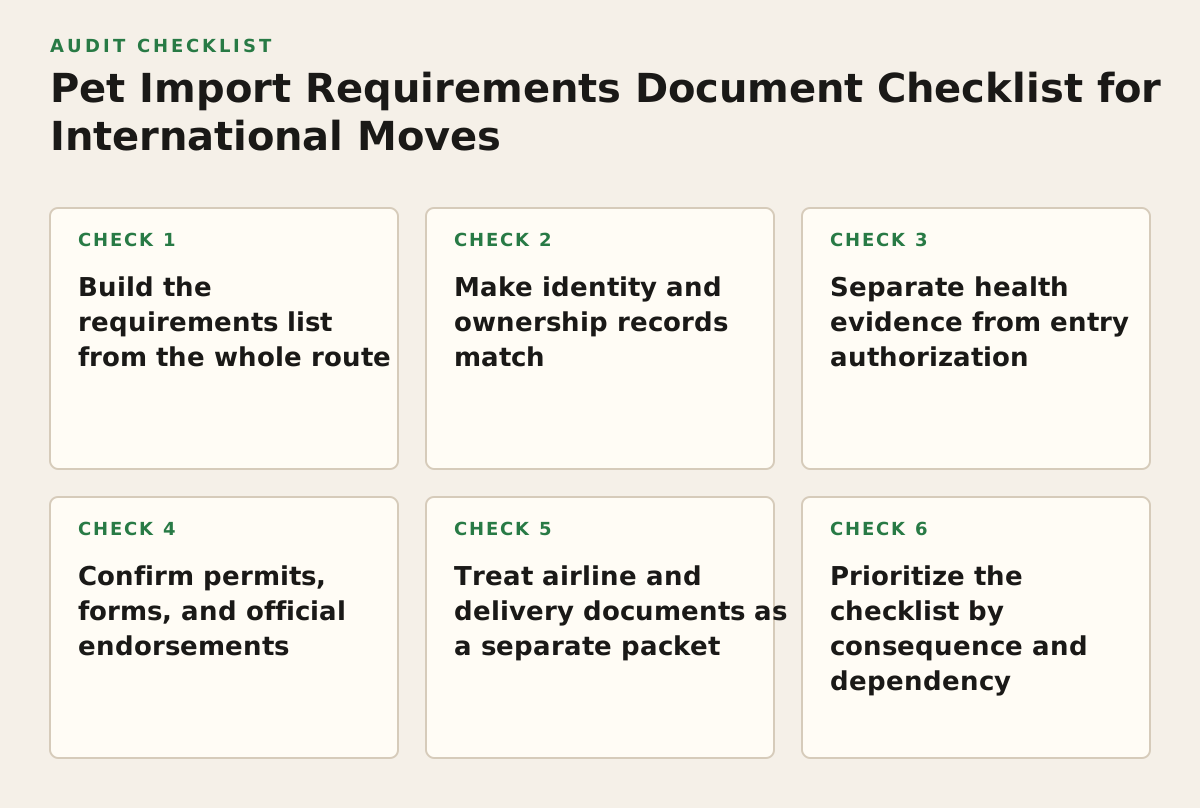
1. Build the requirements list from the whole route
When it applies: Always, and especially when a pet changes planes, enters a country temporarily, or travels separately from its owner. Start with the destination’s official import rules, then check transit-country requirements and the carrier’s conditions. A connection that looks like a simple airport transfer on a passenger itinerary can still create a documentation question if the pet must be checked in again, clear customs, or stay overnight.
Why it works: Requirements attach to different parts of a journey. A government may set entry conditions, a transit country may have its own rules, and an airline may require specific forms or handling arrangements. The USDA APHIS pet travel portal directs travelers to country-specific requirements for pets leaving the United States; use the corresponding official authority when the journey starts elsewhere (USDA APHIS pet travel). For travel within or into the EU, consult the European Commission’s pet movement guidance rather than relying on a general checklist alone (European Commission: EU legislation on pet movement).
Record each authority and each leg
- Write the origin, destination, planned transit points, and whether the pet stays airside at each connection.
- Identify the government authority that controls import rules at the destination and each relevant transit point.
- Check whether the pet’s species, age, country of origin, or travel purpose changes the requirements.
- Keep a dated note of the official page or office consulted and the rule that applies.
Failure mode: Treating “country requirements” as a single list and missing a transit condition or route-specific restriction. Implementation example: A PCS family routing a dog through a third country records the destination rule, transit rule, and airline’s connection procedure in separate rows. If the airline later changes the connection, the family can see which checks must be repeated. For military households coordinating orders and shipment dates, the military pet shipping planning page can help frame the transport logistics alongside the document review.
2. Make identity and ownership records match
When it applies: For any pet crossing a border, and whenever the owner’s name, the pet’s registered details, or the person traveling with the animal differs across records. Import paperwork is easier to verify when the pet can be consistently matched to its supporting documents.
Why it works: Officials and carriers may compare the pet’s identification details across veterinary records, certificates, permits, and travel documents. A typo in a microchip number or a name mismatch can turn an otherwise complete file into a correction request. Treat the pet’s identifying information as a master record, not something to retype from memory on each form.
Create a controlled identity sheet
- Copy the pet’s name, species, breed or description, sex, age or date of birth, color, and microchip number from source records.
- Record the owner’s legal name and contact details exactly as they appear on relevant travel documents.
- Note who is accompanying the pet and whether an authorization or proof of relationship is needed for that arrangement.
- Compare each draft form against the source records before a veterinarian or authority signs it.
Failure mode: A certificate uses one microchip digit incorrectly, or a traveling family member’s name is substituted for the owner’s without checking the destination’s rules. Implementation example: An executive relocating with a cat gives the veterinarian a one-page identity sheet copied from the microchip record and passport, then checks the completed certificate line by line before it is finalized. Keep original records and a legible digital copy, but do not assume a scan replaces an original when a rule calls for a signed or endorsed document.
3. Separate health evidence from entry authorization
When it applies: When a destination asks for vaccination evidence, a health certificate, parasite treatment, testing, or other veterinary documentation. The specific combination depends on the route and the animal; a vaccination record alone is not automatically an import authorization.
Why it works: Each document proves a different thing. A vaccination record documents a veterinary history; a health certificate records an examination or required statements; a test result documents a laboratory finding. The destination authority determines what evidence it accepts and whether it must be issued or completed within a defined period. Ask the issuing veterinarian to work from the official destination instructions, not from a form used for a different country.
For dogs entering the United States, CDC requirements depend in part on the dog’s travel history and other circumstances, so check the current CDC instructions for the individual trip rather than assuming a standard health record is enough (CDC: Bringing a dog into the United States). This is particularly important for a family returning from an overseas assignment: the origin of the return flight does not necessarily tell the whole story of where the dog has been.
Use a document-to-purpose check
- Vaccination evidence: verify the pet’s identity, product details, administration date, and any required validity period against the rule.
- Health certificate: confirm who may issue it, what examination or declarations are required, and whether it needs official endorsement.
- Test or treatment record: match the pet’s identity and result or treatment details to the destination’s stated requirements.
- Supporting history: retain prior certificates and records when the route’s rules depend on earlier events or travel history.
Failure mode: Scheduling a veterinary appointment based on a generic “international certificate” assumption, then discovering that a required test or treatment must occur in a particular sequence. Implementation example: A veterinarian preparing a dog for a move checks the destination’s current rule first, then marks each required record as “needed,” “not applicable,” or “authority confirmation required” before booking any time-sensitive clinical step.
4. Confirm permits, forms, and official endorsements
When it applies: When the destination requires an import permit, a government certificate, an official endorsement, a customs declaration, or a specific entry form. These are distinct steps: a permit may authorize entry, a certificate may attest to health conditions, and an endorsement may be a separate government action.
Why it works: Assigning an owner to each document prevents the common mistake of assuming that one signature completes the entire process. APHIS explains that U.S. export documentation and endorsement depend on the destination’s requirements; its country-specific guidance is the appropriate starting point for pets departing the United States (USDA APHIS pet travel requirements). If the animal is departing another country, identify that country’s competent authority instead.
Failure mode: A form is completed but not submitted to the agency that must approve or endorse it, or an application is prepared with a planned itinerary that later changes. Implementation example: For a government or diplomatic relocation, the coordinator assigns a named owner to the permit, the veterinary certificate, and any endorsement. The family keeps the permit approval separate from the certificate so that a change to one does not obscure the status of the other.
Make ownership visible
- For each item, record the issuing party, responsible person, submission method, required original or copy, and current status.
- Ask the issuing authority whether the form version and signature method are acceptable for the planned route.
- Record the permitted itinerary and check whether a route or date change requires an amendment or new approval.
- Carry contact details for the relevant issuing office and the person coordinating the move.
For a cat or dog moving to Hawaii, use the Hawaii Department of Agriculture’s current animal quarantine instructions to determine the applicable entry pathway and required documents; do not assume that U.S. domestic travel means no special preparation (Hawaii Department of Agriculture: Animal quarantine information). Owners arranging Hawaii pet shipping should coordinate the official checklist with the route and arrival plan.
5. Treat airline and delivery documents as a separate packet
When it applies: Whenever an airline, ground carrier, customs broker, or delivery provider is involved. Government approval does not by itself reserve space, confirm acceptance conditions, or communicate who will collect the pet at arrival.
Why it works: Transport documents solve operational questions that import permits do not: which pet is booked, who hands the animal over, where it is collected, and who can act if the itinerary changes. Ask the carrier or transport coordinator for its current requirements, because the accepted paperwork and process can vary with route, aircraft, and service arrangement.
Keep the handoff details with the travel file
- Save the booking confirmation and written carrier instructions for the pet’s route.
- Record the shipper, consignee, emergency contact, and the person authorized to collect the pet.
- Confirm how originals travel, which documents must be attached to the travel container or presented at check-in, and which stay with the owner.
- Write down the arrival handoff, customs contact, local delivery address, and a backup contact.
Failure mode: The import file is complete, but the arrival contact is unreachable or the collection person lacks the documents the carrier expects. Implementation example: A corporate relocation manager sends the family, veterinarian, and transport coordinator the same final itinerary sheet, with document custody clearly marked: “traveler carries,” “travels with pet,” or “provided to arrival agent.” Treat those labels as a coordination aid, not as permission to omit documents required by authorities.
6. Prioritize the checklist by consequence and dependency
When several people are preparing a move, a flat list hides what can block everything else. Use the framework below to sequence work by dependency and consequence. It is a starting policy, not a universal timeline: set dates from the actual authority’s instructions and the confirmed itinerary.
| Priority | Document or decision | Why it comes here | Owner and completion evidence |
|---|---|---|---|
| Route gate | Destination, transit, species, and entry-pathway requirements | Defines which other documents and steps apply | Relocation lead; dated official-rule notes |
| Identity gate | Microchip and consistent pet and owner details | Errors can carry into every later form | Owner or veterinarian; checked identity sheet |
| Clinical gate | Vaccines, examinations, tests, or treatments required by the route | May affect which certificate can be issued and when | Veterinarian; source records and results |
| Authority gate | Permit, certificate, endorsement, or arrival form | May require a separate application, signature, or approval | Named applicant; approved copy or submission receipt |
| Transport gate | Carrier booking, document custody, customs, and collection plan | Connects paperwork to actual handoffs | Transport coordinator; written itinerary and contacts |
Failure mode: Marking an item “done” because someone started it, even though the authority has not approved it or the final document has not been issued. Implementation example: Use three statuses—“not started,” “in process,” and “verified complete”—and require the evidence in the final column before closing a row. If an authority’s rule is unclear, mark the item “confirmation required” and ask the authority; do not convert an assumption into a completed task.
7. Use a staged implementation plan before departure
Apply the checklist in order and reopen it whenever the route, travel date, pet, or person accompanying the animal changes. For a move planned in 2026, verify that the official source is current at each decision point; an old saved checklist is useful for tracking, not proof that the rule remains in force.
- Define the itinerary. List every country and connection, the pet’s travel mode, and the intended arrival and collection arrangement.
- Verify official rules. Check the destination and relevant transit authorities, noting the source, date checked, and any rule that needs confirmation.
- Lock the identity record. Compare the pet’s identification and owner details with the original records before forms are drafted.
- Ask the veterinarian to map clinical requirements. Provide the official instructions and ask which records, tests, examinations, or treatments apply and in what order.
- Assign each approval. Name the person responsible for permits, certificates, endorsements, and required forms; track evidence of completion rather than relying on verbal updates.
- Confirm transport and handoffs. Reconcile the carrier’s written instructions with the approved route, document custody, arrival contact, and collection plan.
- Perform a final cross-check. Compare names, microchip details, dates, route, signatures, and originals against the itinerary. Recheck after any change.
Failure mode: Completing the checklist once and not revisiting it after a flight change, delayed departure, or change in who accompanies the pet. Implementation example: A family whose connection changes pauses document closeout, checks whether the new transit point changes any rule, and updates the itinerary sheet before distributing the final packet. For complex international, PCS, or Hawaii moves, BestPetTravel can coordinate transportation, paperwork, customs support, tracking, and delivery logistics; see BestPetTravel when you need help connecting the document plan to the physical move.
Authored with NotFair SEO