
Pet Delivery Service: How to Choose Safe, Compliant Pet Transport
September 14, 2026
Compare a pet delivery service by route, paperwork, handling, price model, and risk so your dog or cat reaches its new home with fewer surprises.
A pet delivery service is a coordinated transportation arrangement that moves a dog or cat between specified locations while managing the handoffs, travel documents, carrier requirements, and delivery appointment. For a military PCS, overseas assignment, corporate relocation, diplomatic move, or Hawaii transfer, the real purchase is not simply an airline ticket. It is a plan for the animal’s eligibility, routing, custody, exceptions, and arrival.
The useful question is therefore not “Who can ship my pet?” It is “Which level of coordination matches this route, this animal, and my tolerance for administrative risk?” A local ground courier may be ideal for a short domestic move. An international relocation coordinator may be justified when several authorities, airlines, customs procedures, and timed documents are involved. This guide explains how to compare those choices without treating one service model as universally best.
What a Pet Delivery Service Actually Includes
Pet transport is an interlocking chain of custody. One party may collect the animal, another may handle an airport handoff, an airline may carry the pet, and a destination representative may complete customs or final delivery. A competent provider should make those handoffs visible rather than reducing the job to “door to door” as if every segment were performed by one team.
The main service categories
- Local or regional ground transport: A driver collects and delivers the pet by vehicle, often for a veterinary appointment, airport transfer, boarding move, or domestic relocation within a manageable driving radius.
- Domestic door-to-door transport: A coordinator may combine ground legs with domestic air travel and arrange pickup and delivery around the airline’s acceptance rules.
- International relocation coordination: The provider manages route research, document sequencing, airline coordination, destination requirements, customs support, and delivery logistics.
- Government, military, or diplomatic relocation support: The work may include strict reporting dates, reimbursement documentation, limited flight options, family travel coordination, and discreet communication.
- Special-case transport: Senior animals, brachycephalic breeds, multiple pets, oversized crates, animals requiring medication instructions, or routes with unusual embargoes need an individual feasibility review.
These categories overlap, but they do not carry the same implementation burden. A ground-only booking can often be planned around a pickup window. International transport may require a veterinary examination, an official certificate, an endorsed document, a specific arrival airport, and a destination inspection or quarantine process. The United States Department of Agriculture’s Animal and Plant Health Inspection Service directs owners to destination-country requirements and explains that documents may need endorsement before travel; requirements vary by destination and can change. See the USDA APHIS pet travel guidance.
What the buyer is really purchasing
Ask a provider to separate its work into four deliverables:
- Eligibility: Can this animal legally enter the destination on the proposed date and route?
- Execution: Who books, collects, transfers, monitors, and delivers the pet?
- Evidence: Which confirmations, receipts, certificates, and handoff records will you receive?
- Recovery: What happens if a flight is canceled, a document is rejected, weather interrupts the route, or the pet misses a connection?
This separation prevents a common misunderstanding: paperwork assistance is not the same as physical transport, and airline booking is not the same as end-to-end custody. Your quote should identify which tasks are included, which are passed to third parties, and which remain your responsibility.
Why the Service Model Matters for Relocation Decisions
Choosing badly usually creates a timing or handoff problem, not an obvious failure at checkout. A low-touch option can look efficient until the owner discovers that a destination form had to be issued within a narrow period, the selected airline would not accept the breed or crate, or the delivery address was inaccessible after customs release.
Route complexity is the first buying variable. Count the authorities and transitions, not just the miles. A domestic move involving one driver and one address has a different risk profile from an overseas move involving a veterinarian, government endorsement office, airline cargo desk, customs broker, and destination delivery partner.
Different buyers face different failure costs
- Military families: A PCS schedule can be tied to report dates, household-goods movement, temporary lodging, and reimbursement rules. A provider should explain how it documents eligible charges and what happens if official travel changes.
- Internationally relocating families: The main risk is usually sequence control. A microchip record, vaccination, test, certificate, or endorsement may need to precede the next step. The provider should give a dated document matrix rather than a generic checklist.
- Hawaii-bound or Hawaii-departing owners: Hawaii has destination-specific animal quarantine rules. The state’s Animal Industry Division publishes its requirements and forms through its official animal quarantine information page. Treat Hawaii pet shipping as a regulated entry project, not merely a domestic flight.
- Corporate and executive relocations: The priority may be schedule resilience, one accountable coordinator, confidential handling of addresses, and a documented fallback if the preferred itinerary disappears.
- Veterinarians and relocation professionals: The practical need is a provider that can receive accurate records, state exactly what the clinic must issue, and avoid asking the clinic to interpret an unfamiliar destination process.
There is also an animal-specific risk calculation. A healthy adult cat accustomed to a carrier may tolerate a straightforward route differently from an elderly dog, a flat-faced breed, or an animal with a history of travel anxiety. The provider should not promise that transport is risk-free. Instead, it should identify the airline’s acceptance conditions, veterinary questions, temperature exposure, rest points, and the owner’s authority to approve a reroute.
Use measurable success criteria
Before comparing quotes, write down what “successful delivery” means. Useful criteria include:
- The pet is accepted only after the required documents and carrier specifications are verified.
- Each custody transfer has a named party, time window, and confirmation method.
- The owner receives status updates at agreed milestones rather than vague reassurance.
- Any delay triggers a documented escalation path and a decision about food, water, temperature, and shelter.
- The final handoff records the recipient, location, time, and visible condition of the pet.
These are service-level expectations, not guarantees of an uninterrupted journey. They give a family, employer, or relocation manager something observable to review after delivery.
How Pet Delivery Works From Intake to Handoff
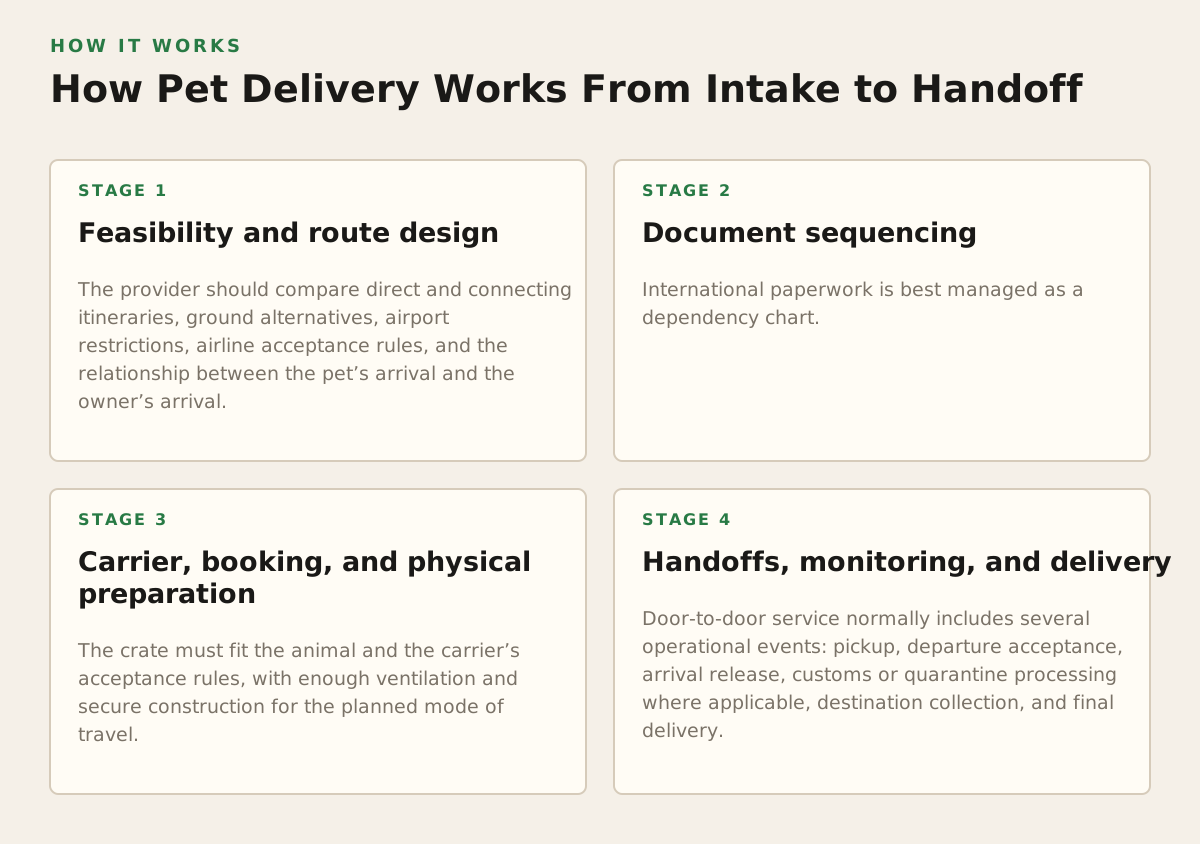
A reliable plan starts with intake, not with a preferred departure date. The coordinator should collect the animal’s identity, species, breed, age, weight, medical considerations, microchip information, crate dimensions, origin, destination, owner travel plans, and desired delivery window. For international journeys, the destination country and transit points determine which requirements must be researched.
1. Feasibility and route design
The provider should compare direct and connecting itineraries, ground alternatives, airport restrictions, airline acceptance rules, and the relationship between the pet’s arrival and the owner’s arrival. A route is not genuinely feasible merely because a booking engine displays seats. Airlines may impose restrictions based on aircraft type, season, temperature, breed, crate size, or cargo acceptance.
For dogs entering the United States, the Centers for Disease Control and Prevention maintains current entry requirements that can include documentation, age, microchip, vaccination, and country-specific conditions. Requirements can depend on where the dog has been during the relevant period, so a coordinator should verify the animal’s travel history rather than rely on a single generic checklist. The CDC dog importation guidance is the appropriate primary reference for that determination.
2. Document sequencing
International paperwork is best managed as a dependency chart. For example, one record may be needed before a test, a test before an official certificate, and the certificate before airline acceptance. Some documents are issued by a private veterinarian; others may require government endorsement or destination submission.
A useful tracker includes:
- Requirement and issuing authority
- Pet or traveler information that must match exactly
- Earliest issue date and expiration or validity rule
- Person responsible for obtaining it
- Upload, mailing, endorsement, or presentation method
- Backup action if the document is delayed or rejected
Do not let a provider say only that it “handles paperwork.” Ask whether it prepares forms, reviews clinic records, submits documents, obtains endorsements, monitors approvals, or merely tells you where to apply. Those are different workloads and should be visible in the scope of service.
3. Carrier, booking, and physical preparation
The crate must fit the animal and the carrier’s acceptance rules, with enough ventilation and secure construction for the planned mode of travel. The animal should be acclimated to the crate well before departure, but a provider should not prescribe sedatives casually. The American Veterinary Medical Association cautions that sedation or tranquilization can increase travel risks and may be restricted or refused by airlines; owners should discuss the animal’s health and travel plan with a veterinarian. See the AVMA pet travel guidance.
The booking file should state who confirms acceptance. “The flight is reserved” is not necessarily the same as “the airline has accepted this pet under the correct service.” Request the airline confirmation, cargo or checked-travel instructions where applicable, crate specifications, drop-off location, and cutoff time.
4. Handoffs, monitoring, and delivery
Door-to-door service normally includes several operational events: pickup, departure acceptance, arrival release, customs or quarantine processing where applicable, destination collection, and final delivery. A live-tracking promise is useful only when the provider explains what is tracked and how often an exception is escalated. GPS on a vehicle cannot by itself confirm airline acceptance or customs release.
For a delivery appointment, confirm the recipient’s identity, contact number, address access, parking or building restrictions, and what happens if nobody is present. For a family in temporary lodging or a military installation, delivery logistics may require gate access instructions and a backup contact.
Where Pet Transport Plans Break Down
Most avoidable failures occur at the seams. The owner may believe the veterinarian, airline, coordinator, and destination agent are working from one file when each actually holds a different version. A strong provider creates one source of truth for names, dates, microchip details, itinerary, and emergency contacts.
Frequent failure points
- Document mismatch: A name, microchip number, date, or address differs across the certificate, booking, and identification record.
- Unverified airline acceptance: The itinerary exists, but the pet has not been accepted for that specific aircraft, route, crate, or travel date.
- Transit-country assumptions: A connection is treated as neutral even though the animal may be subject to transit rules or a change of custody.
- Temperature and weather disruption: A route becomes unsuitable near departure, and no alternate ground, flight, or holding plan exists.
- Customs timing: The pet arrives outside the operating hours of the relevant clearance or inspection process.
- Delivery ambiguity: The destination address is technically correct but inaccessible, unstaffed, or different from the release location.
- Medical overconfidence: A provider gives health or sedation advice beyond its role instead of coordinating with the veterinarian.
When a provider describes a “guaranteed” delivery date, ask what is actually guaranteed. A company can control its own pickup window and communication process more readily than it can control an airline cancellation, government inspection, weather event, or border decision. Prefer precise commitments—such as notification timing and escalation ownership—to absolute promises outside the provider’s control.
How to evaluate contingency planning
Request a written answer to three scenarios: the airline cancels the flight, the destination authority rejects a document, and the pet arrives before the receiving party can collect it. The answer should identify who makes decisions, which costs require your approval, where the pet stays, how food and water are handled, and how you will be contacted.
For example, an illustrative planning exercise might assign four decision checkpoints: 30 days before departure for route feasibility, 14 days for document completion, 72 hours for final acceptance, and departure day for weather and handoff confirmation. These are not universal deadlines or regulatory benchmarks. They simply show how a household can create escalation points rather than discovering problems at the airport.
Red flags include:
- A quote that names a destination but not the actual origin, airport, route, pet size, or travel date.
- Pressure to book before the provider verifies entry conditions.
- No named person responsible for document review.
- Unclear separation between included services, pass-through charges, and optional services.
- Refusal to explain cancellation, delay, or rebooking responsibilities.
- Claims of universal airline access, risk-free travel, or guaranteed government approval.
How to Compare Service Types, Quotes, and Budgets
Price should be evaluated as a route-specific scope of work, not as a universal rate for “pet shipping.” A quote may combine professional fees, airline or cargo charges, ground transport, crate costs, veterinary work, government endorsements, customs or inspection charges, storage, taxes, and emergency changes. Some items may be paid directly by the owner or may change after the route is finalized.
| Buyer need | Service type to consider | Main trade-off |
|---|---|---|
| Short domestic transfer with a flexible schedule | Ground courier or limited coordination | Often simpler, but distance, rest stops, and delivery windows may be less predictable. |
| Domestic move involving an airline and two addresses | Domestic door-to-door coordination | More handoff oversight, but additional coordination and pass-through charges. |
| International move with certificates, endorsements, or customs | International relocation coordination | Higher administrative burden, but less document-sequencing work for the owner. |
| PCS or government move with fixed reporting dates | Military or institutional relocation support | Better alignment with orders and records, but reimbursement and approval rules must be confirmed. |
| Hawaii route with destination-specific entry requirements | Hawaii-focused transport coordination | Requires careful timing and compliance; a normal domestic booking may not address entry processing. |
| Senior, brachycephalic, oversized, or medically complex pet | Custom feasibility review with veterinary involvement | Fewer acceptable routing options and greater need for contingency planning. |
Budget without invented market prices
Do not accept a vague “starting at” figure as a planning budget. Obtain route-specific written quotes from providers that have the animal’s details, origin, destination, travel window, crate dimensions, and required service level. Then request a separate contingency estimate for likely changes such as a rebooked flight, extra ground leg, overnight holding, document correction, or delivery outside the original window. A contingency estimate is a planning tool, not a promise that those charges will occur.
If you need to build an internal approval request before final quotes arrive, use this clearly labeled illustrative budget framework, not a market benchmark:
- Regulatory and veterinary: list examinations, vaccinations, tests, certificates, endorsements, permits, and destination inspections as separate line items.
- Transport: separate airline or cargo charges, ground collection, airport transfers, destination delivery, and any crate or handling costs.
- Coordination: identify the provider’s professional fee and exactly which communications, document reviews, bookings, and handoffs it covers.
- Contingency: create a reserve line for one plausible disruption, but ask the provider to explain the assumption rather than treating a percentage as a universal rule.
- Owner-paid exclusions: record items such as personal travel, boarding, hotel changes, or fees paid directly to government agencies.
For a hypothetical approval sheet, you might show five line-item categories, two quote scenarios—standard route and disrupted route—and a blank contingency amount pending the provider’s written estimate. The numbers in that worksheet should come from your actual quotes and official fees. Avoid inserting a supposed industry average when no route, country, airline, animal, or date has been specified.
Questions to ask before signing
- Which tasks are included from my address to the final delivery address?
- Who verifies destination entry requirements, and when will I receive the written checklist?
- Who books the airline segment, and how is pet acceptance confirmed?
- Which charges are fixed, estimated, pass-through, or excluded?
- What information would cause the quote or route to change?
- Who owns the decision during a cancellation, delay, rejected document, or missed connection?
- How and when will status updates be sent?
- What records will I receive after each handoff and after final delivery?
- What are the cancellation, rebooking, refund, and emergency-approval terms?
- Can you describe a route you would decline and why?
How Practitioners Should Apply the Decision
Start with a one-page case brief. Include the pet’s species, breed, age, weight, health considerations, microchip status, crate dimensions, origin, destination, owner travel date, required arrival window, and whether the move is military, corporate, diplomatic, or personal. This lets providers quote the same problem instead of producing incomparable summaries.
For a PCS household, attach orders or the relevant reporting constraint only through a secure process and ask the provider to distinguish reimbursable documentation from transport planning. Families researching military pet shipping should also ask how the plan handles a change in report date, temporary lodging, installation access, or a split itinerary.
For an international family, ask the veterinarian and coordinator to work from the same document matrix. Do not schedule the final examination merely because the calendar looks convenient; first verify the destination’s validity windows and endorsement path. Official requirements should be rechecked close to travel because authorities can update entry rules. USDA APHIS provides destination-specific resources, while CDC requirements apply to dogs entering the United States; use the relevant authority for the actual route rather than relying on an old checklist. See the USDA APHIS guidance and CDC requirements.
For a Hawaii move, make the destination authority’s process the organizing constraint. Confirm which forms, identification, veterinary actions, inspection arrangements, and arrival conditions apply to the island and airport involved. A transport coordinator can manage sequence and handoffs, but the owner remains responsible for supplying accurate information and authorizing required veterinary care.
For a corporate or diplomatic relocation, define communication boundaries at intake. State who may receive itinerary details, which address should appear on delivery paperwork, who can approve an emergency reroute, and whether the employer or relocation firm needs invoices in a particular format. Discretion is best treated as an operating requirement—limited access, accurate contacts, and controlled sharing—not as a vague marketing adjective.
Finally, score providers against the same evidence:
- Written route feasibility and assumptions
- Clear service boundaries and named responsibilities
- Document tracker with dates and owners
- Airline acceptance and crate plan
- Contingency procedure with approval rules
- Transparent quote structure and exclusions
- Communication schedule and handoff records
The most defensible choice is usually the provider whose plan makes uncertainty visible. For a simple move, that may be a focused ground service. For a multi-authority international, military, or Hawaii route, choose a coordinator that can connect paperwork, airline arrangements, customs support, live status communication, and final delivery without hiding the limits of its control.
BestPetTravel provides door-to-door domestic and international pet transportation, including airline coordination, paperwork, customs support, live tracking, and delivery logistics. If your move involves a PCS assignment, Hawaii, or an overseas relocation, BestPetTravel can help you turn the route into a documented plan with clear responsibilities.
Authored with NotFair SEO