
Military Pet Shipping Kennel Acclimation Plan for PCS Travel
November 1, 2026
Use this military pet shipping kennel acclimation plan to choose the travel crate, build calm practice in stages, and know when to slow down before PCS travel.
A military pet shipping kennel acclimation plan pairs the kennel confirmed for your itinerary with gradual, reward-based practice and a record of how your pet responds. Start by checking the travel requirements, then build from voluntary exploration to short periods of door closure and movement. The practical outcome is a household plan that shows what your pet can currently manage—and when to pause, adjust, or seek veterinary advice before a PCS move.
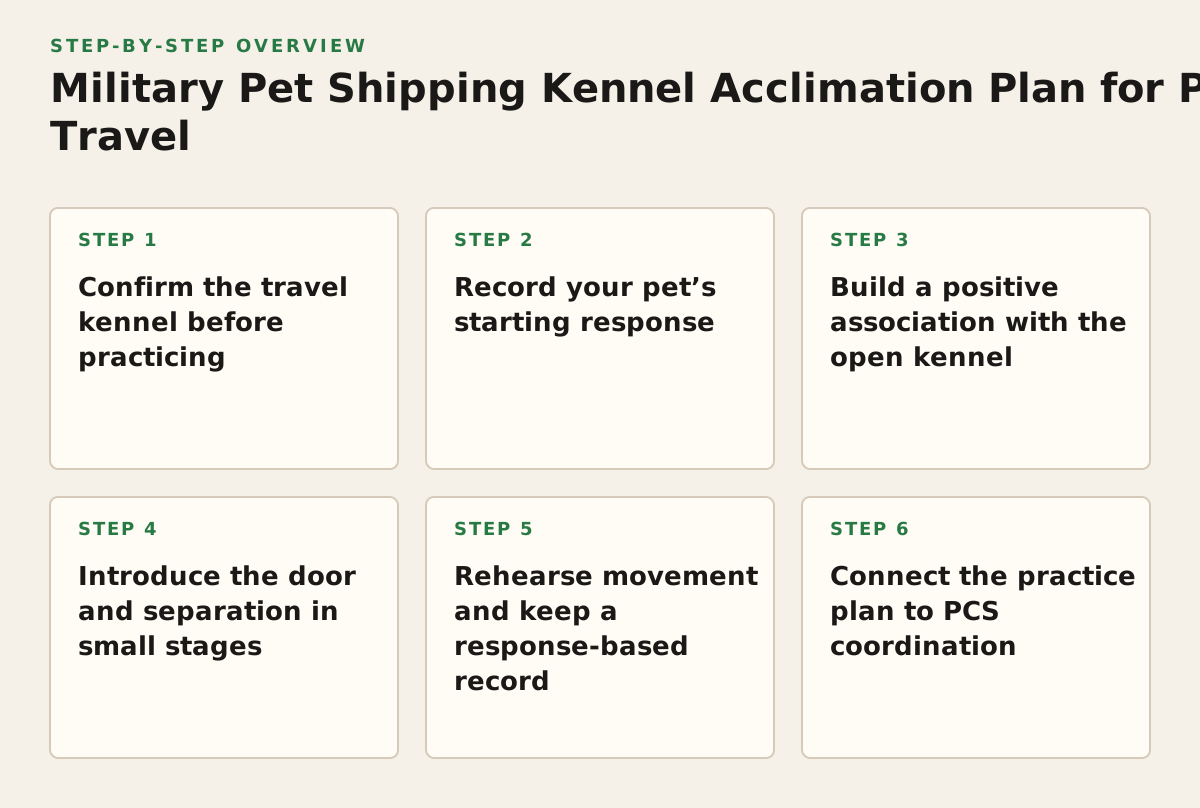
Step 1: Confirm the travel kennel before practicing
Train with the setup your itinerary actually requires
Ask the airline or the party coordinating your move which kennel specifications and restrictions apply to your pet and route. Check the required kennel type and dimensions, and ask about ventilation, labeling, and permitted accessories. IATA publishes general guidance for containers used to transport live animals, but the operating airline’s instructions govern your specific booking; see IATA’s pet travel information and confirm details with the carrier.
For an international move, verify destination entry requirements separately. USDA APHIS explains that requirements depend on the destination, so a kennel that suits one leg does not establish that your paperwork or arrangements are complete for another. Use the USDA APHIS pet travel guidance to identify the relevant destination instructions, then confirm them with the appropriate authorities. For a Hawaii move, the Hawaii pet shipping page is a starting point for planning, not a substitute for current entry requirements.
Once you identify the travel kennel, set it up at home and keep it available for calm, optional exploration. Record any carrier restrictions that affect what may go inside. A familiar blanket or reward may help during practice, but do not assume it can travel in the kennel unless the carrier or transport coordinator permits it.
Step 2: Record your pet’s starting response
Describe what you can observe, not what you hope the kennel means
Before beginning a progression, watch how your dog or cat responds to the open kennel. Note whether they approach, sniff, enter, take food nearby, or move away. Also write down behaviors that appear when your pet is uncomfortable, such as trembling, hiding, persistent vocalizing, pawing at the door, or refusing a normally valued treat. A behavior by itself does not diagnose a medical issue; a repeated change can help you see that a practice step is too difficult.
Keep a short baseline that anyone helping with the move can understand:
- Current response: approaches freely, enters only for food, avoids the kennel, or appears distressed.
- Possible triggers: door movement, household noise, handling, being alone, or vehicle motion.
- What helps: a familiar reward or item, if allowed in the kennel during travel.
- Health questions: breathing, mobility, anxiety, or other concerns to raise with your veterinarian.
Contact your veterinarian if your pet panics, attempts to escape, injures themselves, or has a health concern that could affect travel. The AVMA recommends discussing travel plans with a veterinarian; its traveling-with-your-pet guidance can help you prepare questions. Do not use medication or sedatives to make kennel practice easier without veterinary direction and confirmation that the travel provider permits the plan.
Step 3: Build a positive association with the open kennel
Let your pet choose whether to approach
Place the kennel in a relatively quiet area and secure its door so it cannot swing or latch unexpectedly. Begin with a reward near the entrance. If your pet approaches comfortably, reward that choice; later, place the reward farther inside. Keep the door open so entering and leaving remain voluntary. Do not push, pull, or carry a reluctant pet into the kennel: that may make the kennel predict restraint instead of a positive experience.
For a cat, leave the carrier available between practice sessions rather than bringing it out only for a stressful trip. International Cat Care’s cat travel guidance discusses preparing a cat’s carrier as part of travel preparation. For either species, use a reward your pet already enjoys and keep the environment manageable; a new noise or visitor may make it harder to judge the kennel response.
Advance when your pet voluntarily enters and exits and can remain relaxed inside with the door open. Make it easier when they freeze, rush out, or stop taking a reward they normally want. Move the reward toward the entrance, reduce nearby activity, or end the session and try again under calmer conditions.
Step 4: Introduce the door and separation in small stages
Change one challenge at a time
When open-door entry is comfortable, first move the door slightly without closing it. Reward calm behavior and return the door to its open position. Later, close it briefly while you remain beside the kennel. Add distance or briefly step out of view only after your pet can stay settled with the door closed. Separating these steps helps you notice whether the door, confinement, or your absence is causing difficulty.
- Move the door a little, then reopen it while your pet remains calm.
- Close it briefly while staying beside the kennel; open it before distress builds.
- After calm repetitions, take a small step away and return.
- If your pet remains settled, try a brief moment out of view before building further.
Illustrative starting policy: you might begin with a door-closed interval of about 5–10 seconds while staying nearby. This is an example, not a standard or required schedule. If your pet tenses, paws, or vocalizes persistently, shorten the interval or return to door movement without latching. If they remain relaxed across repeated attempts, a small increase may be reasonable. Do not leave a distressed pet to “cry it out.” RSPCA crate-training guidance for dogs also describes gradual, positive introduction rather than using the crate as punishment; see its crate-training advice.
Step 5: Rehearse movement and keep a response-based record
Make the next practice step depend on the last one
After your pet can settle with the door closed, practice a manageable part of the travel routine, such as moving the kennel a short distance. If that goes well, consider other relevant practice, such as household sounds or a short vehicle trip when appropriate. Avoid adding several new challenges at once: a pet may tolerate the kennel at home but respond differently when it moves. If movement leads to distress or signs of illness, stop and consult your veterinarian before repeating it.
Worked example—illustrative starting policy: a dog enters voluntarily and stays relaxed while the door is open. The family closes the door for about 5–10 seconds while staying beside the kennel, then opens it while the dog is calm. After repeated comfortable sessions, they try a brief step out of view. They write down the dog’s response instead of advancing because a calendar says it is time. Those intervals are examples only; shorten them at signs of stress and increase gradually only when the dog remains settled.
| Practice stage | Illustrative starting policy | Signal to adjust |
|---|---|---|
| Open kennel | Offer calm opportunities to investigate. | If your pet avoids it, move the reward closer to the entrance or reduce activity nearby. |
| Door movement | Move the door without latching it. | If your pet startles or retreats, make the movement smaller and slower. |
| Door closed | Try about 5–10 seconds beside the kennel. | If your pet tenses or paws, reopen sooner and return to an easier step. |
| Movement | Try a short carry only after closed-door practice is comfortable. | If motion causes distress or illness, stop and ask your veterinarian about next steps. |
These are illustrative starting policies, not airline rules, benchmarks, or a mandatory timetable. Track the last comfortable stage and the behavior that followed each change. That record lets family members and the move coordinator distinguish a completed practice step from one that still needs work.
Step 6: Connect the practice plan to PCS coordination
Share what is known and what still needs confirmation
Acclimation does not replace airline approval, travel paperwork, or destination preparation. Share the kennel details and your pet’s current tolerance with the person coordinating the move. For a household using military pet shipping resources, keeping the practice record alongside PCS planning materials can help family members refer to the same notes.
- Confirm the kennel and any restrictions with the airline or transport coordinator.
- Keep the last comfortable practice stage and observed stress signals in writing.
- Ask your veterinarian about fitness to travel, anxiety, and medication questions.
- Verify destination documents and timing with the relevant official authorities.
- If the route, kennel, or household setup changes, reassess the practice rather than assuming the previous response will carry over.
A changed itinerary or kennel may change what your pet encounters, so treat the record as a guide to the next practice step—not proof that travel will be stress-free. The useful plan is the one that helps your family notice a problem early and adjust before departure.
First, confirm the kennel for your itinerary
Before the next training session, ask the airline or move coordinator to confirm the kennel specifications and restrictions for your pet’s route. Set up that kennel at home, record your pet’s initial response, and begin with voluntary exploration rather than closing the door. BestPetTravel provides door-to-door domestic and international pet transportation, including airline coordination, paperwork, customs support, live tracking, and delivery logistics. If you need help coordinating the transport side of a PCS move, contact BestPetTravel and keep kennel acclimation decisions grounded in your pet’s response and your veterinarian’s guidance.
Authored with NotFair SEO