
International Pet Shipping Rates: How to Estimate and Control Your Move
September 16, 2026
Understand international pet shipping rates, cost drivers, paperwork risks, and quote questions for PCS, family, executive, and Hawaii pet moves.
International pet shipping rates are not a single fare for putting a dog or cat on an airplane. They are the combined cost of preparing an animal for entry, reserving compliant transportation, moving the pet between addresses and airports, and managing the documents and handoffs that make the itinerary legal and workable. For a military family, executive relocation, diplomatic move, or Hawaii transfer, the useful question is not “What is the average price?” but “Which services and risks are included in this route-specific estimate?”
This distinction matters because two moves with the same origin and destination can require different work. A 12-pound cat traveling in an airline-compliant carrier may need a simpler plan than a large dog whose kennel cannot fit as checked baggage. A PCS move may involve government documentation and a tight reporting date. A Hawaii arrival may turn on inspection, quarantine, and document timing. The sections below explain how to read a quote, identify avoidable cost exposure, and decide when professional coordination is worth the fee.
What International Pet Shipping Rates actually measure
A rate is best understood as a route-specific service estimate, not a universal price list. It should translate the physical and regulatory requirements of one animal moving between two particular locations into identifiable cost layers. The estimate may contain confirmed charges, estimated third-party charges, and conditional items that apply only if a document, inspection, routing, or carrier rule creates additional work.
The five cost layers behind a quote
- Transport capacity: the airline, cargo or passenger arrangement, applicable animal-handling charge, and any approved carrier or kennel requirement.
- Ground movement: pickup, delivery, airport transfers, border handoffs, and local driving on one or both sides of the trip.
- Veterinary preparation: examinations, vaccinations, microchip work, laboratory testing, certificates, medications, and endorsement or authentication where required.
- Compliance and handling: document review, permit work, customs or broker coordination, quarantine-related administration, and time-sensitive corrections.
- Contingency exposure: boarding, rerouting, missed connections, additional storage, rebooking, or a new examination if the original plan changes.
These layers do not all belong to the transport company. A veterinarian, government authority, airline, kennel provider, customs agent, or local carrier may invoice separately. That is why a quote should identify who performs each task and whether the amount is fixed, estimated, or payable directly to another party.
For example, a professional coordinator may arrange airline coordination, paperwork, customs support, live tracking, and delivery logistics, while the owner separately pays a veterinarian for an examination. That division is not automatically a problem. It becomes a problem when the quote makes the owner guess whether a required task is included or merely discussed.
What changes the estimate before anyone books a flight
The most influential inputs are operational rather than cosmetic:
- Origin and final destination, including whether the addresses are remote or cross a national border.
- Dog or cat species, breed, age, health condition, and travel restrictions that may affect routing.
- Animal weight plus kennel dimensions and combined weight, not just the pet’s body weight.
- Travel method: cabin where permitted, checked handling where available, manifested cargo, or a multimodal itinerary.
- Required veterinary records, tests, permits, government endorsements, and destination-specific deadlines.
- Whether the service is airport-to-airport, door-to-airport, airport-to-door, or fully door-to-door.
- Preferred departure window, blackout dates, connection tolerance, and the consequences of a delayed arrival.
International pet shipping rates therefore should be compared only after the scope is normalized. A lower figure may omit home pickup, destination delivery, a required import permit, customs assistance, or a contingency plan. A higher figure may include those items and reduce the number of separate decisions left to the owner.
Why the lowest international pet shipping rate can be misleading
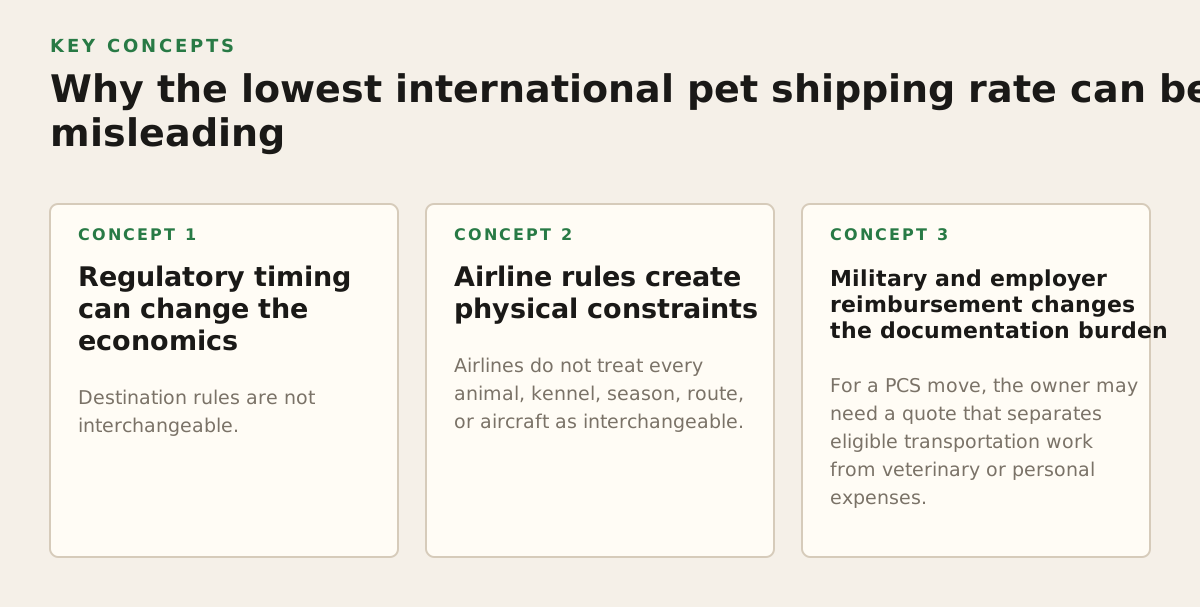
Price matters, but failure cost is part of the price. A route that cannot accept the kennel, a certificate issued outside the permitted window, or a missed connection can create costs that were not visible in the initial airfare. For families reporting to a new duty station or employees starting work overseas, the financial damage may include hotel stays, boarding, replacement tickets, and lost work time.
Regulatory timing can change the economics
Destination rules are not interchangeable. The United States Department of Agriculture’s APHIS pet-travel guidance directs owners to review destination-country requirements and work with an accredited veterinarian where applicable; its requirements vary by country and can include health certificates, vaccinations, tests, and permits. See the official USDA APHIS pet travel guidance. A quote prepared without confirming the destination’s current rules may look attractive simply because it excludes work that has not yet been identified.
Dog entry can involve a separate layer of public-health controls. The U.S. Centers for Disease Control and Prevention lists documentation and other requirements for dogs entering the United States, and those requirements can depend on where the dog has been during the relevant period. The current CDC dog importation guidance should be checked for a U.S.-bound move in 2026. This is especially important for diplomatic, military, and corporate itineraries that cross several countries before reaching the final residence.
Hawaii illustrates the same principle within the United States. The Hawaii Department of Agriculture publishes animal-quarantine information and destination procedures that can involve advance preparation, documentation, inspection, and waiting periods. Review the official Hawaii Animal Quarantine Station information rather than assuming a mainland domestic trip follows ordinary airline practice.
Airline rules create physical constraints
Airlines do not treat every animal, kennel, season, route, or aircraft as interchangeable. The International Air Transport Association’s live-animal program explains that the IATA Live Animals Regulations address the handling and transport of live animals and are used as a reference by airlines and other participants; see the IATA live animals guidance. In practice, the usable routing depends on the carrier’s current acceptance rules, aircraft, connection, temperature controls, kennel dimensions, and destination handling.
A pet may therefore be medically fit to travel but operationally unable to use the cheapest itinerary. Large or unusually shaped kennels can force cargo routing or a different airport. A route with two connections can be cheaper on paper but expose the animal to additional handoffs and fewer recovery options. For brachycephalic breeds, elderly animals, anxious animals, or pets with medical needs, the relevant decision is not simply fare versus fare; it is cost versus routing risk.
Military and employer reimbursement changes the documentation burden
For a PCS move, the owner may need a quote that separates eligible transportation work from veterinary or personal expenses. Reimbursement rules are program-specific and can change, so the member should confirm the current policy with the responsible military office rather than assume every line item qualifies. A clear invoice with dates, services, and third-party charges is more useful than a single bundled total.
Corporate relocation departments and diplomatic offices have a similar need for traceability. They may require a named traveler, origin and destination addresses, a purchase order, confidentiality around the itinerary, or proof that a particular service was completed. Those requirements do not necessarily raise the transport charge, but they affect how the work must be documented and approved.
How a professional estimate is built from the route outward
A defensible estimate begins with a fact pattern, then tests that fact pattern against official rules, airline constraints, and the owner’s service needs. The order matters. Booking first and researching entry requirements later can produce a reservation that is unusable.
Stage one: define the move and the animal
Start with a complete movement brief rather than a vague request for “shipping.” Include:
- Current address, destination address, airport preferences, and the date the owner must arrive.
- Species, breed, age, sex, approximate weight, microchip status, and any relevant health history.
- Measured kennel length, width, and height, plus whether the kennel is already compliant and available.
- Traveling human’s status, such as PCS orders, employer relocation, diplomatic assignment, or family move.
- Desired service boundary: owner-arranged veterinary care, coordinated veterinary care, airport transfer, or door-to-door management.
- Known constraints, including heat, cold, medication schedules, mobility limitations, quarantine concerns, or a hard reporting date.
Measurements should be actual measurements, not an estimate based on breed. A kennel that is 36 inches long rather than 30 inches can affect airline acceptance, vehicle space, and the number of animals a ground partner can move on one run. When a pet and kennel are both close to a carrier’s threshold, the coordinator should confirm the rule before presenting the transport charge as firm.
Stage two: map the legal sequence
Next, build a requirement calendar. The calendar should show what must happen, who signs it, how long a result remains valid, and what event triggers the next step. A typical sequence may include microchip verification, vaccination, waiting period, laboratory test, health certificate, government endorsement, import permit, airline review, customs clearance, and delivery.
The sequence is not identical for every country. Some requirements are completed well before departure; others must occur within a narrow window. Some documents are electronic, while others require an original or a government endorsement. The coordinator’s job is not to make the rules disappear but to prevent a late discovery from turning a planned move into a rebooking.
For an overseas family move, this calendar may be the most valuable part of the service. For a military member, it can be aligned with orders and the report date. For a veterinarian or relocation professional, it creates a handoff record showing which clinical task remains with the practice and which logistics task belongs to the transporter.
Stage three: request capacity and price the service scope
Only after the route and compliance path are understood should the provider seek airline capacity and ground support. The estimate should distinguish these categories:
| Quote category | What it means | Question to ask |
|---|---|---|
| Confirmed | A charge or booking currently accepted under stated conditions. | What could cause this item to change before departure? |
| Estimated | A reasonable working amount based on a third party or incomplete detail. | Who will issue the final invoice? |
| Conditional | A charge that applies only if a specified event occurs. | What event triggers it, and can it be avoided? |
| Excluded | An owner, veterinarian, airline, government, or local provider cost outside the quoted scope. | What must I arrange and pay separately? |
International pet shipping rates are easier to compare when the quote uses these labels. A provider should also state whether the rate covers one pet or multiple pets, one kennel or several, one address or multiple stops, and one-way transport or a return arrangement.
Illustrative calculation, not a universal benchmark
The following is a planning example only, not a market rate or recommendation. Suppose a family requests door-to-door transport for one medium-sized dog from a U.S. residence to a European residence. The owner receives this illustrative breakdown:
- Air transport and animal handling: $1,150 estimated.
- Origin and destination ground logistics: $900 estimated.
- Veterinary examination, laboratory work, and certificate-related tasks: $475 estimated.
- Document coordination and customs support: $650 confirmed service fee.
- Possible boarding or rebooking reserve: $500 conditional.
The planning total would be $3,675 if every listed item applied, while the expected total before the conditional reserve would be $3,175. The figures are deliberately illustrative. The useful lesson is the structure: the owner can see which amount is transport, which is preparation, which is coordination, and which exists only for a disruption. A quote with one unexplained total cannot support the same decision.
Where international pet shipping estimates break down
Most unpleasant surprises come from a mismatch between assumptions and physical or regulatory reality. The solution is not to promise that every risk can be eliminated. It is to expose the assumptions early enough that the owner can change the plan.
Common failure point: incomplete or inconsistent records
A microchip number that does not match the veterinary record, a vaccination recorded before the required identification event, a missing signature, or a certificate with the wrong destination can invalidate an otherwise healthy itinerary. The owner should ask who performs the final document review and whether the review occurs before airline booking or only before departure.
Owners should keep a single document set with consistent spelling, dates, microchip details, and addresses. A veterinarian may correctly complete the medical portion while a separate authority handles endorsement. Those are different responsibilities and should not be treated as one generic “paperwork” line.
Common failure point: kennel and routing assumptions
Do not order a kennel based only on an online size chart. Measure the animal according to the carrier’s requirements, allow the animal to stand and turn as required, and have the planned airline or coordinator confirm acceptance. A kennel that works for one carrier may not work for another, and a passenger itinerary may not be available for the same pet on the same date.
Illustrative planning questions include:
- Does the route require cargo handling, or is another method legally and operationally available?
- Can the aircraft accept the kennel’s dimensions and the animal’s combined weight?
- Are there connection airports where the animal must be collected, inspected, or re-tendered?
- What happens if weather, aircraft changes, or capacity restrictions cancel the planned segment?
- Does the destination permit delivery immediately, or is an inspection or clearance step required first?
Common failure point: treating conditional charges as hidden fees
A conditional charge is not automatically unreasonable. An overnight boarding fee after a missed connection, a replacement health certificate after a date change, or an extra customs intervention may be genuinely triggered by events outside the provider’s control. The problem is a conditional item with no definition.
Every conditional amount should have a trigger, an approval process, and a method of calculation. Ask whether the provider will seek authorization before incurring it, except where immediate action is required for the animal’s welfare or legal release. This approach gives the owner control without pretending that disrupted transport has no consequences.
Common failure point: comparing unlike service boundaries
One quote may cover airport-to-airport service while another includes pickup, destination delivery, live tracking, and customs support. Another may include only coordination, leaving the owner to schedule the veterinarian and obtain the government endorsement. The lowest total is not a useful result until the service boundaries match.
For a high-profile or diplomatic move, discretion and controlled communication may be operational requirements, but they should still be described precisely: designated contacts, approved communication channels, delivery authorization, and who may receive itinerary information. Avoid paying for vague assurances. Ask for the actual process.
How practitioners apply the numbers to real relocation decisions
Experienced planners use the estimate to choose a workable plan, not merely to negotiate the smallest headline figure. The right choice depends on the owner’s exposure to delay, the animal’s needs, the destination rules, and the amount of coordination the owner can personally manage.
For military PCS families
Start with the report date and work backward through the destination’s legal timeline. Ask for a quote that clearly separates transportation, veterinary work, government charges, ground service, and possible disruption costs. Keep orders, receipts, invoices, and proof of payment together, then confirm current reimbursement rules through the appropriate official channel.
Members arranging military pet shipping may benefit from a provider that understands the interaction between orders, airline capacity, destination requirements, and a family’s fixed arrival schedule. The practical test is whether the plan identifies a fallback if the first routing disappears—not whether the estimate uses military language.
For international family relocations
Families should decide how much work they want to own. An owner with a flexible schedule and a nearby accredited veterinarian may handle medical appointments while hiring a coordinator for airline and customs work. A family moving with children, selling a home, and starting employment on a fixed date may reasonably place more of the sequence under one coordinator.
Ask for the point at which the provider takes responsibility for each handoff. “Door-to-door” should mean more than two transportation legs: it should identify who receives the pet, who checks documents, who handles a delay, and who confirms delivery.
For Hawaii moves
Hawaii-bound owners should treat compliance timing as a central planning issue, not an administrative footnote. Review the current state requirements first, then ask the provider to map examinations, tests, forms, payment deadlines, inspection, and release or quarantine possibilities against the planned arrival date.
If a family is comparing Hawaii pet shipping options, request a route-specific estimate that distinguishes mainland ground transport, airline handling, Hawaii inspection or quarantine-related charges, and final delivery. A domestic label does not make the process simple when the destination has its own animal-entry system.
For corporate, diplomatic, and professional referrals
Corporate relocation managers need a clean approval document and a reliable contact structure. Ask for a scope that can be attached to a relocation authorization, with third-party charges clearly labeled. Diplomatic and government families should establish who may receive itinerary details and who can authorize a change without delaying the animal.
Veterinarians and relocation professionals should avoid promising a total before the route is validated. A useful referral packet includes the pet’s records, microchip information, kennel measurements, origin and destination, owner travel date, and the specific clinical tasks the practice will retain. That reduces duplicate work and makes it easier to spot a conflict between medical timing and the proposed flight.
The questions that produce a decision-ready quote
- What exact services are included from the current address to the final delivery address?
- Which costs are confirmed, estimated, conditional, excluded, or paid directly to another party?
- Which destination rules were checked, and on what date in 2026?
- Who reviews the documents, and what happens if an authority rejects or corrects one?
- What kennel dimensions, routing restrictions, and airline acceptance conditions apply?
- What is the fallback for a missed connection, weather disruption, capacity cancellation, or delayed clearance?
- When can the price change, who approves the change, and how will the owner be notified?
- What information, if any, must remain limited to designated family, employer, military, or government contacts?
The specific recommendation is to request a written, route-specific estimate only after the provider has the animal profile, kennel measurements, addresses, travel window, and destination requirements. For owners who want coordinated airline arrangements, paperwork, customs support, tracking, and delivery logistics, BestPetTravel can help organize the move; visit BestPetTravel to request a route-specific assessment, and provide the complete move details.
Authored with NotFair SEO