
International Pet Relocation Customs Support Options: A Practical Guide
November 11, 2026
Compare international pet relocation customs support options, from self-managed clearance to destination agents, and map paperwork, duties, and handoffs.
International pet relocation customs support options range from handling the process yourself to hiring a destination customs agent or coordinating customs through a pet-relocation provider. The right choice depends on what the destination requires, who can prepare and submit each document, and whether your move needs someone to coordinate the handoffs. Customs clearance is only one part: animal-health entry rules, airline requirements, and any customs declarations or charges may involve different authorities.
Separate customs clearance from permission to bring a pet
People often use “customs” as shorthand for every step at the border. In practice, it helps to separate the work into two tracks: permission for the animal to enter and border clearance for the shipment. An import permit, health certificate, vaccination record, or inspection requirement belongs to the animal-entry track. A customs declaration, tariff classification, or assessment of charges may belong to the customs track. The agencies, forms, and responsible parties can differ.
For example, a pet may meet the destination’s veterinary entry conditions while the shipment still needs a declaration or clearance step. Conversely, a customs agent may assist with a shipment’s border processing but cannot make an animal eligible if a required veterinary document is missing. Ask each prospective helper which track they handle and which authority makes the final decision.
Requirements are destination-specific and can depend on the animal, origin, route, and travel circumstances. The U.S. Department of Agriculture’s pet travel guidance directs travelers to destination-specific rules for pets leaving the United States; the European Commission’s EU pet movement rules set out separate conditions for entering or moving within the EU. These are reasons to verify the actual route, not assume one country’s process applies everywhere.
- Veterinary or animal-health authority: sets entry conditions such as required documentation, examinations, or permits.
- Customs authority: handles applicable declarations and the customs treatment of goods or accompanied animals.
- Airline or cargo handler: applies its own acceptance and transport procedures.
- Pet owner or appointed representative: supplies accurate information and completes the tasks assigned to them.
Not every move involves the same customs procedures, and this guide cannot determine a specific pet’s eligibility or charges. Confirm both tracks with the relevant destination authorities before booking transport.
Choose the level of support that matches the move
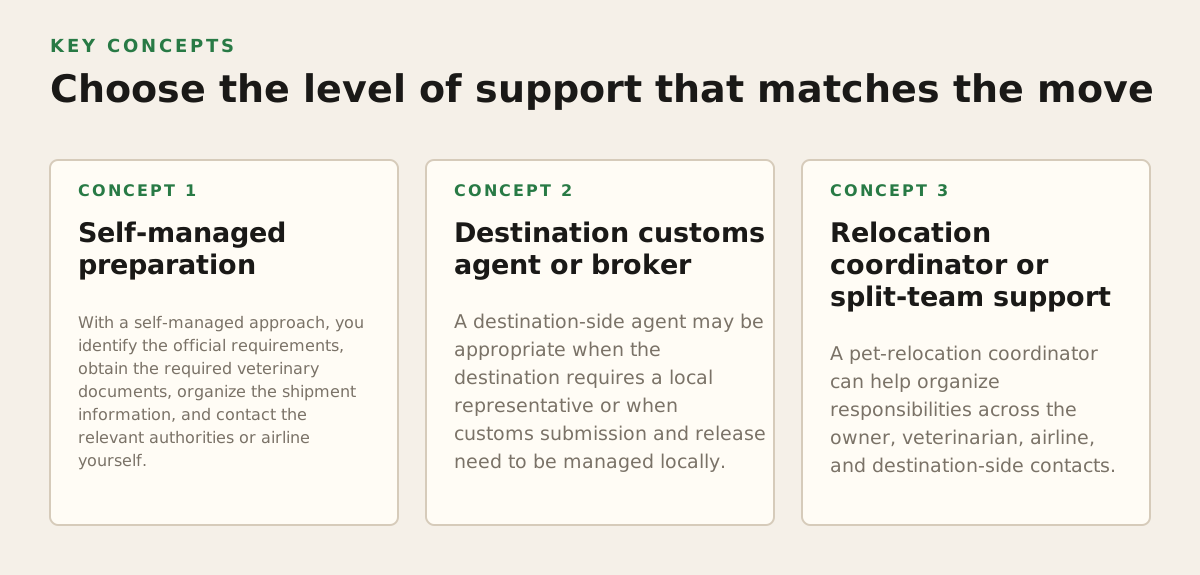
There is no single customs-support arrangement that fits every international relocation. The useful distinction is who owns the coordination, not simply whether a service is called “customs clearance.” A straightforward move may leave the owner comfortable managing official instructions directly. A move with several authorities, a complex itinerary, or limited time at destination may call for a professional to coordinate defined parts of the process.
Self-managed preparation
With a self-managed approach, you identify the official requirements, obtain the required veterinary documents, organize the shipment information, and contact the relevant authorities or airline yourself. This can work when you can confidently interpret the rules and keep responsibility for each task in one place. It does not mean that you can waive a required agent, permit, inspection, or declaration if the destination requires one.
For a dog moving from the United States, for instance, check the destination’s animal-health conditions through the appropriate official sources and separately ask the carrier what it needs to accept the animal. The CDC’s dog import guidance concerns entry into the United States; it is not a substitute for the destination country’s rules when the trip is outbound. Identify the direction of travel before relying on a government checklist.
Destination customs agent or broker
A destination-side agent may be appropriate when the destination requires a local representative or when customs submission and release need to be managed locally. Before appointing one, ask whether the agent handles pet shipments specifically, what documents they need from you, and whether their role includes animal-health coordination or only customs processing. Local customs handling is not automatically veterinary import clearance.
Ask for the agent’s scope in writing: which authority they contact, what they submit, who pays any assessed charges, and what happens if officials request additional information. Do not assume that “door-to-door,” “clearance,” or “import support” includes every item on that list; the exact meaning depends on the provider’s agreed scope.
Relocation coordinator or split-team support
A pet-relocation coordinator can help organize responsibilities across the owner, veterinarian, airline, and destination-side contacts. Some owners use a split arrangement: their own veterinarian prepares health documents, a relocation provider coordinates transport and paperwork, and a destination agent handles local customs steps. The advantage is a clearer chain of responsibility; the trade-off is that every handoff needs an owner and a deadline.
BestPetTravel’s business description includes door-to-door domestic and international pet transportation, airline coordination, paperwork, customs support, tracking, and delivery logistics. Those stated capabilities make it a potential point of coordination to discuss, but they do not establish the exact scope, availability, or customs arrangements for a particular route. Ask for written confirmation of what the company would handle and what remains yours or another party’s responsibility.
Build a responsibility map before documents are issued
Start with the destination’s official requirements, then turn each requirement into a named task. Avoid a vague checklist that says “get papers” or “clear customs.” Those labels conceal dependencies: one document may need to be issued by an authorized professional, endorsed by a government authority, or presented in a specified form. Confirm the current instruction with the authority responsible for the requirement.
The United Kingdom, for example, publishes separate official instructions for bringing a pet to Great Britain. Japan’s animal quarantine service publishes dog and cat import information through its official guidance. These examples illustrate why a general “international pet checklist” cannot replace destination-specific verification.
- Pin down the route: record the pet’s origin, final destination, any transit points, and whether the animal travels with you or as cargo. Ask whether each country on the route has requirements that apply to transit.
- Identify each authority: note which agency governs animal entry, which handles customs, and which party sets carrier acceptance rules. Use official government or carrier instructions, not a summary alone.
- Assign the document work: for every required form or record, write down who obtains it, who checks it, who submits it, and who carries or presents it.
- Confirm the handoff: establish how the destination representative receives the documents and who responds if an authority asks for a correction or additional evidence.
- Keep a single record set: retain copies of submitted documents, confirmations, contact details, and written instructions in one place accessible to the people managing the move.
A practical responsibility map might assign the owner to provide the pet’s identification and travel details, the veterinarian to prepare specified medical records, a relocation coordinator to reconcile the itinerary and paperwork, and a destination agent to complete an agreed local customs step. That is an illustrative division of work, not a claim that every destination permits those parties to perform those tasks. Verify who is legally or procedurally authorized to act.
Prevent the handoff problems that delay clearance
Many avoidable problems start with mismatched assumptions rather than a missing service. The owner believes the coordinator has filed a permit; the coordinator is waiting for a signed document. A customs contact expects a shipment reference; the airline has not issued it. Or a veterinary document is prepared for one itinerary while the route changes. Write down the trigger for each handoff—what must happen first, who confirms it, and how the next person knows it is complete.
- Unclear scope: Ask whether “customs support” means advice, document review, submission, representation, or coordination with a local agent. Get the answer in writing.
- Conflicting instructions: When a provider’s checklist differs from an official authority’s instructions, ask which rule applies to your route and request confirmation from the responsible authority.
- Unconfirmed charges: Ask who will explain any assessed customs charges, who is responsible for payment, and whether the estimate excludes government fees or third-party costs. Do not rely on an assumed total.
- Route changes: Recheck entry and transit requirements if the origin, destination, stopover, carrier, or travel date changes. A previous approval or document plan may not cover a revised itinerary.
- Unavailable decision-maker: Record the official contact route and the named person responsible for responding if documents are queried. A general inbox or verbal assurance may not resolve a time-sensitive issue.
If the move is for a military PCS, coordinate pet tasks with the wider household move rather than treating the animal’s shipment as an afterthought. Confirm who in the family owns each document and transport decision, especially if orders or travel arrangements change. BestPetTravel has a page labeled military pet shipping; the page label alone does not establish the customs scope for a specific PCS route, so request route-specific details.
Check destination-specific rules—and keep Hawaii separate
For an overseas move, the destination’s official animal-health and customs instructions should control your checklist. The exact requirements may vary with origin and the pet’s circumstances, so ask the relevant authority or a qualified representative to confirm the rules for your itinerary. If a professional is involved, give them the full route and ask them to identify what they verified and when.
A move to or from Hawaii is a different case: Hawaii is a U.S. state, so do not treat it as international customs clearance. It has its own animal-entry requirements, which should be checked with the Hawaii Department of Agriculture’s animal quarantine information. That distinction matters for families comparing overseas relocation with a Hawaii move: domestic travel does not mean no entry rules, but it is not the same customs process as an international import. BestPetTravel’s Hawaii pet shipping page is relevant to that separate planning question.
Before selecting support, use this short decision test:
- Can you identify the official animal-entry rules and customs steps for every relevant part of the route?
- Do you know which person or organization is responsible for each submission and handoff?
- Can you manage follow-up if an authority requests clarification while you are traveling or relocating?
- Does a destination rule call for local representation or another step you cannot perform yourself?
If you can answer those questions clearly, self-management or a limited, clearly defined support arrangement may be sufficient. If ownership is unclear, several parties need to coordinate, or the route has unresolved entry questions, pause before booking and request a written division of responsibilities. BestPetTravel describes international pet transportation with paperwork, airline coordination, and customs support; contact BestPetTravel to ask what support is available for your specific route and what you would still need to arrange.
Authored with NotFair SEO