
International Pet Relocation Cost: What You’re Really Paying For in 2026
September 6, 2026
Understand international pet relocation cost, from veterinary documents and airline fees to customs support, routing risks, and practical ways to budget.
International pet relocation cost is the total expense of moving a dog or cat legally and safely across borders—not simply the price of an airline ticket. A realistic estimate may include veterinary preparation, government documents, an airline-approved crate, cargo or checked-pet charges, ground transportation, customs processing, quarantine exposure, and professional coordination.
That distinction matters because two pets traveling on the same route can have very different totals. A small dog with an existing microchip and current records may need fewer steps than a large dog entering a rabies-controlled destination. A family on military orders may also face different scheduling and reimbursement questions than an executive moving privately, while a pet traveling to Hawaii follows a separate state import process even though the destination is within the United States.
What an international pet relocation quote actually measures
A relocation quote is best understood as a route-specific risk and service estimate. It should describe the animal, origin, destination, travel date, transportation method, required documents, and the work being performed on the owner’s behalf. Without those inputs, a low headline figure may only represent one visible charge.
The five cost layers
Most international moves can be separated into five layers. The categories overlap operationally, but separating them helps a family or relocation professional identify missing assumptions:
- Compliance preparation: examination, vaccinations, microchip verification, certificates, laboratory work, endorsements, permits, and translations when required.
- Air transport: the airline’s pet charge, cargo booking or air waybill, crate requirements, handling, and any carrier-specific restrictions.
- Ground logistics: pickup from the residence, transfer to the airport, destination delivery, boarding, or a handoff to a local representative.
- Border and destination handling: customs, agriculture inspection, import clearance, quarantine administration, port fees, and local release procedures.
- Coordination: itinerary planning, document review, airline communication, tracking, contingency planning, and delivery management.
Professional service fees are therefore only one line in the total. An owner may arrange part of the move personally and pay providers directly, or hire a door-to-door company to coordinate multiple parties. Neither approach is automatically cheaper: self-management can reduce coordination fees while increasing the risk of a missed document, unusable route, or costly change.
Why the destination controls more than the distance
Air miles are an imperfect predictor. Import rules are usually driven by disease-control policy, the animal’s origin, vaccination history, and the destination’s inspection system. The European Union, for example, publishes entry requirements that distinguish between identification, rabies vaccination, health documentation, and circumstances such as movement from a non-EU country. Requirements should be checked against the official destination rules in force for the intended 2026 arrival date; the European Commission’s official pet movement legislation page is a useful starting point.
Hawaii is another example of why geography alone does not explain a quote. The state has its own animal import program, including documentation and inspection pathways that can affect whether a pet qualifies for direct release or must complete additional procedures. The Hawaii Department of Agriculture’s Animal Quarantine Information page should be treated as the controlling source for current requirements.
For military families, the practical question is often not “What does the flight cost?” but which requirements must be completed before the report date, which expenses are potentially reimbursable under current orders, and who will manage the pet if the itinerary changes. Those questions belong in the initial quote rather than after tickets are issued.
Why international relocation costs change from one pet to another
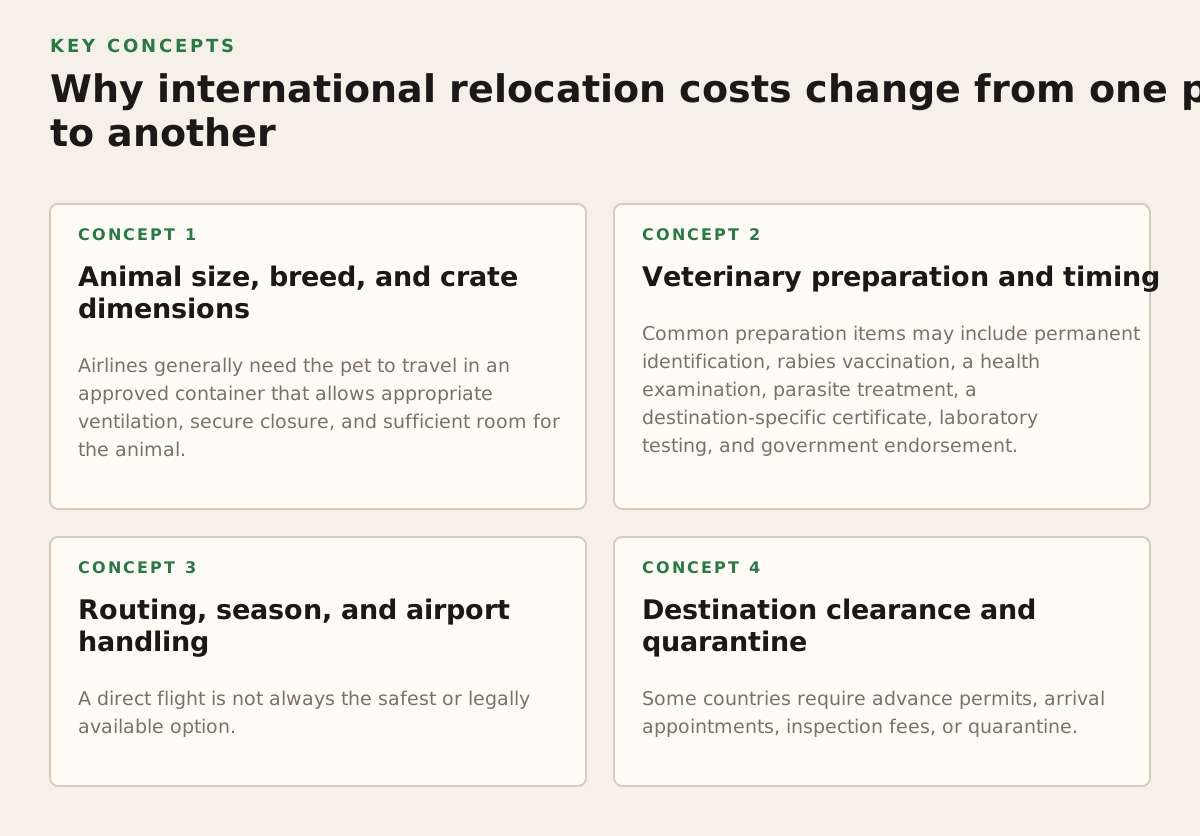
Several variables have a direct mechanism behind them. A good estimate names the variable, explains what triggers it, and identifies whether the amount is fixed, conditional, or still unknown.
Animal size, breed, and crate dimensions
Airlines generally need the pet to travel in an approved container that allows appropriate ventilation, secure closure, and sufficient room for the animal. A larger dog may require a larger crate, more cargo capacity, a different vehicle, or a route that can accept the combined dimensions. Brachycephalic breeds may face carrier restrictions because of heat and respiratory risk. These are not cosmetic details: they can eliminate an otherwise convenient itinerary.
Owners should measure the dog or cat while standing naturally and provide weight and breed information before asking for a firm routing recommendation. Crate dimensions can change the aircraft and handling plan, so a quote based only on the animal’s body weight is incomplete.
Veterinary preparation and timing
Common preparation items may include permanent identification, rabies vaccination, a health examination, parasite treatment, a destination-specific certificate, laboratory testing, and government endorsement. The exact sequence matters. A vaccination may need to occur after a readable microchip is recorded, and a health certificate may have a limited validity window.
The United States Department of Agriculture’s Animal and Plant Health Inspection Service explains that destination countries set their own requirements and that official export health certificates may need endorsement. Its Pet Travel resource provides country-specific starting points and directs travelers to current instructions. Because requirements change, a 2024 checklist copied into a 2026 move file is not a reliable basis for a quote.
A veterinarian’s fee is also different from an endorsement or laboratory fee. A relocation coordinator can organize the sequence, but the owner still needs a veterinarian who can examine the pet and complete the required medical work. If a test fails, a vaccination is late, or the certificate contains an error, the schedule and cost can change.
Routing, season, and airport handling
A direct flight is not always the safest or legally available option. Some destinations require arrival through a particular airport, an approved carrier, or an inspection facility. A connection may be necessary because of airline schedules, aircraft type, pet embargoes, temperature restrictions, or the absence of a suitable cargo service.
Connections introduce handoff and delay exposure. Each additional airport can mean another handling event, a longer ground transfer, or a different airline with its own acceptance rules. A route with a higher transport charge may still produce a lower overall risk if it avoids an overnight hold or an incompatible transfer.
Seasonal restrictions can also affect routing. Airlines may limit animal acceptance during extreme heat or cold, sometimes based on conditions at the origin, connection, and destination. Since weather is not known with certainty months ahead, a responsible plan includes a change policy rather than promising an unchangeable departure.
Destination clearance and quarantine
Some countries require advance permits, arrival appointments, inspection fees, or quarantine. Others allow a compliant pet to proceed with minimal delay. If a document is missing, the pet may be held, returned, or placed into a controlled facility at the owner’s expense, depending on local law.
The Centers for Disease Control and Prevention, for example, publishes U.S. dog import requirements that vary according to where a dog has been during the relevant period and whether it is arriving from a high-risk country for dog rabies. The CDC’s dog importation page is the appropriate reference for a dog entering the United States in 2026. Rules for cats and for other destinations must be checked separately.
Illustrative cost construction—not a universal price list
The following is an illustrative budgeting example, not a market quote or recommended universal budget. It shows how a total can be built from separate decisions. Actual amounts must be obtained from the veterinarian, laboratory, airline, government authority, airport handler, and relocation provider involved in the specific move.
- A family relocates one medium-sized dog from the United States to Country A. The dog already has a readable microchip and current rabies vaccination, so the medical work may be limited to a destination-required examination and certificate process.
- The family adds a large airline-approved crate, an airport transfer, and one airline itinerary. The crate and ground vehicle are selected for the dog’s actual dimensions, not an assumed “standard” size.
- The destination requires an import permit and an arrival inspection. Those are treated as separate conditional items rather than hidden inside the airline line.
- The family also requests door-to-door coordination and live shipment updates. Those services are priced separately from government and airline charges.
- If the pet must travel on a different date because of a temperature restriction, the quote identifies which charges may be changeable, refundable, or payable again.
This example illustrates why a single advertised number can mislead. The important output is not a precise figure without evidence; it is a complete list of cost-bearing events with a status such as confirmed, estimated, conditional, or owner-paid.
How the relocation process turns requirements into a budget
International pet transport is a sequence, not a single booking. The sequence determines whether expenses occur once, recur, or become avoidable.
Step 1: Build the animal and route profile
Start with data that affects eligibility and handling:
- Species, breed, age, sex, and approximate weight
- Microchip number and the date it was implanted or verified
- Rabies history and other vaccination records
- Origin address, destination address, and planned arrival country
- Preferred departure window and flexibility around the report date
- Whether the pet is traveling with an owner, separately, or under military or corporate relocation orders
- Any medical, behavioral, mobility, or crate-training concern that affects handling
For a family moving on PCS orders, include the installation, port of departure, gaining location, and required arrival date. For a diplomatic or executive move, include privacy and handoff requirements early; changing from airport pickup to discreet residence delivery after the route is booked can require a new ground plan.
Step 2: Convert destination rules into a dated checklist
A checklist should identify the issuing authority, the document owner, the completion date, and the expiration or use window. “Health certificate required” is not enough. The working question is: which certificate, signed by whom, within what period before arrival, and does it require official endorsement?
Document timing is a cost-control mechanism. Completing a test too early may require repeating it. Completing it too late may force a flight change. Ask the coordinator or veterinarian to distinguish between:
- Requirements that can be completed months before departure
- Requirements tied to a vaccination or microchip date
- Requirements valid only during a short pre-travel window
- Documents that must travel with the pet in original form
- Documents that must be submitted electronically before arrival
Keep scanned copies, but do not assume a scan replaces an original or endorsed document. The authority controlling entry—not the airline’s call center or a social-media group—should decide what is legally sufficient.
Step 3: Select the transport model
There are several practical models:
- Owner-accompanied travel: the pet and owner use the same general itinerary when the airline and destination rules permit it.
- Manifest cargo: the pet travels as a booked shipment, which may be necessary for size, route, or airline policy reasons.
- Door-to-door relocation: a provider coordinates pickup, airline arrangements, destination handling, and delivery.
- Hybrid self-managed travel: the owner completes veterinary work and part of the airport process while hiring help for complex clearance or ground transport.
The least expensive-looking model may create the most work. A self-managed shipment can be appropriate for an experienced owner with schedule flexibility, a straightforward route, and a destination where the owner can personally complete clearance. It is less attractive when the pet arrives before the family, the owner is reporting to a military installation, or the destination language and inspection process are unfamiliar.
Step 4: Request an itemized quote with assumptions
A usable quote should show more than “transportation.” Ask for these fields:
| Quote field | Why it matters |
|---|---|
| Origin and destination addresses | Determines pickup, delivery, airport, and cross-border ground work. |
| Pet weight and crate dimensions | May affect airline acceptance, handling, vehicle size, and routing. |
| Airline or transport method | Shows whether the quoted amount depends on a particular carrier or service. |
| Veterinary and government items | Separates medical preparation from coordination and transport fees. |
| Customs, inspection, and quarantine status | Identifies charges that may be conditional or payable at destination. |
| Change and cancellation terms | Explains exposure if orders, visas, weather, or airline schedules change. |
| Included communication and tracking | Clarifies who receives updates and who acts during a delay. |
Do not accept “all-inclusive” without asking what happens when the airline changes the itinerary, a document is rejected, the pet misses a connection, or delivery occurs outside normal hours. Assumptions are part of the price; hidden assumptions are future disputes.
Where an international pet relocation plan breaks
Most expensive problems are not caused by the normal route. They arise when a dependency is missed and the owner has no time to recover.
Document mismatch
A microchip number typed incorrectly, a rabies date that does not match the record, a missing signature, or an invalid certificate date can stop acceptance. The practical safeguard is a document review against the destination checklist before the final veterinary appointment and again before departure.
Use one master record for the pet’s name, microchip number, birth date, owner details, and vaccination dates. If a family, veterinarian, airline, and relocation company each maintain separate versions, transcription errors become more likely.
Airline acceptance is not the same as legal entry
An airline may accept a booking while the destination authority still rejects the documents. Conversely, a pet may meet import rules but be refused by a carrier because of crate dimensions, breed policy, weather, or aircraft limitations. Airline acceptance and border compliance are separate gates.
That is why the itinerary should be checked in both directions: first against the destination’s entry requirements, then against each airline and airport handling requirement. A phone confirmation should be recorded with the representative’s name, date, and booking reference, but it should not replace written documentation where the authority requires a formal permit or certificate.
Schedule compression
Owners often begin after receiving a firm report date. That can leave no time for a waiting period, laboratory result, permit issuance, or an airline booking window. The answer is not always to pay for expedited service. Sometimes the legal sequence cannot be shortened, and paying more only creates the appearance of progress.
For a 2026 move, use a planning calendar with three dates:
- Earliest legal readiness: when all required conditions can first be satisfied.
- Operational booking date: when the airline, handler, and ground providers should be reserved.
- Recovery deadline: the last date on which a missed step can be corrected without moving the pet’s departure.
These dates are route-specific. They should not be treated as a universal number of weeks or months.
Weather, embargoes, and aircraft changes
A pet itinerary can be disrupted even when the owner’s paperwork is perfect. Extreme temperatures, aircraft substitutions, route cancellations, and carrier embargoes may force a new plan. A responsible quote should state whether the provider monitors the route, who approves changes, and how additional airline or ground charges are handled.
Do not sedate a pet for air travel without direct veterinary guidance. The International Air Transport Association’s official guidance on transporting pets discusses container, preparation, and handling considerations, while the treating veterinarian must address the animal’s individual medical condition. A calming strategy should focus on crate acclimation and safe handling unless a veterinarian gives specific instructions.
Arrival without a delivery plan
Arrival is not the end of the move. The pet may be released at a cargo terminal rather than a passenger baggage area, and the owner may be delayed by immigration, military in-processing, or a connecting flight. Confirm the receiving party, phone number, airport meeting point, operating hours, and backup contact before departure.
For a family moving to Hawaii, the delivery plan should be aligned with the animal quarantine pathway and the family’s lodging. For overseas PCS travel, it should account for the possibility that the service member reaches the installation before the residence is available. The best route is one that ends with a named person responsible for the pet—not merely a flight status marked “arrived.”
How practitioners apply the estimate to real relocation decisions
The useful question is not “How do I find the cheapest pet flight?” It is “Which combination of compliance, timing, handling, and support gives this pet a lawful and manageable move?” Different audiences answer that question differently.
Military PCS families
Military families should create the pet plan as soon as orders are credible, even if the household itinerary is not final. Start with the gaining country or territory’s rules, then map the veterinary sequence backward from the required arrival date. Keep receipts, orders, approvals, and provider invoices in one file, but verify reimbursement eligibility through the applicable branch, installation, or current travel guidance rather than assuming every pet expense qualifies.
When a family has multiple pets, price each animal separately before asking for a household total. One cat may be eligible for a simpler airline arrangement while a large dog requires cargo handling or a different route. Combining them into one average obscures the constraint that controls the move.
Families researching military pet shipping should also ask who handles a change in report date, a delayed household-goods shipment, or a pet arriving before housing. Those are operational questions, not sales extras.
International family and executive relocations
For corporate employees and executives, the pet’s arrival often needs to align with temporary housing, school start dates, security procedures, or a residence handover. A door-to-door plan can be valuable when the owner cannot personally visit the cargo terminal or when a local representative must complete clearance.
Ask the relocation provider to separate:
- Work performed before departure
- Airline and airport charges paid to third parties
- Destination customs or inspection charges
- Ground pickup and delivery
- Contingency work caused by a delay or rejected document
This separation gives an employer or mobility team a defensible expense record. It also makes it easier to decide what the company will cover and what the employee will pay personally.
Government, diplomatic, and high-profile moves
Discretion does not remove regulatory obligations. The pet still needs compliant identification, documents, carrier acceptance, and a lawful receiving process. It may, however, require a more carefully controlled chain of communication, limited disclosure of residence details, and a named point of contact at each handoff.
Specify those needs before booking. A vague request for “private handling” could mean anything from residence pickup to a restricted-contact protocol. The provider should explain what can actually be arranged without claiming confidentiality, security, or government authorization that it does not possess.
Moves to or from Hawaii
Hawaii-bound owners should use the state’s official requirements as the source of truth, then build the veterinary and document schedule around the selected arrival pathway. A family may choose to manage the process itself if it has time and can submit every item correctly. Professional coordination may be more useful when the pet is large, the family is moving under orders, the owner will not arrive at the same time, or the household needs residence delivery.
For Hawaii pet shipping, ask specifically whether the quoted service covers only transportation or also document review, airport handling, inspection coordination, and final delivery. “To Hawaii” describes a destination; it does not define the work included.
A decision rule for choosing the right level of help
Use a provider when the move has several independent failure points and the cost of a missed step is greater than the coordination fee. Self-manage when the route is straightforward, the owner has schedule flexibility, the destination authority is clear, and the owner can personally handle every required handoff.
Before signing, ask five practical questions:
- Which charges are confirmed, estimated, conditional, or excluded?
- Who verifies the destination’s current requirements for the intended 2026 arrival?
- Who rebooks the pet if the airline cancels or weather blocks acceptance?
- Who meets the pet at destination, and what happens if the owner is delayed?
- What information and documents will the owner receive at each milestone?
The strongest recommendation is to choose the plan with the clearest dependencies, not automatically the lowest initial total. For a military PCS, that may mean prioritizing schedule recovery and reimbursement documentation. For a Hawaii move, it may mean careful state compliance and inspection planning. For an executive or diplomatic relocation, it may mean controlled handoffs and residence delivery. In every case, request a dated, itemized estimate that distinguishes mandatory charges from optional support and leaves no uncertainty about who acts when the route changes.
BestPetTravel can help families, service members, companies, and relocation professionals coordinate door-to-door pet transportation, airline arrangements, paperwork, customs support, tracking, and delivery logistics through BestPetTravel.
Authored with NotFair SEO