
How to Choose Pet Transportation Services Near Me for PCS, International, and Hawaii Moves
August 19, 2026
Compare pet transportation services near me by route expertise, paperwork, pricing, and tracking before booking a safe domestic or overseas move.
Searching for pet transportation services near me usually means a move is already creating deadlines: a military PCS report date, an overseas employment start, a Hawaii arrival window, or a veterinary health-certificate appointment. The useful decision is not simply which company is closest. It is which service model can manage your route, your pet’s risk factors, and the paperwork chain without leaving you to solve airport, customs, or delivery problems yourself.
This guide separates the main service categories, explains the work each one actually removes, and gives families, relocation managers, veterinarians, and government personnel a repeatable way to evaluate providers in 2026. You will also find a decision table, budget questions, interview prompts, measurable success criteria, and a sequenced implementation plan.
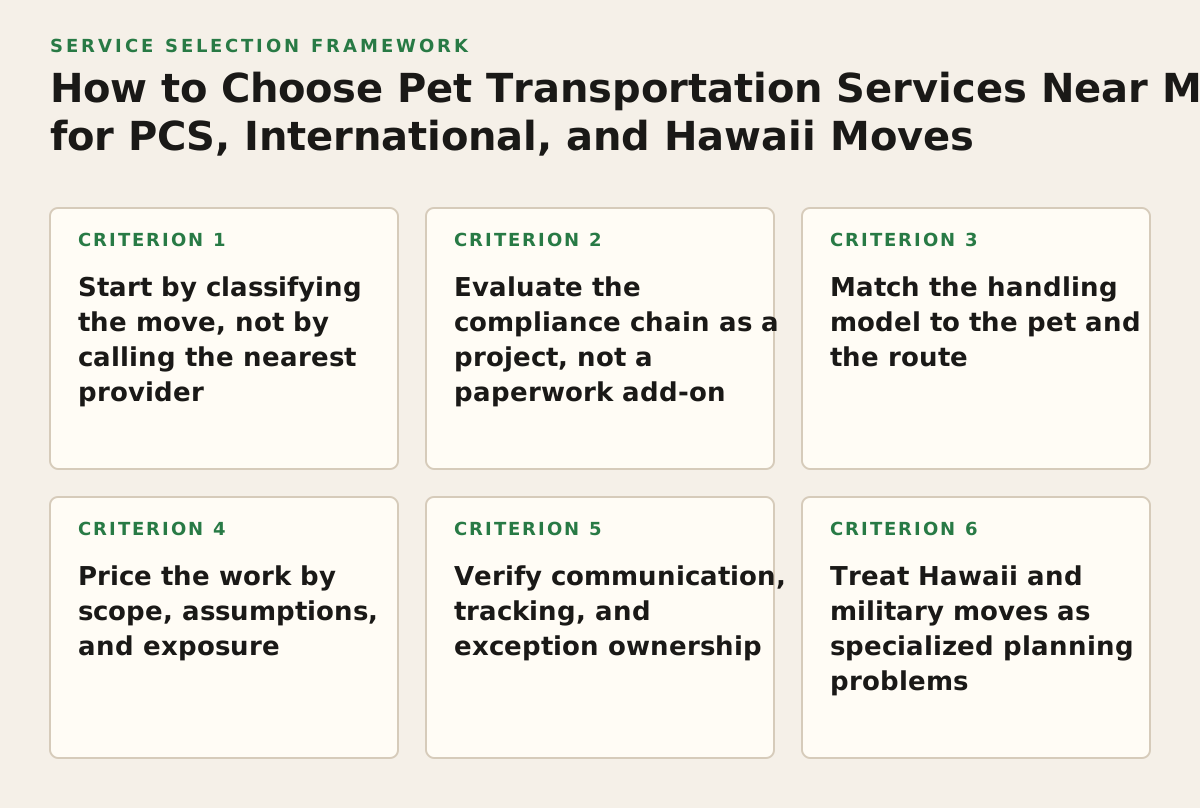
1. Start by classifying the move, not by calling the nearest provider
When it applies: Use this step before requesting quotes. A provider that is excellent for a domestic family move may not be equipped for an import permit, a military installation handoff, or Hawaii’s entry process.
Why it works: Pet transport is a chain of dependent tasks. The route determines the airline options; the airline determines crate and booking constraints; the destination determines veterinary documents, customs, quarantine, and final delivery. If you classify the move first, you can compare like with like rather than comparing a local driver’s fee with a full relocation-management proposal.
| Buyer need or route | Best-fit service type | Main trade-off | Questions to resolve first |
|---|---|---|---|
| Short domestic move where the owner can handle airline or ground arrangements | Ground transport or limited coordination | Lower management burden for the provider, but more tasks remain with the owner | Who handles pickup, crate, airline booking, delays, and delivery? |
| Domestic relocation with a tight work, school, or PCS schedule | Door-to-door domestic pet transportation | More coordination and cost than owner-managed travel; fewer handoffs when properly scoped | Are airport transfers, overnight care, and live status updates included? |
| International move for a dog or cat | International pet relocation with document and customs coordination | Higher administrative burden and greater dependence on destination rules | Who verifies destination requirements and manages customs or broker communication? |
| Military PCS, including installation-to-installation movement | Military-focused relocation coordination | Entitlements, reimbursement rules, and reporting dates may require separate confirmation | Can the provider work around orders, port calls, installation access, and required receipts? |
| Move to or from Hawaii | Hawaii entry-planning and pet transport service | Timing errors can create inspection, quarantine, or missed-flight consequences | Who tracks testing, documents, arrival inspection, and inter-island or final delivery? |
| Executive, diplomatic, or high-profile relocation | Discreet, end-to-end relocation management | May require custom communication protocols and carefully limited disclosure | Who receives updates, how is information protected, and who is the escalation contact? |
Failure mode: Treating “near me” as the primary qualification. A local dispatcher may be perfectly capable of a short ground trip but have no role in international document review or destination customs.
Implementation example: A family moving from Virginia to Japan should write “international, one dog, airline travel, destination customs, door-to-door delivery, military PCS if applicable” before contacting vendors. A family moving between two mainland cities might instead request ground-only, flight coordination, or complete door-to-door options separately.
Build a one-page move brief
- Origin address, destination address, and any military installation or diplomatic facility restrictions.
- Pet species, breed, age, weight, dimensions, temperament, medical conditions, and microchip details.
- Preferred travel window, report date, lease end, port call, or arrival deadline.
- Whether the owner will travel on the same itinerary.
- Required services: crate, vet coordination, airline booking, customs, airport pickup, ground delivery, boarding, or tracking.
- Known constraints such as brachycephalic anatomy, heat or cold exposure, medication, mobility limitations, or multiple pets.
2. Evaluate the compliance chain as a project, not a paperwork add-on
When it applies: This is essential for every international or Hawaii move and still matters for domestic air travel when an airline, state, or receiving facility imposes conditions. Requirements can depend on the animal, origin, destination, transit points, dates, and transport method.
Why it works: A health certificate is only one link. A workable file may also require identification, vaccinations, tests, permits, endorsements, airline acceptance, import review, and arrival inspection. The U.S. Department of Agriculture’s Animal and Plant Health Inspection Service directs travelers to destination-specific pet travel requirements, which is why a generic checklist is not enough for an international itinerary: USDA APHIS pet travel guidance.
For dogs entering the United States, the Centers for Disease Control and Prevention maintains separate import rules and documentation requirements. A provider should identify whether your dog’s recent travel history, age, vaccination status, or country of departure changes the process; do not assume a rule for cats or for one country applies to every dog itinerary. See the CDC dog importation requirements before approving a plan.
Ask for an ownership matrix
- Owner: information and original records you must provide, such as vaccination history, microchip data, and destination addresses.
- Veterinarian: examinations, treatments, tests, certificates, and timing of signed documents.
- Provider: document review, appointment coordination, airline submission, customs communication, and exception handling.
- Government agency: endorsement, permit issuance, inspection, or destination clearance that cannot be replaced by a commercial provider.
- Airline or carrier: acceptance, crate rules, route limitations, embargoes, and day-of-travel decisions.
Failure mode: A provider says “we handle the paperwork” without naming which documents, which authority, and which party has final approval. That wording can conceal an owner obligation or a deadline that is already too close.
Implementation example: For a cat relocating from the United States to an overseas posting, ask for a dated checklist with columns for “requirement,” “source authority,” “responsible party,” “due date,” “submitted,” and “approved.” Ask what happens if a certificate is signed outside the destination’s accepted window.
Use these compliance questions in the interview
- Which official authority governs this route, and where can I verify the requirements myself?
- Will you review the itinerary for transit-country rules, not only the final destination?
- Who books the veterinary appointment and who pays the veterinarian or government fees?
- What documents must be originals, and how are they carried or returned?
- What is the recovery plan if a test, endorsement, permit, or airline approval is delayed?
3. Match the handling model to the pet and the route
When it applies: Use this principle when deciding between owner-accompanied travel, airline cargo coordination, ground transport, or a mixed itinerary. The right choice depends on species, size, health, temperament, weather, route availability, and the number of handoffs—not on a blanket claim that one mode is always safest.
Why it works: Each mode transfers risk differently. Ground travel can avoid airport connections but may take longer. Airline travel may make an international route practical but introduces acceptance rules and connection constraints. Owner-accompanied travel may reduce one handoff while leaving the owner responsible for check-in and document presentation. A professional coordinator should explain those trade-offs in route-specific terms.
The International Air Transport Association publishes standards and guidance for the air transport of live animals, including container and handling considerations. Use its Live Animals Regulations information as a reference point, while recognizing that the operating airline can impose additional requirements.
Compare the handling plan
- Ground-only: Ask about driver changes, rest stops, temperature management, medication instructions, feeding, exercise, and emergency veterinary access.
- Airline coordination: Ask who confirms pet acceptance, verifies crate dimensions, monitors embargoes, and handles a missed or canceled flight.
- Mixed ground and air: Identify every handoff, the person signing for the pet, the location of overnight care, and the communication method at each stage.
- Owner-accompanied: Clarify what the owner must do at the airport and whether the provider still coordinates documents, crate, transfers, and destination delivery.
- Special handling: Discuss heat, cold, respiratory risk, anxiety, medication, mobility, age, and whether the pet should travel at all on the proposed itinerary.
Failure mode: Accepting an itinerary because it is the fastest on paper. A short connection may be operationally fragile if a pet must be transferred between facilities, while a longer itinerary may create excessive ground time or overnight handling.
Implementation example: For a large dog moving to Europe, request two written options: one airline itinerary with professional airport transfers and one ground-to-hub plan. Compare total door-to-door time, number of handoffs, weather exposure, cancellation recovery, and who remains responsible at each stage.
Ask the provider to state measurable success criteria before booking:
- All required documents reviewed and accepted before the submission deadline.
- Airline or carrier acceptance confirmed for the specific pet, crate, date, and route.
- Named handoff contacts and delivery address verified.
- Updates issued at agreed milestones, such as pickup, departure, arrival, customs release, and delivery.
- Escalation started within an agreed response window if the itinerary changes.
4. Price the work by scope, assumptions, and exposure
When it applies: Use this framework whenever a quote appears unusually simple or when multiple providers use different labels for similar services. Pet transport pricing can combine professional fees, airline or ground charges, crates, veterinary work, government fees, customs, boarding, transfers, and taxes. A responsible comparison asks what is included and what is merely estimated.
Why it works: The lowest initial quote can become the most expensive if it excludes a required transfer, document review, or recovery service. The highest quote may include convenience that your family does not need. You need a scope comparison, not a ranking of headline numbers.
Separate the cost categories
- Provider fee: Planning, coordination, document review, pickup, delivery, tracking, or customer support.
- Third-party transport: Airline, ground carrier, airport transfer, or overnight boarding charges.
- Pet preparation: Veterinary examination, testing, vaccination, microchip work, crate, medication, or grooming.
- Government and destination charges: Permits, endorsements, inspections, quarantine, customs, brokerage, or taxes where applicable.
- Contingency exposure: Rebooking, missed connections, extra boarding, weather disruption, route changes, or document correction.
Failure mode: Asking only, “How much does it cost?” without asking, “What event would make this estimate change?” A quote may be accurate for the stated assumptions but unsuitable if the pet’s crate size, travel date, destination rule, or delivery address changes.
Implementation example: Ask three providers for a line-item proposal using the same move brief. Require each to label items as fixed, estimated, owner-paid, or excluded. Then ask for the financial treatment of a canceled flight, failed document review, extra night of boarding, and a change in final delivery address.
Budget questions for a PCS or corporate relocation
- Can the proposal be separated into reimbursable categories and non-reimbursable convenience services?
- Will you provide receipts, invoices, and proof of payment in the format required by the employer or military program?
- Which charges are paid directly by the owner, and which can be coordinated through a relocation department?
- Are government fees and airline charges passed through at cost, quoted as estimates, or marked up?
- What happens if orders, a start date, or a diplomatic posting changes after booking?
Do not invent a “normal” market price from a search result. Route complexity, pet size, season, destination rules, and service scope can change the quote. A useful procurement rule is to compare total expected responsibility, not just total expected spend.
5. Verify communication, tracking, and exception ownership
When it applies: This matters most when the owner is flying separately, when a family is overseas, when a corporate mobility team needs status documentation, or when a diplomatic or high-profile move requires limited and controlled communication.
Why it works: Tracking is valuable only if it tells the right person what action is needed. A location update without a named escalation contact does not solve a missed connection. Define the communication system before travel: who receives updates, at what milestones, through which channel, and what happens when a milestone fails.
Request a communication specification
- Primary coordinator and backup contact, including working hours and after-hours escalation.
- Approved recipients: owner, spouse, relocation manager, veterinarian, sponsor, or authorized assistant.
- Update milestones: pickup, facility arrival, airline acceptance, departure, arrival, customs release, and final delivery.
- Information included in each update: location, pet condition if observed, next action, owner action required, and estimated next milestone.
- Procedure for an itinerary change, delay, refusal, lost document, or veterinary concern.
Failure mode: Assuming a tracking portal equals active supervision. A map can show movement while the pet is waiting for a carrier, a customs release, or a receiving party. Ask who interprets the event and who contacts the airline or destination agent.
Implementation example: A government family traveling ahead of its dog can authorize one relocation coordinator and one family member to receive updates. The provider should document whether the veterinarian receives medical questions and whether the employer sees only logistics rather than sensitive personal details.
For a high-consequence move, the most useful status message is not “arrived.” It is “arrived at the destination facility; customs release is pending; provider is contacting the broker; owner does not need to act unless contacted by 3 p.m.”
6. Treat Hawaii and military moves as specialized planning problems
When it applies: Apply this principle to moves involving Hawaii, military installations, port calls, government orders, reimbursement documentation, or narrow arrival windows. These routes punish last-minute assumptions because the transportation plan and the regulatory plan must arrive together.
Why it works: Hawaii has its own animal quarantine and entry program. The Hawaii Department of Agriculture’s official Animal Quarantine Station guidance should be the starting point for current requirements, forms, fees, inspection arrangements, and applicable waiting or quarantine conditions. A transport provider should help you turn those requirements into dated tasks, but the official authority remains the controlling source.
For a PCS family, a provider should also distinguish transport coordination from military reimbursement or entitlement advice. Orders, amendments, receipts, pet count, origin, destination, and travel dates may affect what the family can claim. Ask the transportation company to organize documentation, but confirm eligibility with the applicable military or employer office.
Failure mode: Booking the flight first and checking entry timing afterward. If required records or approvals are not ready for the planned arrival, the pet can face a different inspection or holding outcome than the family expected.
Implementation example: A service member moving to Oahu should create a backwards plan from the intended arrival date. It should include the microchip and vaccination record review, any required testing, veterinary certification, government submissions, airline acceptance, airport pickup, and delivery to housing or temporary lodging. For the full route, compare providers offering military pet shipping with general domestic transport, then ask each who owns every Hawaii-specific step.
Owners relocating within the islands should not assume that an inter-island flight is administratively identical to a mainland-to-Hawaii arrival. Request a route-specific checklist and confirm which inspection or documentation rules apply to the exact origin and destination.
Specialized interview prompts
- How many Hawaii moves or military PCS moves can you describe without sharing confidential client information?
- Which tasks are handled by your team, and which must be completed by the owner or installation?
- Can you work backward from a report date while preserving the required veterinary and government windows?
- How do you handle a delayed flight when the destination inspection or receiving facility has limited hours?
- What records will I receive for reimbursement, housing delivery, or veterinary continuity?
7. Use verification, not marketing language, to select the provider
When it applies: Use this final evaluation before signing, especially when a company promises “stress-free,” “door-to-door,” “worldwide,” or “full-service” transportation. Those phrases are useful descriptions only when the contract explains their boundaries.
Why it works: A capable provider can state the route assumptions, deliverables, exclusions, responsible parties, and escalation process. You are buying coordination under changing conditions, so clarity is more valuable than polished generalities.
Vendor interview checklist
- What exact service category are you quoting: ground transport, airline coordination, door-to-door relocation, customs support, or a combination?
- Who is the legal contracting party, and which tasks are subcontracted?
- Who is my named coordinator, and who covers an absence or after-hours event?
- What information do you need about breed, crate dimensions, health, behavior, and medication before confirming feasibility?
- How do you verify current origin, transit, airline, and destination requirements?
- What is included in the quote, what is excluded, and which costs are estimates?
- What are the cancellation, rebooking, refund, and change-order terms?
- How are pickup, airport transfer, customs, and final delivery documented?
- What updates will I receive, and who decides when an exception requires a new plan?
- Can you provide a written sample timeline and a written contingency plan for this route?
Red flags include guaranteed arrival despite airline or government dependencies, pressure to pay before the itinerary is feasible, refusal to identify exclusions, no route-specific document checklist, vague answers about crate acceptance, and a promise to “take care of customs” without naming the destination party or required owner documents.
Implementation example: Give each provider the same written scenario: “Two cats, U.S. mainland to an overseas posting, owner arriving separately, delivery to temporary housing, one possible date change.” Score the responses for route knowledge, ownership clarity, contingency detail, document discipline, communication, and scope transparency. A provider that asks better questions may be a better fit than one that returns the fastest quote.
Score the decision before emotion takes over
Use a simple internal scorecard with categories such as compliance ownership, route feasibility, pet-specific handling, communication, contingency management, documentation, and price transparency. Mark each as verified, partially verified, or unverified. Do not average away a critical unknown: an unverified destination requirement should stop booking until resolved.
Implementation plan: turn the search into a booked, auditable move
Follow this sequence so the provider selection does not outrun the compliance work:
- Define the move brief. Record origin, destination, dates, owner itinerary, pet details, service needs, and special constraints. Include whether the move is PCS, corporate, diplomatic, Hawaii-related, or personal.
- Check official requirements. Review the relevant USDA APHIS, CDC, Hawaii, airline, and destination-authority guidance for the exact route. Save the pages and date your notes because requirements can change.
- Request comparable proposals. Send the same brief to qualified providers and require a line-item scope, assumptions, exclusions, responsible parties, and contingency treatment.
- Test the providers with exceptions. Ask how each would respond to a delayed certificate, canceled flight, changed report date, weather disruption, customs hold, or unavailable delivery address.
- Choose based on verified risk ownership. Select the service model that fits the route and pet, not automatically the nearest company or lowest headline quote.
- Assign document owners. Put every requirement into a dated matrix showing who supplies, reviews, submits, approves, and carries each item.
- Confirm the operational handoffs. Obtain written pickup details, crate specifications, airline acceptance, airport contacts, customs or inspection arrangements, delivery instructions, and emergency contacts.
- Set the communication rules. Name recipients, milestones, escalation channels, and the response expected when the itinerary changes.
- Reconfirm before departure. Have the provider and veterinarian verify the pet record, documents, carrier acceptance, weather-sensitive handling, and receiving address before the final travel window.
- Close the file after delivery. Collect delivery confirmation, receipts, travel records, customs or inspection documents, and any veterinary notes needed for reimbursement or continuity of care.
BestPetTravel provides door-to-door domestic and international pet transportation with airline coordination, paperwork, customs support, live tracking, and delivery logistics. For route-specific planning, military families can review military pet shipping, and owners moving to or from the islands can review Hawaii pet shipping. If your move requires one coordinator across transport, documentation, customs, and delivery, BestPetTravel is a practical next step after you have assembled the move brief.
Authored with NotFair SEO