
Ground Pet Transportation Services: A Practical Guide for Relocations in 2026
August 22, 2026
Compare ground pet transportation services for PCS, international, and Hawaii moves, including safety, paperwork, pricing questions, and vendor checks.
Ground pet transportation services move dogs and cats by car, van, or ground courier rather than relying entirely on air travel. For a military family reporting to a new duty station, an executive relocating overseas, or a household coordinating a Hawaii move, the service may cover only one local leg—or manage the pet’s entire door-to-door journey alongside flights, documents, customs, and delivery.
The important distinction is not simply “car versus airplane.” It is who controls the handoffs, which requirements the provider assumes responsibility for, and what happens when a connection, health certificate, ferry, border crossing, or airline acceptance changes. A well-designed ground plan can reduce airport exposure and simplify a difficult domestic segment. It can also create unnecessary cost and delay if a provider treats a regulated international move like an ordinary road trip.
What Ground Pet Transportation Services Actually Include
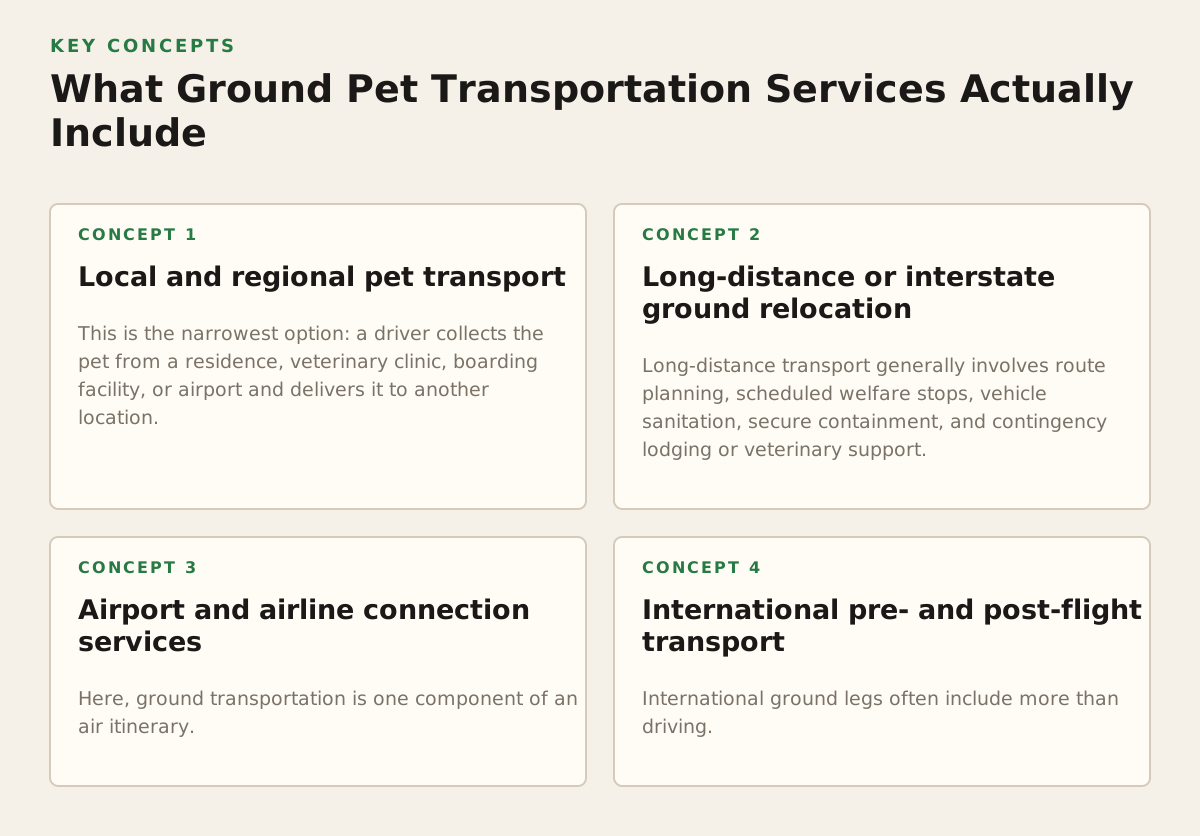
The phrase describes several different service categories. Buyers should identify the category before requesting a quote because the vehicles, staffing, documentation, and risk controls can be very different.
Local and regional pet transport
This is the narrowest option: a driver collects the pet from a residence, veterinary clinic, boarding facility, or airport and delivers it to another location. It can suit a family whose dog is flying separately, a cat moving between temporary housing and a permanent home, or a veterinarian arranging a safe transfer for a client.
Questions that define the service include whether the driver waits during a veterinary appointment, whether the pet remains in the same vehicle, how rest and bathroom breaks are handled, and whether the provider serves rural addresses. A “direct” trip may still include fuel stops or a driver change, so ask what direct means operationally.
Long-distance or interstate ground relocation
Long-distance transport generally involves route planning, scheduled welfare stops, vehicle sanitation, secure containment, and contingency lodging or veterinary support. Some providers use one dedicated vehicle; others combine scheduled routes. The second model may lower the operational burden for the provider but introduces transfer points that must be disclosed.
For a military PCS move, this service may connect a departing home with an airport, temporary lodging, or a new installation. It may also be useful when a pet is too anxious, medically unsuitable, or logistically difficult to place on a short-haul flight. However, a long road journey is not automatically gentler than flying. A nervous cat may tolerate a quiet aircraft hold better than repeated vehicle loading, while a dog accustomed to car travel may benefit from predictable ground movement.
Airport and airline connection services
Here, ground transportation is one component of an air itinerary. The provider may collect the pet, prepare or verify the travel crate, deliver the animal to the airline cargo facility, retrieve the pet after arrival, and drive to the final address. The buyer should determine whether the company merely drives the route or also coordinates the airline acceptance window and release process.
Airline rules are carrier- and route-specific. IATA provides guidance on live-animal transport and container considerations, but its guidance does not replace the operating airline’s current acceptance rules; review the official IATA Live Animals Programme information and confirm the airline’s instructions for the actual itinerary at IATA’s pet travel guidance. A ground provider that cannot explain who confirms the airline handoff is offering less than a full relocation plan.
International pre- and post-flight transport
International ground legs often include more than driving. They may require collection after an accredited veterinarian visit, delivery to an airport-approved facility, retrieval after customs clearance, and final delivery across a border or to a quarantine-approved address. In this category, the service must be evaluated as part of a regulated import chain.
Requirements depend on the destination, origin, species, age, vaccination history, transit countries, and arrival date. The USDA Animal and Plant Health Inspection Service directs owners to destination-specific pet travel requirements and endorsing-veterinarian information at its official pet travel portal. Ground transport does not eliminate an import permit, microchip rule, health certificate, rabies documentation, or pre-arrival notice.
Hawaii ground connections
For Hawaii, the road segment usually connects a home, mainland veterinary appointment, airport, inspection facility, or destination residence. It can be the difference between a coordinated arrival and a pet waiting at an unsuitable location while paperwork is corrected. Hawaii’s Animal Industry Division publishes the state’s animal quarantine and import instructions at its official Animal Quarantine Station page; those rules should be checked for the relevant island and arrival program in 2026.
Ask whether the provider handles the mainland leg only or also coordinates Hawaii document timing, inspection, and final-island delivery. A quote for “airport pickup” may not include an inspection delay, neighbor-island flight, ferry, or delivery outside ordinary business hours.
Why the Ground Leg Matters to the Buyer
Ground transport is often purchased to solve a specific failure point: an airline will not accept the pet on the chosen route, a family cannot drive cross-country before reporting for duty, the destination airport is far from the home, or the owner needs one accountable coordinator. The right service reduces coordination work. The wrong one merely moves that work onto the owner.
Match the service to the operating problem
| Buyer need | Best-fit service type | Main trade-off |
|---|---|---|
| Move a dog between two nearby homes or facilities | Local direct transport | Simple and focused, but usually limited to driving rather than paperwork or air coordination |
| Connect a pet to a domestic flight or retrieve it after landing | Airport transfer with airline coordination | Reduces airport burden, but timing depends on airline acceptance and release procedures |
| Relocate a cat or dog across several states | Dedicated long-distance ground move | Fewer air interfaces, but longer travel time and greater exposure to road, weather, and vehicle contingencies |
| Support an overseas PCS or corporate relocation | Door-to-door multimodal relocation | One coordinator can simplify handoffs, while international documentation and customs remain essential |
| Reach Hawaii with a prepared arrival | Hawaii-focused ground and air coordination | Inspection and island logistics can control the schedule even when the road leg is straightforward |
| Move a medically fragile or highly anxious pet | Customized private transport with veterinary input | More planning and potentially more expensive operations; provider must define emergency authority |
Evaluate burden, not just the quoted transport
Two providers can describe the same move differently. One may include door pickup, crate review, flight booking support, customs coordination, tracking, and final delivery. Another may quote a vehicle and driver while the owner books the airline, obtains the health certificate, delivers the crate, and solves a missed connection.
Request an itemized scope of responsibility. It should identify:
- Pickup and delivery addresses, access restrictions, stairs, gated communities, military housing rules, and rural roads.
- Whether the pet travels in a private vehicle, shared vehicle, climate-controlled van, or approved carrier.
- Driver staffing, transfer points, rest periods, feeding instructions, medication handling, and emergency contacts.
- Airline, airport, customs, quarantine, inspection, ferry, or neighbor-island responsibilities.
- What is included in the base quote and what triggers a change order.
For a diplomatic or executive household, discretion is an operating requirement, not a decorative promise. Ask how arrival details are shared, who receives documents, whether unapproved subcontractors may handle the pet, and whether the delivery appointment can be coordinated privately. Do not assume a provider’s general confidentiality language answers those questions.
Ask how pricing is constructed
Pet transport pricing may reflect distance, vehicle type, dedicated versus shared routing, number and size of pets, driver hours, overnight needs, airport handling, customs work, veterinary appointments, ferry or island connections, and schedule changes. A provider should be able to explain the pricing model and change-order triggers without promising a final number before the route and requirements are known.
Useful budget questions include:
- Is the quote per pet, per vehicle, per route, or a combination?
- Are tolls, parking, fuel adjustments, lodging, crate rental, airport fees, and after-hours delivery separate?
- What happens if a health certificate is delayed, an airline rejects the crate, or customs releases the pet later than planned?
- Is payment refundable if the owner cancels, the airline changes the itinerary, or the destination requirement changes?
- Does the quote include one attempt at delivery or repeated delivery attempts?
Do not use a low headline quote as proof of value. A cheaper local transfer can become expensive if it excludes the airport handoff, while a higher all-in quote may be easier to manage during a PCS reporting window. Treat any budget range supplied before route review as an illustrative planning example, not a universal benchmark.
How a Professional Ground Move Works
A reliable move is a chain of controlled handoffs. The buyer should be able to see what happens before pickup, during transit, at each transfer, and after delivery.
1. Intake and feasibility review
The provider should collect the pet’s species, breed, age, weight, temperament, medical conditions, medications, crate dimensions, feeding routine, and travel history. It should also collect origin, destination, preferred dates, military or employer deadlines, flight details if known, and any temporary lodging constraints.
This is where a provider should identify a route that cannot work. Examples include a carrier embargo, a destination that requires advance approval, an arrival outside an inspection window, or a pet whose medical condition needs veterinary clearance. A serious feasibility review may recommend changing the date or mode rather than accepting an impossible booking.
2. Compliance and document control
Documents should be assigned owners and deadlines. Depending on the move, the file may include identification and vaccination records, microchip information, rabies documentation, an official health certificate, import permits, airline forms, military orders, customs paperwork, and destination declarations.
The Centers for Disease Control and Prevention explains that dog-entry requirements for the United States can vary based on where the dog has been in the recent past and other factors; the current requirements should be checked directly through its official dog importation guidance. This matters to a returning service member or overseas employee: a domestic-looking ground leg may be attached to an international arrival history that changes the compliance file.
Use a single document owner and version-controlled checklist. A provider should tell you who verifies expiration dates, who submits forms, and who confirms acceptance—not merely that “paperwork is handled.”
3. Route, vehicle, and welfare planning
The route plan should account for weather, traffic, border crossings, construction, ferry schedules, overnight stops, and delivery access. Welfare planning should be specific to the pet rather than expressed as a generic promise of care.
For each animal, record:
- Normal meal times and whether food should be reduced before departure.
- Water method, bathroom routine, comfort item, and behavior triggers.
- Medication name, dose instructions supplied by the veterinarian, and authorization for administration.
- Safe handling method, escape risk, bite history, and whether the pet can share space with another animal.
- Emergency veterinary preference and the person authorized to approve treatment.
Never put medication instructions on a verbal-only basis. The owner, veterinarian, and transport coordinator should agree in writing. A driver should not improvise a sedative plan; medication and travel fitness belong under veterinary direction.
4. Handoff and tracking controls
At pickup, the provider should verify the pet’s identity, crate condition, documents, contact details, and destination. At every transfer, the record should show who accepted the pet, when, where, and in what condition. “Live tracking” can mean a GPS position, driver updates, milestone messages, or a customer portal, so ask what information is actually delivered and how often.
Useful success measures are concrete:
- The pet is released only to the named recipient or an approved delegate.
- Every planned handoff has a timestamp and responsible person.
- Document status is visible before the cutoff that governs the next leg.
- Any delay generates an escalation message rather than waiting for the owner to discover it.
- The pet arrives with its crate, medication, documents, and instructions intact.
5. Arrival, customs, and final delivery
At an international airport, the pet may need to pass through cargo handling, customs, veterinary inspection, quarantine review, or another release process before the ground driver can collect it. U.S. Customs and Border Protection advises travelers to check the requirements that apply to animals entering the United States through its official traveling-with-animals guidance. The transport provider should distinguish airport retrieval from legal release: a driver cannot simply collect an animal that customs or an inspection authority has not released.
Final delivery should include a condition check, recipient identification, document transfer, and confirmation that food, medication, crate, and personal items arrived. For temporary housing, obtain written permission before booking delivery. Some hotels, base lodging facilities, apartment buildings, and quarantine accommodations have access windows or pet restrictions that affect the last mile.
Where Ground Pet Transport Plans Break
Most serious problems occur at interfaces, not in the middle of an uneventful drive. A vendor’s contingency plan should name the decision-maker, communication path, and cost treatment for each foreseeable failure.
Airline rejection or schedule change
A pet may be refused because of route restrictions, heat or cold limitations, an unsuitable crate, missing documents, or a change in airline policy. If the ground provider is meeting a flight, ask whether it monitors the booking, who rebooks the animal, where the pet stays, and whether a new airport transfer is included.
Border, customs, and destination-rule delays
A missing endorsement, inconsistent microchip number, incorrect import date, or document issued outside the permitted window can stop a move. The ground provider may identify the issue and coordinate corrections, but it cannot waive a government requirement. Ask whether the company has an in-country customs or compliance partner and what the owner must still provide.
Weather, road, and vehicle incidents
Heat, winter storms, flooding, accidents, and road closures can turn a fixed appointment into a welfare decision. A credible plan explains climate control, stop frequency, emergency shelter, replacement vehicles, veterinary escalation, and owner notification. Be wary of an unconditional “on-time guarantee” that does not explain how safety decisions override schedule promises.
Pet-specific behavior or medical events
Escape attempts, vomiting, dehydration, aggression, respiratory distress, and missed medication require trained judgment. The provider should know when it will stop, call a veterinarian, contact the owner, or seek emergency treatment. The owner should provide current medical records and an emergency authorization policy before departure.
Handoffs and subcontracting
Subcontracting is not automatically unacceptable, but hidden subcontracting is a red flag. Ask for the names or roles of every party that may handle the pet, the insurance arrangement, the communication chain, and the standard used for vehicles and drivers. A provider that cannot identify custody at each stage cannot credibly promise end-to-end accountability.
Common warning signs include:
- A quote that omits pickup or delivery addresses and still claims to be final.
- Pressure to use inaccurate descriptions of the pet or route to obtain acceptance.
- No written policy for delays, missed connections, illness, escape, or emergency veterinary care.
- Requests for medication or feeding instructions that are never documented.
- Vague claims about “all paperwork” without a checklist, deadlines, or document owner.
- No named escalation contact outside the driver’s personal phone.
How Practitioners Should Apply the Service
The practical method is to design the move backward from the hardest deadline. For a PCS family, that may be the report date and temporary lodging checkout. For an overseas executive, it may be the destination import window and residence availability. For Hawaii, it may be the inspection and release schedule rather than the flight departure.
Build a route brief before requesting quotes
Give each provider the same information so the proposals can be compared fairly. Include:
- Exact pickup and delivery locations, including installation gates, airport terminals, ports, or quarantine facilities.
- Pet species, count, approximate size, crate dimensions, temperament, and medical considerations.
- Desired travel dates, hard deadlines, flexibility, and any known flight or ferry booking.
- International history, vaccination and microchip status, and destination-country or Hawaii requirements already identified.
- Whether the owner needs document coordination, customs support, tracking, crate handling, or only a driving leg.
For two pets, do not assume they can share a crate or vehicle space. For a cat and dog traveling together, request a separation and welfare plan. For a brachycephalic dog or a pet with respiratory disease, obtain veterinary guidance before comparing air and ground options. For a working military dog or a pet traveling under unusually sensitive circumstances, explain chain-of-custody and access requirements at intake.
Use a vendor interview checklist
Ask the same questions of every serious candidate and request written answers:
- Who is the contracting party, and who physically transports the pet?
- Is the route dedicated, shared, or subject to transfer? Where can transfers occur?
- What vehicle, containment, climate controls, and driver staffing apply?
- How are meals, water, bathroom breaks, medications, and rest handled?
- Who owns each health certificate, import permit, airline form, customs step, and deadline?
- What exactly does tracking show, and who receives delay notifications?
- What happens if the airline refuses acceptance, customs delays release, or a road closure changes the route?
- Who can authorize emergency veterinary care, and how are costs approved?
- What insurance or liability terms apply to the pet, personal property, and missed delivery?
- Which services are included, which are optional, and what causes a revised quote?
- How is the pet released, and what identification is required from the recipient?
- Can the provider supply a written itinerary, custody record, and final delivery confirmation?
Separate measurable outcomes from marketing language
“Safe,” “stress-free,” and “door-to-door” are not measurable by themselves. Convert them into deliverables. A practical service-level brief might require a named coordinator, document status by agreed dates, milestone updates at pickup and handoff, a response process for delays, and delivery to the approved recipient. Any numerical response time, update interval, or delivery window should be negotiated in the contract; the examples here are a starting policy for discussion, not a universal industry standard.
For an illustrative relocation involving one dog, a mainland home, an airport, a Hawaii inspection process, and a final residence, the file might contain:
- 4 custody events: home pickup, airport acceptance, inspection release, and final delivery.
- 3 document checkpoints: veterinary records before booking, destination compliance before departure, and release paperwork before arrival.
- 2 escalation paths: operational delay and medical emergency.
- 1 named decision-maker: the person authorized to approve rerouting, lodging, or veterinary care.
Those numbers are an illustrative way to expose gaps, not a claim that every move has the same structure. A complex international relocation may have more handoffs; a local clinic transfer may have only one.
Choose the least complicated service that solves the actual risk
If a trusted family member can safely drive a short local leg, a full relocation package may be unnecessary. If the move involves military orders, international import rules, Hawaii inspection, multiple airports, or a fixed reporting deadline, self-managing every handoff may create more risk than it removes. Families planning military pet shipping should account for orders, temporary lodging, installation access, and schedule changes rather than booking transport in isolation.
Likewise, a move to or from the islands should be evaluated as a complete Hawaii pet shipping itinerary. The cheapest driving segment is not necessarily the best choice if it leaves the owner responsible for an inspection deadline, missed release, or neighbor-island connection.
The best recommendation is to buy ground transportation as a defined operational layer: local transfer when that is all the move needs, dedicated long-distance transport when avoiding air is the priority, and door-to-door coordination when documents, customs, airline interfaces, and final delivery create the real burden. Before signing, require the route, custody points, welfare plan, compliance responsibilities, contingencies, and change-order rules in writing.
BestPetTravel provides door-to-door domestic and international pet transportation, including airline coordination, paperwork, customs support, live tracking, and delivery logistics. For PCS, Hawaii, or overseas relocations that need one coordinated plan, BestPetTravel.
Authored with NotFair SEO