
Global Pet Transportation: A Practical Guide for International Moves in 2026
September 18, 2026
Plan global pet transportation with a route, document, airline, and contingency framework for military PCS, Hawaii, corporate, and family relocations.
Global pet transportation is the coordinated movement of a dog or cat across borders, combining veterinary preparation, import compliance, airline or ground transport, customs clearance, and delivery to the final address. The safest approach is to treat the move as a chain of country-specific requirements—not as a single flight reservation—and assign one person to verify every handoff before the animal travels.
What Global Pet Transportation includes
An international pet move has three separate systems that must agree: legal entry, physical transport, and delivery logistics. A pet can be healthy and have a confirmed airline booking yet still be refused entry because a form is incomplete, a vaccination falls outside the destination’s window, or the arrival airport cannot process the shipment as planned.
The destination country sets the entry rules, the departure and transit countries may add their own controls, and the airline applies operational restrictions. The U.S. Department of Agriculture’s Animal and Plant Health Inspection Service (APHIS) explains that requirements vary by destination and may include health certificates, vaccinations, tests, identification, and endorsement; its official pet travel guidance should be checked for the specific country and the 2026 travel date.
The four planning layers
- Animal readiness: microchip status, vaccines, parasite control, fitness to fly, temperament, and crate acclimation.
- Document readiness: destination permits, health certificates, laboratory results, government endorsements, import declarations, and ownership or military orders when relevant.
- Movement readiness: airline acceptance, aircraft and temperature limits, crate specifications, transit-country rules, and airport handling.
- Recovery readiness: customs presentation, local delivery, emergency contacts, food and medication instructions, and a plan if the original itinerary changes.
These layers should be planned together. For example, choosing a nonstop route may reduce handling but offer fewer departure dates. A cheaper connection may introduce a transit country with an additional veterinary requirement. A large dog may need cargo transport even when a small cat could travel under an airline’s cabin policy. The decision is not simply “Which flight is available?” but “Which legally permitted route creates the fewest uncontrolled handoffs?”
Who owns each decision
For a family move, the owner may coordinate the veterinarian while a relocation specialist manages documents and transport. A corporate executive, diplomat, or government official may also need discreet scheduling and a limited-disclosure contact plan. The important control is a named owner for every task, not the job title of the person performing it.
| Task | Responsible party | Evidence to retain |
|---|---|---|
| Confirm destination entry rules | Relocation coordinator or owner | Official requirement page and dated checklist |
| Assess fitness and complete treatment | Accredited veterinarian | Medical record, certificates, laboratory reports |
| Accept the routing and crate | Airline or transport coordinator | Booking confirmation and written acceptance |
| Prepare arrival handoff | Receiving agent or family contact | Address, identification, phone numbers, contingency instructions |
Why the route matters more than the flight
International pet travel is a route-planning problem because each border crossing creates another compliance and handling event. A direct flight is not automatically the best choice: it may land far from the final destination, operate only seasonally, or have aircraft restrictions that exclude the pet’s crate. Conversely, a connection can be practical when it avoids extreme temperatures or provides a reliable animal-handling station.
Airline rules also matter independently of government rules. The International Air Transport Association’s official Live Animals Regulations information describes the industry framework used for transporting live animals, while the operating airline determines its acceptance conditions, embargoes, aircraft limitations, and booking process. That means a government-approved route still requires airline confirmation for the actual date, aircraft, crate, and animal.
A route screen that exposes hidden risk
Before requesting a quote, map the complete movement:
- Origin residence to departure airport.
- Departure airport acceptance and security or cargo processing.
- Each flight segment and every transit airport.
- Arrival inspection, customs, or quarantine processing.
- Final delivery to the residence, temporary lodging, base, or veterinary facility.
For each point, ask whether the pet changes custody, whether the crate leaves climate-controlled space, whether a document is inspected, and who can act if the schedule changes. A short ground transfer may be safer than adding a flight. A long airport wait may be acceptable only if the facility and carrier can accommodate the animal.
Build a route matrix rather than comparing flight numbers alone. Useful columns include country or airport, legal requirement, carrier restriction, responsible person, confirmation deadline, and backup action. This matrix is especially valuable when a pet travels separately from the family because the owner cannot solve a document problem from the passenger terminal.
Worked planning examples
The following are illustrative planning examples, not universal deadlines. The destination authority, veterinarian, and airline set the actual timing.
- Example 1: A family moving from the United States to Germany on 20 September 2026 might begin the document matrix on 20 June, verify the microchip and vaccine record on 25 June, and reserve the airline only after the carrier confirms the aircraft and crate.
- Example 2: A military family receiving overseas orders on 1 May might create two routes—one for the member and one for the pet—by 8 May, then ask the transportation office and airline about seasonal capacity before selecting a departure.
- Example 3: A dog traveling to Hawaii might use a primary airport plan and a mainland veterinary contingency by 1 August, with the owner treating Hawaii’s pre-arrival process as a separate workstream rather than assuming ordinary domestic travel rules.
- Example 4: A corporate transferee with a cat could designate the family’s destination address, temporary housing address, and local veterinary contact as three separate delivery records to prevent a late change from reaching only one participant.
The value of these dates is sequencing, not false precision. A document that is valid on the day it is issued may not remain valid for the chosen arrival window, and a route that works in winter may be unsuitable during a hot-weather embargo. Reconfirm the itinerary after any change to the flight, transit point, arrival date, or destination address.
How the move works from veterinary visit to delivery
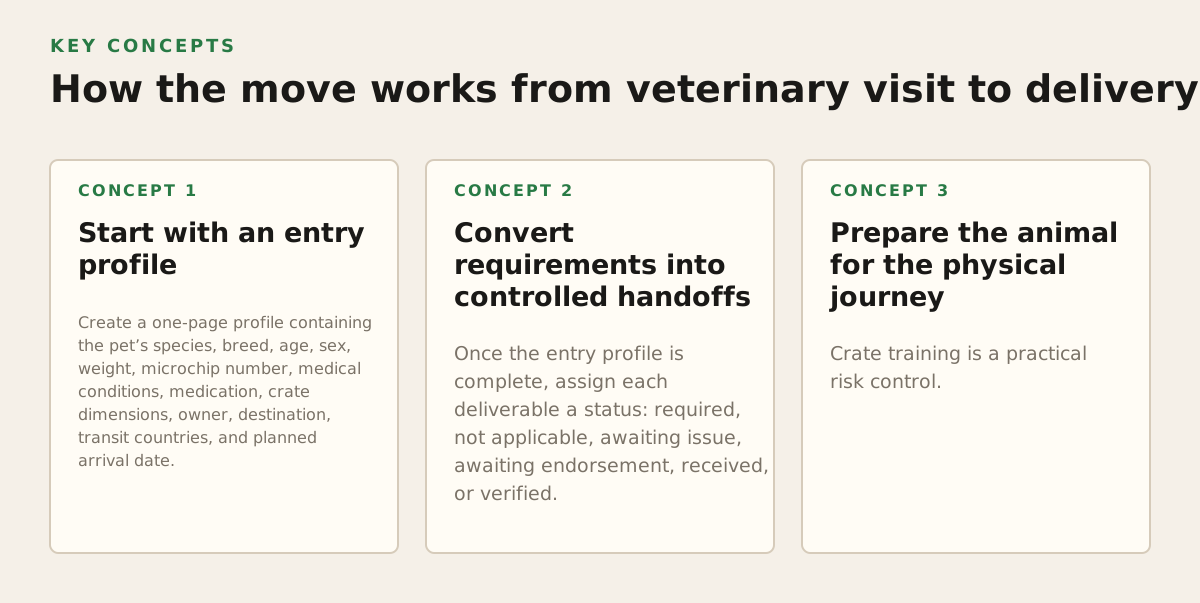
Start with an entry profile
Create a one-page profile containing the pet’s species, breed, age, sex, weight, microchip number, medical conditions, medication, crate dimensions, owner, destination, transit countries, and planned arrival date. Give that profile to the veterinarian and transport coordinator. It prevents a common error: preparing documents for the final country while overlooking a transit requirement.
For dogs entering the United States, the Centers for Disease Control and Prevention provides current requirements on its official bringing a dog into the United States page. Those requirements can differ according to where the dog has been during the relevant period, so “the dog is coming from Country X” may not be enough information. Cats and dogs also should not be treated as interchangeable: the applicable rule set, forms, and inspection process can differ.
Ask the veterinarian to reconcile the medical record with the travel identity. The microchip number should match the documents, the owner’s name should be consistent where required, and laboratory results should be attached to the correct animal. If a pet has a respiratory condition, anxiety, mobility limitation, or brachycephalic anatomy, discuss the route and season early rather than relying on sedation as a solution.
Convert requirements into controlled handoffs
Once the entry profile is complete, assign each deliverable a status: required, not applicable, awaiting issue, awaiting endorsement, received, or verified. Keep originals and scans in separate locations, but do not assume a digital copy substitutes for an original when an authority or airline requires paper.
- Identity check: compare the microchip record, medical record, certificate, and booking.
- Date check: confirm that vaccines, tests, certificates, and permits fall within the destination’s permitted windows.
- Signature check: verify whether a private veterinarian, government veterinarian, notary, or other authority must sign.
- Submission check: record where each document was sent, by whom, and when approval or endorsement is expected.
- Arrival check: prepare the person receiving the pet with copies, phone numbers, and instructions for delays.
Government forms are not interchangeable with an airline’s booking record. The airline needs operational information—crate size, animal weight, contact details, and route acceptance—while border authorities need evidence of eligibility. A complete packet serves both purposes without treating one as proof of the other.
Prepare the animal for the physical journey
Crate training is a practical risk control. The pet should be comfortable entering, turning, standing, and resting in the travel crate well before departure. The owner should attach feeding and watering instructions in a way that remains legible, provide familiar but safe bedding if permitted, and keep medication directions with the responsible handler. Do not place loose objects in the crate that could injure the animal or block ventilation.
At departure, the coordinator should confirm acceptance, document condition, and communicate the next handoff. At arrival, the receiving person should verify identity, inspect for obvious distress, offer water as directed, and follow the agreed veterinary escalation plan. Live tracking can improve visibility, but it does not replace airline confirmation or a person empowered to make a route decision.
Where international pet moves break
Most serious failures occur at boundaries: between a veterinarian and an authority, between a passenger booking and a cargo booking, or between a flight arrival and the final delivery vehicle. A useful review looks for single points of failure instead of merely adding more paperwork.
- Rule changes: an official requirement changes after the owner saves an old webpage or form.
- Identity mismatch: one digit in a microchip number or a different spelling of the owner’s name creates doubt.
- Timing drift: a delayed flight moves arrival outside a certificate or test window.
- Carrier rejection: the airline accepts the route in principle but not the specific aircraft, crate, breed, or temperature conditions.
- Unowned arrival: customs, quarantine, or delivery staff cannot reach the person authorized to collect the pet.
Use a contingency ladder: first adjust the ground transfer, then consider a flight change, then activate a veterinary or boarding arrangement, and only after that consider a full reroute. Each level should have an authorized decision-maker and a spending or approval limit established by the owner. The exact limit is a client policy, not a universal industry standard.
Weather deserves its own decision rule. A route that is legal may still be unsuitable when heat, cold, storms, or aircraft exposure increases risk. Build a seasonal alternative before the booking is issued. For a pet with a medical concern, identify a destination veterinarian and an emergency contact before travel; that is more useful than a generic promise to “monitor the pet.”
Hawaii requires particular care because the state maintains an animal quarantine program and publishes entry information through the Hawaii Department of Agriculture and Biosecurity. Owners should use the state’s official animal quarantine information page for current forms, inspection, and pre-arrival instructions in 2026. Treat Hawaii pet shipping as a regulated arrival project, not as an ordinary mainland domestic flight.
How practitioners apply the framework
Military PCS relocations
A PCS move adds a second schedule: the service member’s orders and travel dates may be firm before pet capacity is available. Begin by separating what the military transportation office controls from what the owner, veterinarian, and airline control. The family should ask about reimbursement or assistance policies through its current official channels rather than assuming a benefit applies to every route or rank.
For military pet shipping, keep the pet’s route matrix beside the family’s PCS itinerary. Include the gaining installation, temporary lodging, port or airport, authorized receiving contact, and a plan if the family arrives before the pet. A destination base may be only one part of the delivery address; confirm whether the pet is going to housing, a kennel, temporary quarters, or an off-base residence.
Hawaii arrivals and departures
For a Hawaii move, distinguish the state’s entry process from airline acceptance and from the final island transfer. A pet may clear one step and still need another inspection or ground arrangement. Confirm the island of final residence, the airport of arrival, the inspection location, and the person who will collect the animal.
Owners should not buy a nonrefundable itinerary merely because a vaccination has been completed. First verify the state’s current process, then align the veterinary appointment, submission or approval timing, airline acceptance, and arrival date. If the owner is moving between islands, add that segment to the route rather than treating it as an informal afterthought.
Corporate, diplomatic, and veterinary clients
Corporate and diplomatic relocations often have compressed schedules, temporary housing, assistants, drivers, or security requirements. The practical response is a minimum-necessary information plan: share the pet’s medical and identity details with the people who need them, while giving drivers and building staff only the delivery information required for their handoff. A designated alternate contact prevents a public official’s schedule change from stranding the animal.
Veterinarians and relocation professionals can improve outcomes by agreeing on the division of labor at the first appointment. The veterinarian validates health and treatment records; the relocation coordinator validates the route and administrative sequence; the owner validates identity, authority, and final decisions. No participant should certify a requirement outside their role.
Before release, use a final gate with five questions:
- Has the destination and every transit point been checked against current official guidance?
- Does the animal’s identity match every document and booking?
- Has the airline accepted this animal, crate, aircraft, and date?
- Is a named person responsible at departure, transit if needed, arrival, and delivery?
- Is there a realistic response if weather, paperwork, or the flight schedule changes?
The best operational recommendation is to choose the route only after those five answers are documented, then keep one live record through delivery. BestPetTravel provides door-to-door domestic and international pet transportation, including airline coordination, paperwork, customs support, live tracking, and delivery logistics; for a multi-border or military move, contact BestPetTravel through BestPetTravel to discuss the route and handoffs before booking.
Authored with NotFair SEO