
Door-to Door Pet Transportation: A Practical Guide for Relocations
September 7, 2026
Door-to door pet transportation explained for PCS, international, and Hawaii moves, including paperwork, airline coordination, risks, and delivery planning.
Door-to door pet transportation is a coordinated service that moves a dog or cat from the current residence to the new residence, rather than treating the airline segment as the entire assignment. For a military family, overseas employee, diplomatic household, or veterinarian helping a client, that distinction matters: the work includes route planning, health documentation, airline coordination, customs support, and final delivery. The objective is not merely to place an animal on a flight. It is to manage the connected handoffs that determine whether the pet arrives legally, safely, and at a usable time.
What door-to-door pet transportation actually includes
A pet’s journey has several different operating environments. The animal may leave a home in a private vehicle, enter an airport cargo or passenger process, travel through one or more airports, pass an import inspection, and continue by ground vehicle to the destination. Each environment has different rules, failure points, and responsible parties. Door-to-door means continuity across those environments, not that one person physically accompanies the pet every mile.
A complete plan normally defines four endpoints:
- Origin door: the residence, military installation, veterinary hospital, boarding location, or other approved pickup point.
- Departure handoff: the location and time at which the pet enters the airline or airport process.
- Arrival release point: the airport facility, border inspection point, quarantine location, or other place where the pet is legally released.
- Destination door: the receiving residence, hotel, temporary lodging, base housing, or designated caretaker.
Those endpoints must be connected by a written sequence. If a family knows only the flight number, it may still lack the pickup window, document owner, customs contact, receiving driver, or contingency plan. A professional transportation file should identify who has the pet at each stage, which document is being checked, and what event authorizes the next handoff.
The difference between a flight booking and a relocation plan
An airline booking answers a narrow question: how will the animal travel on a particular flight? A relocation plan answers broader questions: is the animal eligible for that flight, will the destination accept the documents, who handles the arrival inspection, and what happens if the itinerary changes? Airline acceptance can depend on aircraft type, temperature restrictions, kennel dimensions, breed or species policies, connection structure, and whether the animal travels in the cabin, as checked baggage where permitted, or as manifested cargo.
Airline and shipper requirements should be treated as separate from government import requirements. The International Air Transport Association’s traveler guidance explains that airlines can impose their own pet-travel conditions and that kennel preparation is part of the shipper’s responsibility; review the current guidance in 2026 at IATA’s official pet travel information. Government approval does not guarantee airline acceptance, and an airline reservation does not prove import compliance.
What the service provider is coordinating
For a domestic relocation, coordination may center on safe ground transport, timing, carrier preparation, and delivery. For an international relocation, the file may also include destination permits, veterinary certificates, laboratory work, official endorsement, customs preparation, and airport release. Hawaii requires its own planning track because the state administers animal import requirements that differ from ordinary interstate travel. The Hawaii Department of Agriculture’s Animal Industry Division publishes current animal quarantine information at its official Hawaii Animal Quarantine page.
In practical terms, door-to-door service is a chain-of-custody and compliance problem with transportation attached. The most useful deliverable is not a vague promise of assistance; it is a documented plan showing the route, deadlines, owners, dependencies, and fallback actions.
Why the door-to-door model matters for relocations
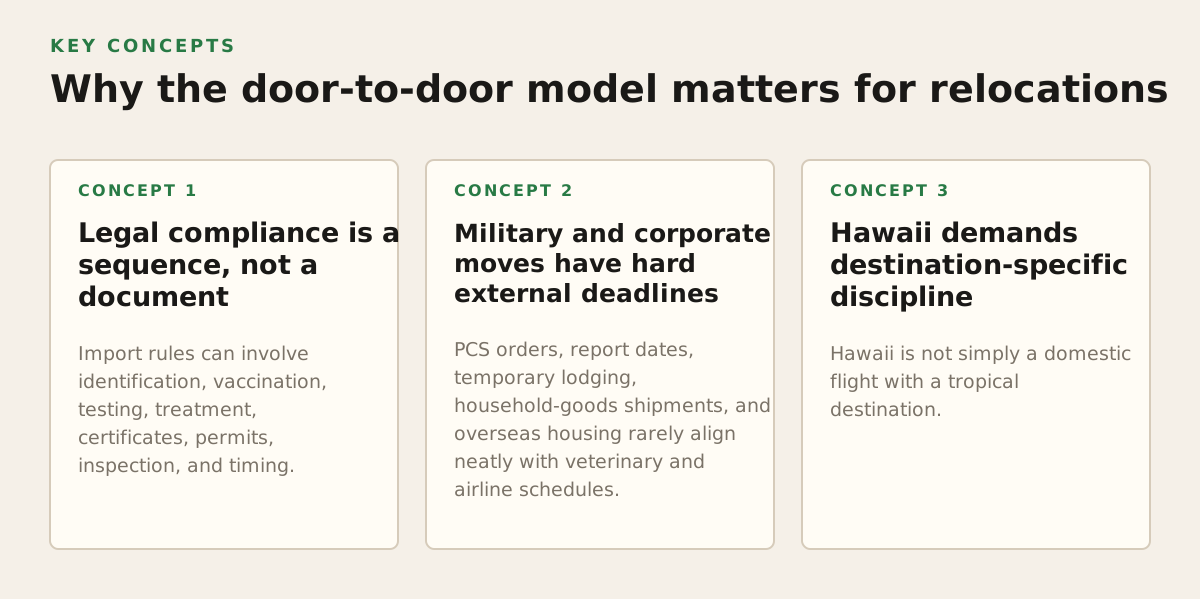
Pet travel failures rarely come from a single dramatic mistake. More often, a small omission at one stage becomes an expensive problem at the next. A certificate may be valid but issued outside the destination’s permitted window. A flight may be available but unsuitable for the kennel or season. A family may arrive at the destination while the pet remains in an arrival facility awaiting a document review. The value of coordination is reducing disconnected decisions.
Legal compliance is a sequence, not a document
Import rules can involve identification, vaccination, testing, treatment, certificates, permits, inspection, and timing. The requirements depend on the animal’s species, origin, destination, age, travel history, and route. The United States Department of Agriculture’s Animal and Plant Health Inspection Service directs travelers to destination-specific requirements through its official pet travel resource. That resource should be checked in 2026 before a route is finalized, not merely after tickets have been purchased.
The sequence matters because one requirement can depend on another. For example, a destination may require a particular identification method before recognizing a vaccination record, or it may require a certificate within a defined period before arrival. A coordinator should convert official rules into a dated action register rather than copying a general checklist into an email.
Military and corporate moves have hard external deadlines
PCS orders, report dates, temporary lodging, household-goods shipments, and overseas housing rarely align neatly with veterinary and airline schedules. A family may have a narrow window between vacating a home and reporting to a duty station. An executive may need the pet delivered after the residence is ready but before an extended assignment begins. A diplomatic or government household may require discreet communication and a controlled receiving plan.
For military families, orders and pet documents should be planned as parallel workstreams. The travel office may manage the family itinerary while a pet transportation coordinator manages the animal’s eligibility and movement. Information from one stream must still be reconciled with the other:
- Compare the family’s departure date with the earliest legally usable veterinary document date.
- Compare the pet’s arrival airport with the household’s onward transportation and lodging.
- Confirm whether the destination address is final, temporary, or restricted to authorized contacts.
- Record reimbursement or command-specific paperwork separately from government import paperwork.
- Build a contingency contact tree for the service member, spouse, coordinator, veterinarian, airline, and receiver.
Families considering military pet shipping should also distinguish transportation planning from any benefit or reimbursement question. A transportation provider can organize the move, but the family must confirm eligibility, submission rules, and required receipts with the appropriate military or government office.
Hawaii demands destination-specific discipline
Hawaii is not simply a domestic flight with a tropical destination. Its animal import process can require advance preparation and inspection-related steps. The state’s official guidance should control the plan, including the applicable program, forms, fees, identification requirements, and arrival procedures in force in 2026. Do not schedule the airline segment until the Hawaii entry path is understood.
For a family moving on short notice, the critical question is often not “Can the pet fly?” but “Can the pet be released when it arrives?” A pet may travel successfully and still face delay if the receiving process is incomplete. A Hawaii plan therefore needs both a flight plan and a release plan, with the latter tied to the correct airport and arrival window.
How a professional pet transportation move works
A reliable move begins with an intake that is detailed enough to expose constraints before money is committed or dates become difficult to change. The coordinator should collect the pet’s species, breed, age, weight, measurements, temperament, medical considerations, identification details, origin, destination, preferred dates, and travel history. The owner’s requirements matter too: military reporting dates, temporary lodging, privacy needs, accessibility, and whether a trusted receiver can accept delivery.
Stage 1: Build the route around eligibility
Start with the legal and physical constraints, then select the route. The shortest route is not always the best route. A connection may reduce driving but add an airport handoff. A longer ground segment may avoid a difficult transfer. A particular aircraft may have a cargo hold limitation or seasonal restriction. The route decision should document the trade-off instead of presenting an itinerary as self-evidently optimal.
A route review should answer:
- Which segments are by ground vehicle, passenger cabin, checked process where allowed, or cargo?
- Which carrier or facility accepts the animal, kennel, and species on each segment?
- Where does custody change, and who confirms acceptance?
- Which destination authority reviews the animal on arrival?
- What is the backup if a flight is delayed, canceled, misconnected, or refused at check-in?
Temperature, aircraft type, connection time, airport operating hours, and kennel fit can all affect feasibility. A coordinator should not promise a route until the airline’s current rules and the animal’s measurements have been reconciled. IATA’s official traveler guidance describes carrier and kennel considerations, but the operating airline remains the controlling source for its booking and acceptance policy.
Stage 2: Turn requirements into a document matrix
Rather than maintaining one undifferentiated folder, separate the file into categories. The matrix should show the document, issuing authority, pet or traveler it applies to, issue date, expiration or use window, original or copy requirement, and person responsible for carrying it.
| Document category | Decision it supports | Typical owner | Failure if missing |
|---|---|---|---|
| Identification record | Whether the animal can be matched to its health and import records | Owner and veterinarian | Record mismatch or delayed review |
| Vaccination or treatment record | Whether destination rules are satisfied | Veterinarian | Rejection, retesting, or delayed release |
| Health certificate | Whether the animal is medically documented for the relevant journey | Accredited veterinarian and owner | Airline or authority refusal |
| Official endorsement or permit | Whether a government process has been completed when required | Owner or coordinator | Document deemed incomplete |
| Transport record | Whether airline and ground teams have matching movement details | Coordinator and carrier | Missed handoff or incorrect release |
The exact categories vary by route. The table is a planning tool, not a substitute for official rules. For entry into the United States, the Centers for Disease Control and Prevention publishes dog-import requirements and updates at its official dog importation page. If the pet is a cat or another species, the applicable federal, state, and destination rules must be reviewed separately.
Stage 3: Prepare the pet and the receiving environment
Preparation is more than buying a kennel. The animal should be accustomed to the carrier in advance, and the owner should provide accurate feeding, medication, handling, and emergency-contact instructions. Sedation decisions belong with the veterinarian; owners should not improvise medication because a flight is stressful. The destination should be ready with water, food, a leash or secure carrier, medication, and a quiet recovery area.
For each move, create a practical handoff packet containing:
- Current contact information for the owner and destination receiver.
- Veterinary records and the route-specific document set.
- Feeding, medication, behavior, and handling instructions.
- Photographs or identifying details useful at a handoff.
- Flight, ground-transfer, facility, and emergency contact information.
- Written authority for an alternate receiver if the primary person is unavailable.
Live tracking is useful only when paired with human ownership. A status update can show that a flight departed, but it cannot by itself resolve a customs hold, an incorrect receiver phone number, or a delayed ground vehicle. The coordinator should define what each status means and who acts when the status stops changing.
Stage 4: Manage arrival, release, and final delivery
Arrival is a separate operational phase. The pet may need inspection, document review, customs processing, facility release, or a transfer to a local driver. The receiving person should know where to wait, what identification may be required, and what happens if the release time changes.
A strong delivery instruction includes:
- The approved delivery address and an alternate secure location.
- The name and phone number of the person authorized to receive the pet.
- Access instructions for a base, apartment building, hotel, or gated community.
- Local veterinary and emergency contacts supplied by the owner.
- A welfare check after delivery, including water, food, rest, and medication.
For international moves, customs support should be planned before arrival rather than treated as an airport favor. The coordinator needs to know which party is the importer or consignee, which documents travel with the pet, and whether a broker, facility, or government office must be contacted. Final delivery is complete only after legal release and confirmed receipt.
Where pet transportation plans break down
The most useful risk review is specific. “Delays are possible” is not a contingency plan. A workable plan identifies the trigger, the consequence, the owner of the response, and the decision deadline.
Paperwork errors and timing conflicts
Common document failures include an incorrect identification number, inconsistent spelling, missing signature, wrong destination, unacceptable form version, or a certificate issued too early or too late. These errors can be difficult to correct once the pet is at the airport. A document audit should compare the animal’s identifier, owner name, route, dates, and destination address across every record.
Use a two-pass review:
- Review the official destination instructions and list every requirement in dependency order.
- Review the completed documents against that list, then have a second responsible person check names, numbers, dates, signatures, and attachments.
The second pass is not a guarantee of acceptance. It is a way to catch clerical discrepancies before an authority or airline does. When rules are unclear, obtain clarification from the relevant official authority or airline rather than relying on a general internet checklist.
Airline, weather, and aircraft constraints
Airline schedules change, aircraft substitutions occur, and acceptance rules can vary by route or operating carrier. Weather can affect both the animal’s welfare and the availability of a connection. A pet may be legal to import but unsuitable for a particular itinerary because of heat, cold, long ground exposure, or an airport’s operating pattern.
Do not treat a backup flight as the only contingency. Also define a safe holding plan: who can collect the pet, where the pet can rest, who can provide food or medication, and how the next movement will be approved. The right response to a disruption may be a delay rather than an immediate rebooking.
Customs and arrival-release confusion
Owners often assume that the person who books transportation also controls customs release. That may not be true. Government inspection, airline cargo handling, customs brokerage, and ground delivery can be separate functions. Before departure, identify the authority responsible for release and the documents that authority will inspect.
For an international move, ask these questions in writing:
- Who is listed as the importer or consignee?
- Which party receives notices from the arrival facility?
- Where is the pet held if release is not immediate?
- Who can authorize additional services or a route change?
- What is the approved delivery plan after release?
These questions are especially important for diplomatic, executive, and government households where the destination address or receiving contact may be confidential. Privacy requirements should be communicated as operating instructions, not assumed from the client’s job title.
Medical and behavioral misjudgment
A pet’s age, breed, respiratory status, anxiety, injury, or medication schedule can change the appropriate mode of transport. A veterinarian should evaluate medical fitness and advise on medication. The transportation plan should then reflect that advice through routing, rest periods, handling notes, and emergency contacts. A carrier cannot replace veterinary judgment, and a veterinary clearance does not override an airline’s operating rules.
Owners should disclose behavior that affects handling, including escape attempts, bite history, barrier anxiety, or fear of unfamiliar people. Accurate disclosure allows the team to choose secure equipment and a lower-risk handoff. Concealing a problem can cause a refusal at origin or an unsafe intervention during transit.
How practitioners apply the model to real moves
The same framework produces different decisions for different audiences. The route, document owner, contingency budget, communication style, and delivery plan should be adapted to the assignment rather than selected from a generic package.
Illustrative planning examples
The following examples are illustrative starting policies, not universal benchmarks. Actual requirements and timing must be confirmed for the route and travel date.
- One-dog domestic PCS: use one origin pickup, one airline segment, and one destination delivery. Assign one person to reconcile the service member’s report date with the dog’s veterinary appointment and create two named receivers in case base access changes.
- Two-cat international relocation: create separate identification and health-record lines for each cat, even when they share an owner. Use a shared flight plan but individual document checks so a discrepancy in one file does not obscure the other.
- Hawaii move: treat the state’s entry and release process as its own workstream. Confirm the applicable program, arrival airport, required records, and post-release driver before selecting the family’s preferred flight.
- Executive relocation: limit sensitive address and itinerary details to the people who need them. Put the receiver’s authorization, secure delivery location, and alternate contact in the operational file.
- Veterinary referral: ask the veterinarian to provide medical and handling information, while the transportation coordinator verifies airline and destination requirements. Keep clinical advice and logistics ownership distinct.
A decision sequence for families and coordinators
When time is limited, use a gate-based process. Do not advance to the next gate merely because a preferred date is available.
- Eligibility gate: confirm destination rules, species eligibility, identification, and any required veterinary steps.
- Route gate: confirm that the airline, aircraft, kennel, season, connections, and ground legs are workable.
- Document gate: verify dates, signatures, endorsements, permits, copies, and responsible custodians.
- Handoff gate: name every origin, airport, inspection, customs, and destination contact.
- Contingency gate: decide what happens after refusal, delay, missed connection, document query, or unavailable receiver.
- Release gate: confirm the legal release path and destination delivery before departure.
This sequence helps a family distinguish a real constraint from a preference. A preferred departure date is negotiable; an official document window may not be. A direct flight may be desirable; a route that cannot accept the kennel is not viable. A destination hotel may be convenient; it is not a valid delivery point if the hotel will not accept the animal or the owner is absent.
Questions that expose weak plans
Before authorizing a move, ask the coordinator or internal relocation team:
- What exact event confirms that the pet has entered each custody stage?
- Which requirements come from the government, and which come from the airline?
- Who checks the final document set, and on what date?
- What is the response if the destination authority asks for clarification?
- Who can receive the pet if the owner is delayed?
- Where does the pet rest if the scheduled connection cannot operate?
- How will the family receive updates, and who is empowered to make a time-sensitive decision?
A provider should be able to explain the plan without hiding behind broad assurances. The best sign of readiness is not a long list of services; it is a clear allocation of responsibility, with dependencies visible before the animal begins the journey.
What to request when selecting door-to-door support
Choose support based on the complexity of the move, not just the flight price or the number of miles. A straightforward domestic transfer may need dependable ground logistics and airline coordination. An overseas, Hawaii, military, or high-profile relocation may require route analysis, document management, customs support, live status communication, and a carefully controlled delivery process.
Request a written scope that identifies:
- Origin pickup and destination delivery locations.
- Airline or transport coordination responsibilities.
- Veterinary-document and government-process responsibilities.
- Customs or arrival-facility coordination, if applicable.
- Tracking and update procedures.
- Handoff contacts and contingency decision-makers.
- Items the owner, veterinarian, airline, or government authority must provide.
Also ask what the provider does not control. A candid scope should state that official authorities control entry decisions, veterinarians control medical advice, and airlines control acceptance under their current operating rules. Clear boundaries prevent false certainty and make escalation faster when a requirement changes.
For a 2026 move, begin with current official destination and airline information, then have the transportation plan reconcile those rules with the family’s actual schedule. This is particularly important when a PCS report date, an overseas employment start date, temporary housing, or a Hawaii arrival window leaves little room for recovery.
BestPetTravel provides door-to-door domestic and international pet transportation with airline coordination, paperwork support, customs assistance, live tracking, and delivery logistics for families, professionals, military relocations, and high-profile clients. To discuss a route-specific plan, visit BestPetTravel.
Authored with NotFair SEO