
Aphis Pet Travel: A Practical Guide for International Dog and Cat Relocation
August 12, 2026
APHIS pet travel explained for military PCS, Hawaii, and international moves: understand certificates, timing, airline rules, and avoidable delays.
For military families, corporate transferees, diplomats, and veterinarians arranging a cross-border move, APHIS pet travel is the U.S. Department of Agriculture process that helps determine and document whether a dog, cat, or other regulated animal can leave the United States for a particular destination. It is not a single permit, universal vaccination rule, or airline booking. It is a destination-specific compliance workflow involving the destination country, an accredited veterinarian, the USDA Animal and Plant Health Inspection Service (APHIS), the airline, and sometimes customs or an import agent.

The practical distinction matters. A pet may be healthy, vaccinated, microchipped, and accepted by an airline yet still be refused entry because the destination requires a particular certificate, laboratory test, government endorsement, import permit, or arrival deadline. APHIS directs owners to identify the destination’s requirements and explains the endorsement process through its official Pet Travel guidance. Those requirements can change, so a relocation plan should be built from the current destination page rather than from a prior move, a social-media checklist, or a neighbor’s experience.
What Aphis Pet Travel Actually Covers
APHIS is the federal agency that supports the export of animals from the United States and provides country-specific guidance for pet travel. Its role is generally to help verify that an animal meets the importing country’s requirements and, when required, to endorse the veterinarian’s paperwork. APHIS is not the destination government: the receiving country decides what it will admit, while APHIS helps document compliance for exports from the United States.
The four authorities in one move
A successful relocation usually has four separate rule sets. Treating them as interchangeable is one of the most common planning errors.
- Destination-country rules: These may govern identification, rabies vaccination, parasite treatment, blood testing, quarantine, import permits, and the format or timing of a health certificate.
- U.S. export rules: APHIS may require a USDA-accredited veterinarian to complete a certificate and may require official endorsement before departure.
- Airline rules: The carrier controls crate acceptance, aircraft or route restrictions, temperature policies, connection handling, and whether a pet travels in the cabin, as checked baggage, or as manifested cargo.
- Transit and arrival rules: A connection through another country, a change of airport, customs inspection, or a final domestic flight can create additional obligations.
For example, a dog flying from the United States to an overseas duty station might need one document for the destination, an endorsement from APHIS, and a separate airline reservation. A cat traveling to a U.S. state may not need the same federal export paperwork, but the state, airline, or local authority can still impose entry conditions. One itinerary can contain several jurisdictions, and the strictest timing rule may control the entire schedule.
What APHIS does not guarantee
APHIS endorsement does not guarantee that an airline will accept the animal or that an overseas border officer will waive a missing destination requirement. It also does not replace a veterinary examination. An endorsed certificate can be rejected if it is outside the receiving country’s validity window, lacks a required laboratory attachment, contains inconsistent identification details, or was issued by the wrong professional.
That is why the useful question is not “Do I have an APHIS certificate?” The better question is: Which authority requires each document, who issues it, who endorses it, and when does it expire? A written answer to those four questions gives a relocation team something it can audit before tickets are issued.
Why the Process Matters for PCS and International Relocation
Pet travel paperwork is a dependency problem. A rabies vaccination may need to occur before a blood sample; the blood result may need to precede an import permit; the permit may need to be referenced on a health certificate; and the certificate may need government endorsement within a narrow period before arrival. If one event occurs too early or too late, the family may have to change flights, extend temporary housing, or arrange boarding.
For a military household, this can collide with report dates, housing availability, port calls, and government-funded travel rules. For an executive or diplomatic family, the constraint may be a fixed posting date, a principal’s travel schedule, or a requirement for discreet handoff. Pet readiness is a project schedule, not an appointment made a few days before departure.
The timing chain
Build the timeline backward from the animal’s lawful arrival date, not forward from the first veterinary visit. The destination’s rules determine the sequence, and APHIS explains that requirements vary by country and animal type through its country-specific pet travel materials. In 2026, the APHIS online guidance remains the appropriate starting point for confirming the current destination pathway; a previous certificate should be treated as historical evidence, not a reusable template.
- Confirm the destination and transit route. Record the country of final entry, every connection, airport changes, and whether the animal will leave the international transit area.
- Verify identification. Match the microchip or other identification information across veterinary records, laboratory reports, import permits, and certificates.
- Map prerequisite events. Identify vaccinations, waiting periods, blood tests, parasite treatments, and examinations that must occur in a particular order.
- Reserve the airline movement. Ask the carrier to confirm the animal’s acceptance, crate requirements, route restrictions, and documentation cutoff before treating the itinerary as final.
- Schedule endorsement and final review. Leave time for corrections, weekends, federal holidays, courier movement, and a rejected or incomplete submission.
The following numbers are illustrative planning examples, not universal APHIS deadlines. A team might set internal checkpoints of 120 days before departure for destination research, 90 days for any prerequisite testing, 45 days for airline confirmation, 21 days for a document audit, and 7 days for a final packet review. The actual legal windows must come from the destination’s current authority and the applicable APHIS instructions.
Why “healthy” is not enough
A clinical examination answers whether the veterinarian believes the animal is fit for travel at that time. Import compliance answers whether the receiving jurisdiction will admit that identified animal under a particular legal pathway. They overlap, but they are not the same question. Clinical readiness and border readiness are separate gates.
A healthy dog can still miss an arrival window. A properly vaccinated cat can still have a certificate with an incorrect address. A family can possess an official-looking form that is unusable because the veterinarian was not accredited for the required export certificate. The operational fix is to maintain a document matrix with an owner, deadline, source, and status for every requirement.
- Requirement and destination authority
- Animal to which it applies
- Issuing professional or office
- Earliest valid date and latest valid date
- Required original, copy, scan, or electronic record
- Person responsible for checking it before departure
How an APHIS Travel File Moves From Vet to Border
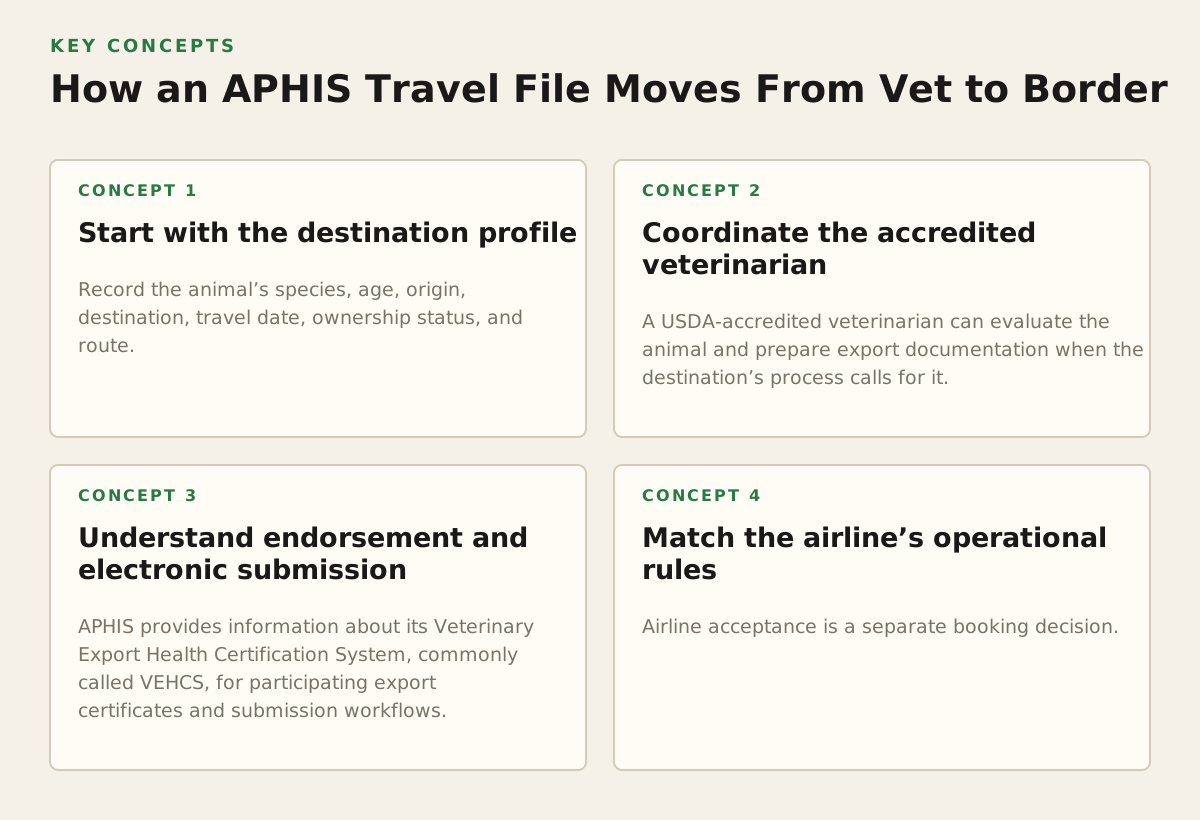
The paperwork path is easier to manage when each handoff has a defined purpose. The veterinarian supplies medical facts and completes the relevant certificate. APHIS, when required, reviews and endorses the export documentation. The airline checks carriage conditions. The destination authority or border official decides admission. Every handoff can introduce a different failure, so do not assume that approval by one participant satisfies the next.
Start with the destination profile
Record the animal’s species, age, origin, destination, travel date, ownership status, and route. Dogs can face rules that do not apply to cats, and a pet accompanying its owner can be treated differently from an animal shipped separately. Some destinations also distinguish between commercial and noncommercial movement, military relocation, rescue transport, and temporary travel.
Use official sources for the legal requirements. The APHIS country guidance is the first U.S. export reference. For dogs entering the United States, the Centers for Disease Control and Prevention maintains a separate official dog importation page, which illustrates why an owner must distinguish the country of departure from the country of entry. A dog returning to the United States is not simply following the rules of the country it left.
Coordinate the accredited veterinarian
A USDA-accredited veterinarian can evaluate the animal and prepare export documentation when the destination’s process calls for it. Before the appointment, provide the veterinarian with the exact destination, route, intended arrival date, and any official permit or certificate instructions. Do not ask for a generic “international health certificate” without identifying the destination pathway.
Bring consistent records and ask the clinic to compare:
- Microchip number and implantation or reading details
- Rabies product, date, manufacturer, and validity information
- Other required vaccinations or treatments
- Laboratory reports and sample dates
- Owner, consignee, and destination addresses
- Flight or transport details when the certificate requests them
Consistency is a compliance control. A transposed microchip digit is not a cosmetic typo if the border officer cannot connect the certificate to the animal. The same applies to a misspelled surname, an incomplete destination address, or a laboratory report that identifies a different animal.
Understand endorsement and electronic submission
APHIS provides information about its Veterinary Export Health Certification System, commonly called VEHCS, for participating export certificates and submission workflows. The current APHIS export guidance explains that the veterinarian or authorized party should follow the applicable country instructions and endorsement process. Whether a certificate is submitted electronically, mailed, or handled through another approved method depends on the specific certificate and current instructions.
Do not infer that “submitted” means “endorsed.” Track at least three statuses: prepared by veterinarian, received for official review, and endorsed and returned. A travel coordinator should retain the endorsed document in the format required by the destination and carry backup copies separately from the animal.
Match the airline’s operational rules
Airline acceptance is a separate booking decision. The International Air Transport Association publishes a Live Animals Regulations and pet travel resource describing industry guidance for the transport of live animals. That guidance does not replace a carrier’s own rules, so the operating airline remains the controlling source for its route and aircraft.
Ask the airline or cargo department to confirm, in writing where possible:
- Whether the animal can travel on the selected flight and connection
- Which crate dimensions and construction are accepted
- Whether seasonal temperature or breed restrictions apply
- Where and when the animal must be tendered
- How medication, feeding instructions, and emergency contacts are handled
- Whether the pet is booked as cabin baggage, checked baggage, or cargo
A routing that looks shortest on a map may create more handling points. A direct cargo movement may reduce transfers but require a different terminal, booking process, or pickup schedule. Choose the route for controllability, not mileage alone.
Where Aphis Pet Travel Plans Break
Most preventable failures occur at the boundaries between rules. Families often plan the veterinary visit correctly but overlook a transit country, an airline embargo, or a destination rule that begins after arrival. The remedy is not more paperwork indiscriminately; it is identifying which requirement is legally tied to which event.
Transit is treated as an afterthought
A connection can matter even if the animal never leaves the airport. If the itinerary requires a terminal change, overnight stay, customs entry, or re-check, the transit country may impose conditions. Ask the destination authority, transit authority, airline, and professional handling the move whether the animal remains in an approved international transit process.
Write down the answer. “The airline said it should be fine” is not a route-control record. If the route changes after endorsement, recheck the entire document set. A new transit country can create a new compliance question.
Dates are calculated from the wrong event
Owners may count from vaccination date when the destination counts from microchip identification, sample collection, laboratory result, certificate issuance, or arrival. These are different events. A certificate can also be valid for one purpose but not another, such as export from the United States versus entry into the destination.
Use a calendar with “earliest allowed” and “latest allowed” fields. Never write only “health certificate due.” Instead, write the governing event and source: “certificate must be issued within the destination’s stated period before arrival,” then verify the current instruction. Arrival date, not departure date, often drives the legal window, but the applicable authority controls the calculation.
Records disagree
Common examples include a microchip number missing a digit, a rabies record using a nickname, a blood test linked to an old address, or an import permit naming a different owner. These inconsistencies can force a corrected certificate or a new review. Ask the veterinary clinic to scan the chip and compare it with every document before endorsement.
Keep a controlled master record rather than allowing several family members, offices, and vendors to edit different versions. A practical file structure might include:
- 01 — destination requirements and official links
- 02 — identification and vaccination records
- 03 — laboratory results and permits
- 04 — draft and endorsed certificates
- 05 — airline booking and crate confirmation
- 06 — arrival instructions and emergency contacts
The crate and the document packet are disconnected
An airline may reject a crate that does not meet its operational rules even when the government documents are complete. Conversely, a compliant crate does not help if the original certificate or permit is missing at check-in. Label the crate and packet with the same animal identifier, but do not place irreplaceable originals where they can be lost with the crate.
For a long move, prepare a hand-carry packet and a secure digital backup. Include feeding instructions, medication information, the owner’s contact details, the destination contact, and the transport coordinator’s escalation number. Redundancy protects against handling failure; it does not cure a legally invalid document.
Hawaii has its own entry logic
Hawaii is a U.S. state, but it has separate animal quarantine and import procedures. The Hawaii Department of Agriculture’s Animal Quarantine Station guidance provides official information for bringing dogs and cats into the state. Families should use that state process rather than assuming that mainland domestic travel rules apply.
For a PCS family or employee relocating to the islands, begin with the official Hawaii requirements and work backward from the desired release pathway. The timing of identification, vaccinations, tests, forms, and arrival inspection can affect whether the pet is released promptly or held under a different procedure. A move coordinator can help organize Hawaii pet shipping, but the state’s current instructions remain the controlling source.
How Practitioners Apply the Rules to Real Moves
A useful relocation plan converts legal requirements into decisions that a family, veterinarian, airline, and receiving contact can execute. The same framework works for a single cat accompanying a household or several animals moving during a government assignment.
Example: military PCS with a dog
Suppose a service member receives orders for an overseas posting and has a dog with an existing vaccination history. The first decision is not which flight to buy. It is whether the dog’s current identification and records support the destination’s entry pathway. The family should then identify any tests or waiting periods that could outlast the report date.
An illustrative internal plan could look like this:
- Day 1: Confirm destination, transit countries, dependent travel dates, and whether the dog will travel with the family or separately.
- Day 14: Have the accredited veterinarian scan the microchip, reconcile records, and identify missing prerequisites.
- Day 30: Complete any event that must precede a laboratory test or waiting period, following the destination’s actual rule.
- Day 75: Request airline confirmation and identify the cargo or passenger terminal process.
- Day 100: Assemble the certificate packet and submit for endorsement if required.
- Day 115: Conduct a final document, crate, route, and arrival-contact audit.
The numbers above are an illustrative starting policy, not a statement of legal deadlines. The point is to reserve recovery time. A PCS schedule that leaves no space for a corrected certificate or changed flight creates avoidable risk. Families arranging military pet shipping should also ask their transportation office or military sponsor which reimbursement and carrier rules apply; those administrative rules are separate from animal-entry requirements.
Example: executive relocation with two cats
Two cats may share a household itinerary but not identical records. One may have a current rabies vaccination while the other needs a new examination. Each animal needs an individually traceable file. Do not assume that one import permit, laboratory result, or certificate covers both unless the issuing authority explicitly says so.
For a high-profile or diplomatic household, privacy and continuity are operational considerations. Limit sensitive itinerary details to people who need them, designate one authorized decision-maker, and use a receiving contact who can accept the animals if the principal’s flight changes. Discretion should reduce exposure, not reduce documentation.
Example: veterinarian supporting a client
A veterinarian does not need to become the family’s airline dispatcher, but the clinic should know which facts are legally material. Ask the client to supply the official destination instructions before the appointment. Then verify the animal’s identity, use the correct certificate, document required treatments, and explain which steps remain outside the clinic’s control.
A short client handoff can prevent confusion:
- What the clinic completed
- What APHIS endorsement still requires
- What the airline still must confirm
- What the owner must carry to the airport
- What date or event could invalidate the current paperwork
This division of responsibility is especially important when a relocation company is involved. The coordinator can manage calendars, document collection, airline communication, and arrival logistics, while the veterinarian makes medical determinations and the authorities make legal decisions.
Example: Hawaii move with a fixed reporting date
A family moving from the mainland to Hawaii should first select the intended arrival airport and release pathway, then identify which forms and tests the state requires. If the family wants a particular release outcome, it should plan around that outcome rather than merely booking the earliest available flight.
The operational trade-off is straightforward: a faster departure may be cheaper or easier for the humans but may place the pet outside the required preparation window. A later flight may allow the records to mature and the paperwork to be reviewed. Optimize for lawful release and animal welfare, not the family’s preferred date in isolation.
Use a Source-Controlled Checklist Before Booking
Search results, forum posts, and old relocation files are useful for generating questions but poor final authorities. In 2026, requirements can be revised while a cached checklist remains online. Store the date accessed and the issuing authority beside every requirement. If two sources conflict, escalate to the destination authority, APHIS, the airline, or an accredited veterinarian instead of averaging the answers.
Minimum pre-departure review
- Destination confirmed: country, state, airport, and final delivery address are recorded.
- Route confirmed: every transit point and overnight stop has been reviewed.
- Animal identity confirmed: the microchip or accepted identifier matches all documents.
- Veterinary pathway confirmed: the provider is qualified for the required certificate.
- Laboratory and permit status confirmed: reports are attached to the correct animal and still valid.
- APHIS status confirmed: endorsement is not merely requested; the endorsed document is available when required.
- Airline acceptance confirmed: the carrier has accepted the animal on the actual flight and equipment.
- Arrival handoff confirmed: a person, vehicle, and destination address are ready at the correct terminal.
Questions that expose hidden risk
Before issuing tickets, ask questions that force a yes-or-no answer:
- What exact event starts the destination’s waiting period?
- Does the animal need a permit before the certificate is issued?
- Does the transit route require entry into a second jurisdiction?
- Which document must be original, and which can be a copy?
- Who is authorized to correct a certificate after endorsement?
- What happens if the airline cancels the flight after the certificate window begins?
- Who receives the pet if the owner is delayed at customs?
Keep the final review short enough that someone can perform it at the airport. A 30-line control sheet is more useful than a 100-page file nobody opens. For each item, show the source link, responsible person, status, and consequence of failure.
When to use professional coordination
Professional help is most valuable when several constraints overlap: military reporting dates, multiple animals, a complicated transit route, Hawaii entry procedures, cargo movement, government or diplomatic privacy needs, or a destination with laboratory and endorsement steps. Coordination does not eliminate the owner’s responsibility to provide accurate information, and it cannot override an authority’s decision. It can, however, reduce missed handoffs by giving the move one calendar, one document owner, and one escalation path.
For BestPetTravel clients, the sensible scope is to define the service before work begins: airline coordination, paperwork management, customs support, live tracking, and delivery logistics may each address a different part of the journey. The central recommendation is to begin with the official destination requirements, then build the veterinary, APHIS, airline, and arrival schedule around the strictest verified dependency.
If your move involves PCS orders, an overseas posting, or Hawaii entry, BestPetTravel can coordinate the door-to-door logistics around that compliance plan through BestPetTravel. Use a professional coordinator when the cost of a missed document, missed flight, or failed arrival handoff is greater than the effort of managing the move alone.
Authored with NotFair SEO